A year after the October 1 referendum on seceding from Spain, Catalonia is no closer to independence, and many of the figureheads of the movement remain in jail.
The unauthorised poll produced a “yes” vote but saw leaders of the independence movement either imprisoned or exiled. It was the country’s largest political crisis since it began its transition to democracy in 1975.
At least nine politicians and civil society leaders remain in jail and others are in exile. Their loved ones told Al Jazeera the political fallout has been profound, both inside and out of Spanish prisons.
Carme Forcadell, the former president of the Parliament of Catalonia, was jailed in March for her role in the vote.
Her husband, Bernat Pegueroles, said: “At first, my wife didn’t suspect she would be arrested, but later on, she packed a bag and always had it at hand, as if she knew that she’d be gone soon.
“In the beginning, she wasn’t coping well [in prison] and had to take anti-depressants. My wife went from being a very active person to not being able to do anything in a small, enclosed space. It had a huge impact on her.”
Spain’s 1978 constitution says the country is “indivisible”.
Madrid charged Catalan leaders with rebellion and sedition for their secessionist efforts.
Protests against imprisonment
Pedro Sanchez, the new Spanish prime minister, is more conciliatory than his conservative predecessor, Mariano Rajoy, but he, too, has rejected calls to intervene and free the prisoners, saying he has no control over Spain’s independent judiciary.
Sanchez became prime minister in June after Rajoy lost an unrelated confidence vote.
The Catalan government also underwent changes, with separatist Joaquim Torra replacing Carles Puigdemont as the acting president of Catalonia since May.
After the referendum, Madrid used Article 155 of the Constitution of Spain to suspend the region’s autonomous powers and impose direct rule.
You can’t start a dialogue with people in jail.
Alba Puig, daughter of Lluis Puig
After fresh elections were held three months ago and a new regional administration was formed, the Spanish government lifted Article 155.
“In the current political climate, it is very unlikely that Sanchez will run the risk of making any move that could increase the chances of the prisoners being released,” Xavier Cuadras-Morato, an associate professor of economics at Universitat Pompeu Fabra in Barcelona, who has written extensively on the subject of secession, told Al Jazeera.
Alba Puig, the daughter of Lluis Puig, the Catalan minister of culture in exile in Brussels, blasted efforts at dialogue between Spain and Catalonia.
Puig accompanied Puigdemont, who also remains in Brussels, when he fled to the city on October 30 last year.
Family members are eyeing the European Court of Human Rights in Strasbourg as the eventual solution, but the process may take years.
“We are prepared,” said Puig. “Our other option is waiting for 20 years for the charges to expire”.
She added:“You can’t start a dialogue with people in jail”.
Dismissed Catalan President Carles Puigdemont is now in exile in Brussels [Reuters]
The issue has reverberated throughout the region, with “liberty for the political prisoners” posters and yellow ribbons, a symbol of Catalan independence, hung Barcelona’s balconies.
However, rights groups such as Amnesty International have refrained from using the term “political prisoners”, saying there is no generally accepted definition of the term in international law.
The annual celebration of the Catalan National Day or “La Diada” on September 9 was dedicated to the imprisoned and exiled leaders.
But they are not just remembered on La Diada. Every week, several hundred people gather to sing, read poetry and protest for the release of the prisoners throughout Barcelona and in front of the prisons where the leaders are jailed.
Each week, between 200 and 500 people gather in front of Lledoners, a men’s prison 70km from Barcelona where seven of the nine leaders are detained, and sing for them.
The two female prisoners, Carme Forcadell and Dolors Bassa, are staying in two other prisons that are also visited weekly by supporters.
The prisoners communicate with the crowd by waving a yellow scarf out of the window or turning the lights on and off.
Carme Forcadell, the former president of the parliament of Catalonia, was jailed in March for her role in the vote. Her husband, Bernat Pegueroles, said she was depressed at the start of her imprisonment [Sergio Perez/Reuters]
“I think it’s a problem for Spain that there are political prisoners,” said Susanna Barreda, the wife of Jordi Sanchez, president of the Catalan National Assembly, a civic group that has led the campaign for secession.
Sanchez was imprisoned in October 2017.
“It’s the first point that should be addressed in any political solution,” she told Al Jazeera.
Barreda and Sanchez have three children. They can visit him once a month, sometimes twice a month, for 90 minutes.
“My children all take it differently. The eldest son has really taken the cause to his heart,” Barreda said. “My daughters are finding it very tough and can barely speak about it.”
She said there have also been financial consequences for the family.
“We went from two salaries to one straight away and then we went through all our savings.”
But they were supported by the Catalan Association of Civil Rights (ACDC), which was set up for the families of those in jail or in exile.
Cofounded by Alba Puig, ACDC also sends members across Europe to educate others on the situation in Catalonia, and recently released a children’s book with 11 short stories about civil rights.
Pegueroles, Forcadell’s husband, said he found it difficult to understand the moral and legal reasoning behind the detentions.
“I asked my wife’s defence lawyer if the judges can sleep at night; if they’re not ashamed of what they’re doing,” Pegueroles said.
“His answer was: ‘They’re not ashamed. They sleep well because they know they’re saving Spain.’”
A motion graphic explaining how the events unfolded when Stephen Paddock opened fire from his hotel room on concert goers at the Route 91 Harvest music festival near the Mandalay Bay resort and casino on the Las Vegas Strip. Ramon Padilla, Janet Loehrke George Petras, Jim Sergent USA TODAY
Within hours of the worst mass shooting in U.S. history a year ago in Las Vegas, the federal agency in charge of regulating guns found itself under pressure to ban a rapid-fire device and penned in by legal boundaries that officials said prevented them from acting quickly, according to newly disclosed emails from inside the Bureau of Alcohol, Tobacco, Firearms and Explosives.
Blame rained down on the ATF after gunfire showered concertgoers from a 32nd-floor room at the Mandalay Bay hotel Oct. 1, leaving 58 dead and more than 800 injured. Critics popped up everywhere – cable news anchors and politicians on both sides of the aisle, the National Rifle Association and Gabrielle Giffords’ anti-gun-violence group, and even from the ATF’s own ranks of current and former agents.
The focus was Slide Fire, a plastic add-on known as a “bump stock” that allowed Stephen Paddock to run through more than 1,100 rounds of ammunition in 10 minutes. Bump stocks were affixed to half of Paddock’s guns. Since 2010, up to 520,000 of the devices have been purchased in the USA, the Department of Justice reported.
The emails offer an unvarnished look inside the agency as it reacted to the tragedy. They help explain why, despite almost immediate bipartisan support for a ban and an endorsement several months later by President Donald Trump, bump stocks continue to be available in most of the country.
As ATF agents in Nevada helped police investigate the massacre, the political storm began building in Washington. Were bump stocks legal? Even the ATF director wasn’t sure.
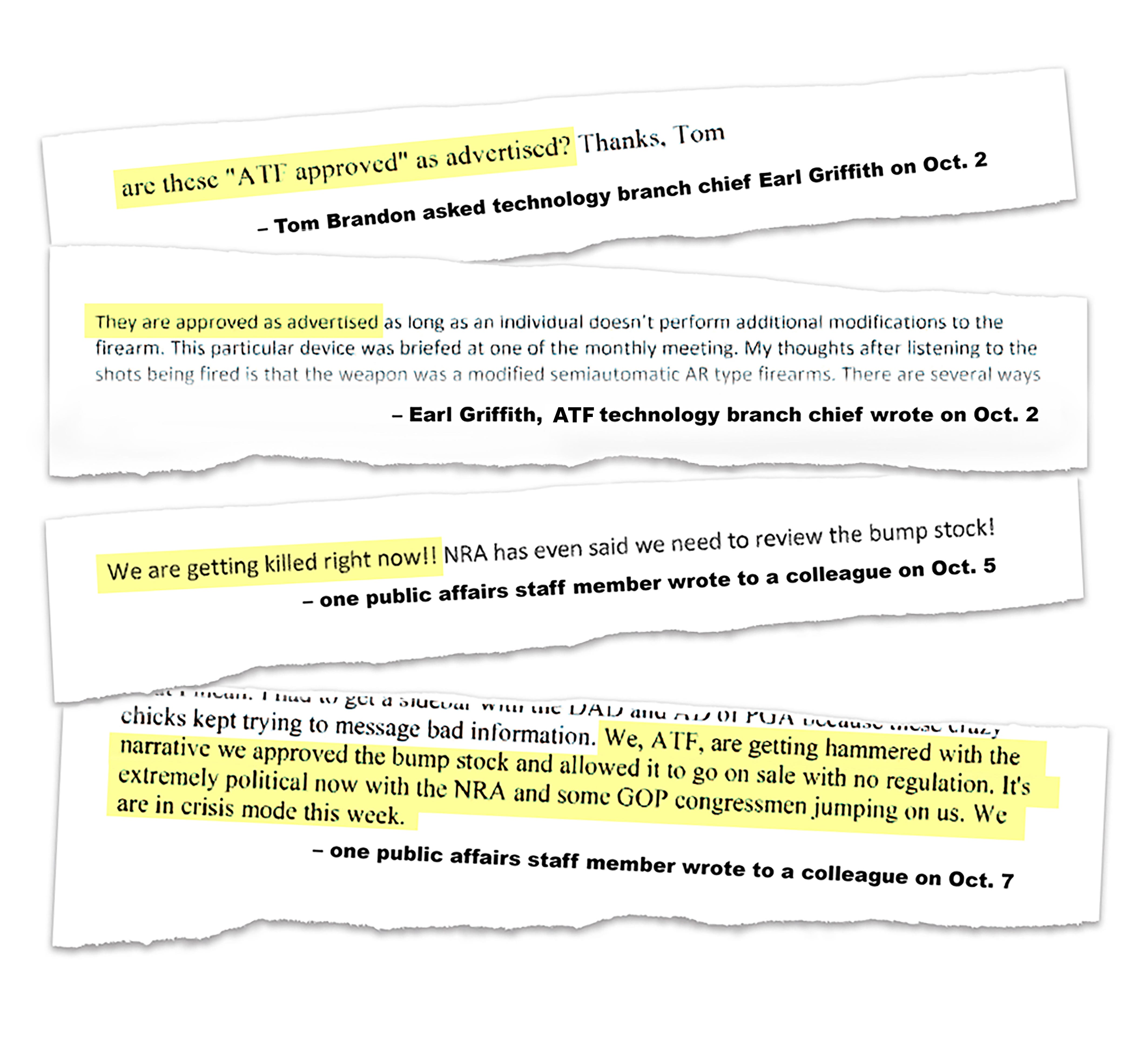
“Are these ‘ATF approved’ as advertised?” Tom Brandon asked technology branch chief Earl Griffith the day after the shooting in one of the 5,300 pages of emails released this month after Freedom of Information Act requests by USA TODAY and Democracy Forward, a left-leaning watchdog of the executive branch.
Hours later, Brandon had his answer.
“They are approved as advertised. … We have also approved other bump-fire type devices in the past,” Griffith wrote. The technology branch determines whether new devices are legal.
Brandon traveled to the agency’s facility in West Virginia four days after the shooting to fire a gun with a bump stock himself, the emails show. Later, he testified to Congress that in the interest of public safety, a law should ban them.
Behind the scenes, the agency seemed blindsided by the criticism.
“We are getting killed right now,” a public affairs staff member wrote to a colleague Oct. 5.
“We, ATF, are getting hammered with the narrative we approved the bump stock. … It’s extremely political now with the NRA and some GOP congressmen jumping on us. We are in crisis mode,” another wrote two days later. The ATF withheld the names of the staff members.
Soon, public affairs staff urged media via email to avoid saying the devices were ATF “approved,” as manufacturers claimed. Instead, they said, more accurate language would clarify that the federal agency has the power only to “classify” and “evaluate” machine-gun-like devices.
Asked about the internal emails, ATF spokesman Brad Engelbert said employees “hold a wide range of personal views and opinions on the topic of the day.”
“These individual personal opinions are not the official position of ATF,” Engelbert said.
Eleven states – California, Connecticut, Delaware, Florida, Hawaii, Maryland, Massachusetts, New Jersey, Rhode Island, Vermont and Washington – have banned bump stocks. Across the nation, more than a dozen other cities and states are considering bans.
But a year after the Vegas massacre, online retailers still market the plastic bolt-on stocks for less than $200, and the ATF is evaluating more than 180,000 comments on the ban proposed by the Department of Justice. A final decision could come in the next month.
Bump stocks effectively hobble the ATF’s authority to regulate the sale and ownership of machine guns by making regular semiautomatic weapons function like a machine gun. The device has been allowed to remain on the market through three presidential administrations, beginning in 2003, the emails show.
The ATF has had the authority to make owners register machine guns dating back to a 1930s law and Al Capone’s Tommy guns – among the few weapons tracked by the government, a time-consuming and expensive licensing process.
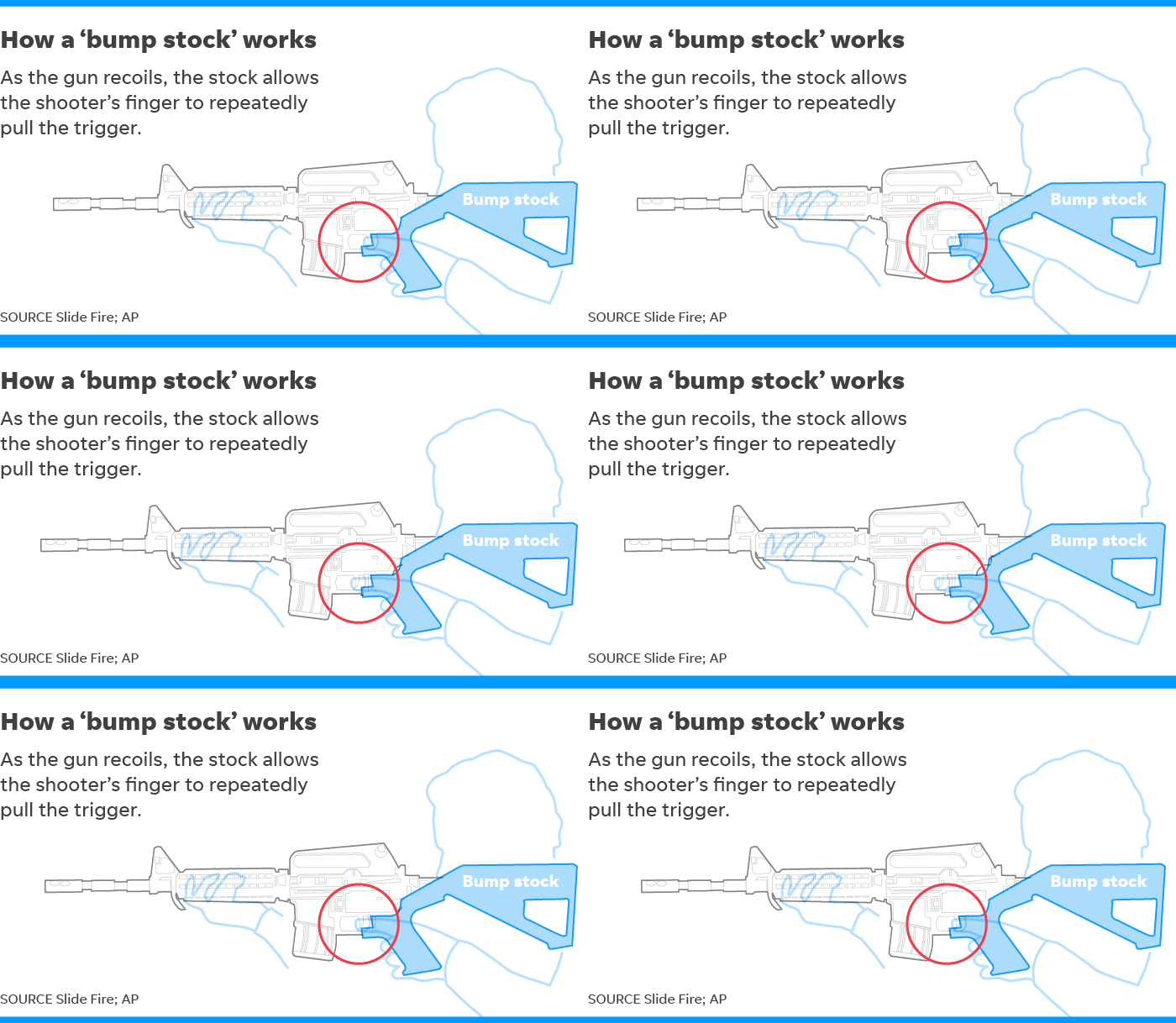
Bump stocks short-circuit that process by combining two legal devices, a plastic stock and a firearm, that together function like a machine gun. The bump stock harnesses the recoil of the rifle to accelerate trigger pulls, technically “bumping” the trigger for each shot after it bounces off the shooter’s shoulder.
Former agent Michael Bouchard, president of the ATF Association of agency retirees, wrote to lawmakers the week of the shooting to defend the agency from criticism that it had approved the devices. Bouchard faulted Congress.
“We would like to clarify this confusing issue to protect honorable ATF employees from false allegations that they chose to make this item legal, when it was the law that prohibited them from regulating the item,” Bouchard wrote.
In an interview with USA TODAY, he said the ATF is squeezed not only by regulations but also by gun manufacturers, who argue for consistency in rulings and will sue over any deviation based on political pressure or public safety, which they say shouldn’t be part of the legal determination.
Pleas for the ATF to take an aggressive stance and ban bump stocks came within a day of the shooting. Retired ATF agent David Chipman was among the first to jump into the fray.
“Only group quieter than NRA this week is ATF. An agency with vast experience preventing gun violence silenced when they should preach,” Chipman wrote on Twitter.
The internal ATF emails indicate that criticism reverberated around the agency. It was clipped and shared up the ranks to the director’s desk.
“Agents were collectively stunned about what happened, and then there’s universal agreement that this needs to be changed urgently and legislatively because it’s a workaround to circumvent the regulations on machine guns,” Chipman told USA TODAY.
As public support swelled that week for a ban, the NRA made a rare call for increased ATF regulation of the device, a move the group preferred to legislation that could prompt a broader anti-gun vote in Congress.
Chris Cox, executive director of the NRA’s Institute for Legislative Action, took credit for stopping the imminent passage of the bipartisan legislation that would have banned the device in an online interview Oct. 26 with YouTube personality James Yeager.
“We needed to slow the process down,” he said. “We are strategically working to make sure really bad policy doesn’t become law.”
Two days later, Brandon and his assistant director for public affairs noted a surge in interest in bump stocks. In an email exchange, they discussed a Boston Globe article that showed the “once obscure devices flying off the shelves” and selling at five times their sales price on the secondary market.
“Supply and demand = $,” Brandon emailed Chris Shaefer on Oct. 28.
“Absolutely amazing … right?” Shaefer responded.
The ATF emails trace the path of misinformation about approvals of the bump stock and similar devices.
The week after the shooting, Brandon and others briefed Trump about the approval of the Slide Fire device in 2010. In ensuing TV appearances, White House adviser Kellyanne Conway pinned blame on the Obama administration’s ATF, adding that as a result, the device couldn’t be regulated under law.
Trump picked up Conway’s language months later in announcing a regulatory ban – one that has yet to start.
“Obama Administration legalized bump stocks. BAD IDEA,” the president tweeted in March. “As I promised, today the Department of Justice will issue the rule banning BUMP STOCKS with a mandated comment period. We will BAN all devices that turn legal weapons into illegal machine guns.”
The internal emails lay out a longer regulatory timeline for the devices. A total of 25 “accelerator devices,” including bump stocks, were analyzed beginning in 2003, under President George W. Bush’s ATF. One bump stock was approved in April 2017 – well into the Trump administration.
Brandon has been part of senior leadership at the ATF since 2011 and began working at the agency in 1989. He took over after the previous director, B. Todd Jones, resigned amid gun rights backlash over a regulatory ban of ammunition that could pierce bulletproof vests.
Last December, the ATF issued its first notice of rule-making to ban bump stocks under the National Firearms and Gun Control acts. In February, Trump signed a memo directing Attorney General Jeff Sessions to ban the devices, accelerating the process. Both actions came as bipartisan legislation stalled on Capitol Hill.
That started the formal rule-making at ATF that continues as the agency evaluates the flood of comments.
Bouchard, the retired agent organization leader, said he was not surprised Congress shied away from a clear legislative fix and instead pushed the agency to change a rule about the devices.
“It’s the perfect way to kick the can down the road, knowing that nothing would be done for months or years – and then there’s likely to be a civil case,” Bouchard said, referring to the anticipated raft of lawsuits by bump stock owners and manufacturers to overturn any ban.
The ATF’s comment period on the rules banning bump stocks closed in June. The ban clarifies that bump-stock-type devices would be considered machine guns because they allow “a continuous firing cycle with a single pull of the trigger” and owners would need to surrender or destroy them.
The agency is wading through comments from individuals and form letters – led by pro-gun groups such as Gun Owners of America and gun control groups such as Giffords’, according to an analysis by The Trace, an online news site focused on gun policy.
If the rule is approved by the ATF and published in the Federal Register, the devices could become illegal immediately, and possession would carry a federal fine and prison time. The NRA lobbied the ATF in its formal comment on the rule for an amnesty period allowing bump stock owners time to destroy or turn over the devices.
Representatives from Democracy Forward, the group that sued to accelerate the release of the internal emails, said the ban is likely to be published soon. Democracy Forward is not the only group that took an interest in the ATF’s internal debate over ways to reverse course on bump stocks.
Mississippi Second Amendment attorney Stephen Stamboulieh received copies of the emails and fed some to pro-gun online news sites such as Ammoland. Stamboulieh said he is poised with a Washington plaintiff to fight for an injunction against the anticipated ban. He said the ATF would break the law and create 500,000 unwitting felons overnight.
“I’m going to sue them day one,” Stamboulieh said.
Radiology technologist Jeff Dettbarn, alleges thousands of tests at the Iowa City VA were improperly canceled, potentially risking veterans’ lives. USA TODAY
IOWA CITY, Iowa – Radiology technologist Jeff Dettbarn said he knew something was wrong at the Department of Veterans Affairs hospital in Iowa City, Iowa, when a patient arrived in February 2017 for a CT scan, but the doctor’s order for it had been cancelled.
“To have a patient show up for a scan and not have an order – you’re like, ‘What the heck is going on?’” he told USA TODAY in an interview.
Dettbarn started collecting cancellation notices for diagnostic procedures such as CT scans, MRIs and ultrasounds.
“I knew something was not right,” he said. “Because none of them were cancelled by a physician.”
Cancellations of more than 250,000 radiology orders at VA hospitals across the country since 2016 have raised questions about whether – in a rush to clear out outdated and duplicative diagnostic orders – some facilities failed to follow correct procedures. At issue is a concern over whether some medically necessary orders for CT scans and other imaging tests were cancelled improperly.
The VA inspector general is now auditing mass cancellations at eight VA medical centers “to determine whether VA processed radiology requests in a timely manner and appropriately managed canceled requests,” VA Inspector General Michael Missal said.
Those hospitals are in Tampa and Bay Pines, Florida; Salisbury, North Carolina; Cleveland; Dallas; Denver; Las Vegas; and Los Angeles.
After receiving inquiries from USA TODAY, a ninth was added – Iowa City.
In Iowa City, Dettbarn alerted the hospital’s compliance officer about his concerns. He is now facing disciplinary proceedings and contends they are an effort to retaliate against him.
The VA declined to comment on disciplinary proceedings without Dettbarn’s written consent to discuss personnel matters, which he did not provide.
This much is clear: in sworn testimony in the disciplinary proceedings against Dettbarn, Iowa City administrative staffer Lisa Bickford saidshe and other employees were told by the hospital’s chief radiologist that they needed to “clean” up a backlog of incomplete diagnostic orders, some dating back years.
The staff responded by “annihilating” thousands of orders in a matter of weeks, Bickford said.
Bryan Clark, a spokesman for the Iowa City hospital, acknowledged the facility failed to follow national VA guidelines for diagnostic order cancellations but said that happened in only a “small number of instances” and that “anything closed improperly was reviewed” and actions were taken to try and ensure veterans received any needed exams. He said the process was intended to “ensure the quality and safety of the care delivered to Veteran patients.”
The VA said many of the orders were outdated or duplicative. The agency said it welcomes the oversight and is working with the inspector general to improve cancellation guidelines further. VA officials said its efforts to close the loop on test orders with physicians and veterans surpasses private sector practices.
Laurence Meyer, the chief doctor overseeing specialty care for the national VA, told USA TODAY he didn’t want to comment on how individual VA hospitals handled cancellations, but he acknowledged, “we’ve received word that a few places haven’t been following the directive as intended.”
“We’ve sent out teams and have reviewed and are aggressively working to fix that,” he said.
The VA’s guidelines on order cancellations have undergone revisions in the past few years.
In 2016, hospitals were told to try to contact patients multiple times before cancellations. Last year, they required review by a radiologist or the ordering provider before cancelling. If the tests were still needed, then patients should be contacted to schedule them. Since last year, they require hospitals to establish a fail-safe “triage” process, such as written verification of review by providers.
Concerns about diagnostic test order cancellations have also been raised at the VA hospital in Tampa. Employees there estimated they cancelled thousands of radiology orders without checking first with doctors or patients, according to depositions in an unrelated discrimination lawsuit brought by four ultrasound technicians.
Those technicians told USA TODAY they worry veterans may have gone months if not a year or longer before they or their doctors realize tests weren’t performed – if they realized at all. Technologist Erin Tonkyro noted that risk factors for many veterans are higher than for other patients.
“Cancer grows very quickly and our patients are not like those patients on the outside — it doesn’t mean that cancer doesn’t happen in private practice. But our veterans have been exposed to such a large amount of toxic environments like Agent Orange; now we’re talking about the burn pits that have happened overseas,” Tonkyro said.
‘We knew it was bad’
At the Tampa facility, radiology managers began tackling outstanding orders in fall 2016.
As many as 10 people were tasked with the job, one administrative staffer testified in a deposition in the technicians’ lawsuit. Multiple employees testified they cancelled orders by date and did not consult any doctors before doing so, nor was there patient contact.
At one point, they disabled office printers because of the volume of cancellations – one employee estimated they cancelled thousands of radiology orders, according to testimony.
“That’s when we really started getting worried,” said Tonkyro, who attended the depositions with her co-plaintiffs, ultrasound technologists Yenny Hernandez, Kara Mitchell-Davis and Dana Strauser. “We knew it was bad, but we had no idea the magnitude of how bad it was.”
Strauser told USA TODAY administrators went beyond past orders and also cancelled future ones. Those could have been follow-up scans for veterans who might have been at risk of developing medical conditions, such as cancer recurrence.
“Doctors will put an order in for six months in advance and sometimes even a year in advance, and we were getting cancellations of those future orders,” she said.
In a statement issued by VA spokesman Curt Cashour, the VA declined to comment on what happened in Tampa, citing the ongoing litigation. “However, we are confident the James A. Haley Veterans’ Hospital has processes and procedures in place to provide the best care possible for our patients,” the statement said.
TheTampa Bay Times first reported the technicians’ concerns in July, and the hospital’s chief of staff, Colleen Jakey, wrote to providers the following month asking them to review cancelled orders, according to a copy of the correspondence obtained by USA TODAY.
“(W)e believe appropriate action was taken,” Jakey wrote, adding that a review of a random sample of cancellations did not turn up any cases of veteran harm. “This is a second-level review of these orders to confirm that each of these patients received the appropriate care and/or follow up.”
The technicians told USA TODAY some doctors have since re-ordered cancelled exams but won’t know if veteran patients suffered any harm from the delays until they are performed and assessed.
‘An important patient safety issue’
VA hospitals came under increasing pressure to address outstanding diagnostic orders after a conference call that national officials convened with radiology managers across the country in January 2017. More than 325,000 orders for scans of veteran patients had not been completed nationwide.
The VA’s top radiologist, Robert Sherrier, called it “an important patient safety issue” in a presentation for the call.
“Ordered studies are not being performed on Veterans and providers may not be aware that the ordered study has not been completed,” he said.
In a dozen states, there were VA medical centers with more than 5,000 outstanding orders, his presentation said. The numbers reached 29,000 in Columbia, S.C.; 21,000 in Cleveland; and 12,000 in Washington, D.C.
Some dated back to the 1980s but others were only months old. VA officials said in some cases, VA staff may not have been able to contact veterans to schedule exams. In other cases, veterans may not have shown up, possibly because their ailments had gone away. Some orders may have been duplicates ordered by two different doctors.
But others may have been tests that were still needed – to monitor tumors or follow up on emergency room visits, for example.
A panel of medical and ethics specialists conducted thousands of chart reviews, Meyer said, determined orders for exams due to be performed before June 2015 could be cancelled outright without jeopardizing veteran health.
But orders due after that date required further steps to ensure patient safety.
The national call to action triggered a dramatic reduction in pending exam orders overdue by two months or longer. As of last month, the VA said, there were only 31,000 nationwide.
‘We look terrible’
At the Iowa City VA hospital, Bickford said the chief of radiology – who also happened to be the top radiology official in the Midwest for the VA – told her after the January 2017 conference call that the facility had more outstanding orders than any VA in the region.
“He came to (us) and said ‘We’ve got to get this cleaned up now. I mean, we look terrible,’” Bickford said. So she and other staff just “went through and started annihilating orders,” she testified in the disciplinary proceeding against Dettbarn.
Any radiology orders more than 60 days past due were considered “invalid” and “expired,” Bickford testified. That is at odds with VA guidelines at the time requiring doctor reviews.
Cancellation records reviewed by USA TODAY show that in some instances, she and other staff cancelled future orders.
In one case, a nurse practitioner ordered an ultrasound for September 2017 as a six-month follow up for a veteran with a history of kidney stones. But an X-ray technician cancelled it in June 2017, calling it an “expired” order.
That same month, records indicate, Bickford cancelled an order for a follow-up CT scan to monitor a veteran’s lung nodules. The test wasn’t due to be performed until September 2017. Also in June, she cancelled a CT to monitor fluid in a patient’s lung not due until November 2017. Records show Bickford selected “patient failed to contact clinic” in both cases. None of the records reviewed by USA TODAY contained personal information identifying patients.
In the disciplinary case against Dettbarn, his supervisors alleged he was “disruptive” and didn’t send one patient’s images to be interpreted — accusations he denies. The investigation was initiated soon after he reported his concerns about the order cancellations.
A federal agency tasked with protecting whistleblowers, the Office of Special Counsel, is now investigating, according to a letter from the office.
Bickford declined to comment and referred questions to the Iowa City VA. In her sworn testimony, she blamed scheduling clerks for not indicating on orders that exams were scheduled. That led employees to assume there was a “dead order” even though a patient had a future appointment, she said, but she estimated that only occurred “maybe a half a dozen times.” When patients arrived for appointments, the errors were discovered, new orders were created and the exams went ahead, she said.
The chief of radiology, Stanley Parker, did not respond to a message left seeking comment at a number listed in public records. In his deposition in the case, he testified that he believed physician-review would have been done before cancelling.
Clark, the hospital spokesman, said Bickford’s testimony about “annihilating” orders was not in context and referred to the “success of the process to right size the number” of outstanding radiology orders at the hospital.
Clark said he doesn’t know how many orders were cancelled at the facility because officials didn’t track it, but he said more than 4,000 were cancelled in January and February 2017 in the southern part of the Midwest region, which stretches from Iowa and Nebraska north to Minnesota and North Dakota.
Clark said “most” cancelled orders were from before 2015, though he didn’t know how many. He said “some” exam orders were “canceled without following proper policies or procedures.”
In those instances, Clark said, “appropriate personnel actions were taken to correct the behavior and staff reviewed the cancelations to ensure every order that required action was appropriately reviewed by a radiology provider.”
Dettbarn has been detailed to a job collating VA records since July 2017. He said that whatever happens to him, he wants the public to know about what he called a “horrible short-cut” administrators took to improve the numbers. Dettbarn said Iowa City officials should do a clinical review like the Tampa VA to ensure veterans weren’t harmed.
“It’s so far beyond wrong what was done,” he said. “This is someone’s health care, this is their body, their life you’re screwing with, and people are playing doctor that aren’t physicians.”
Reporter Tony Leys of the Des Moines Register, a member of the USA TODAY Network, contributing.
General Electric head John Flannery is out after just more than a year at the top of the company. He will be replaced as chairman and CEO by H. Lawrence Culp, Jr. GE shares are up more than 10% on the news.
GE said it will take a $23 billion goodwill charge for its power business. “GE expects to take a non-cash goodwill impairment charge related to the GE Power business,” the release said. GE Power’s current goodwill balance is approximately $23 billion and the goodwill impairment charge is likely to constitute substantially all of this balance.
The conglomerate also warned that it will miss its 2018 earnings-per-share gudiance. In July, the company reiterated it expected to see adjusted EPS of $1 to $1.07 a share.
“While GE’s businesses other than Power are generally performing consistently with previous guidance, due to weaker performance in the GE Power business, the Company will fall short of previously indicated guidance for free cash flow and EPS for 2018,” the release said.
GE’s stock had fallen more than 35% this year through Friday.
Every product here is independently selected by Mashable journalists. If you buy something featured, we may earn an affiliate commission which helps support our work.
A woman kneels in front of a mural of Savita Halappanavar in Dublin as votes are counted in the referendum on the 8th Amendment of the Irish Constitution.
On Oct. 28, 2012, Savita Halappanavar died in University Hospital Galway, Ireland, due to complications of a septic miscarriage after being denied an abortion.
Her death — which an inquest ruled was caused by “medical misadventure” — was the catalyst for Ireland’s historic abortion referendum.
Six years on from Savita’s preventable death, Emma Watson has penned a moving open letter to the 31-year-old woman.
“You didn’t want to become the face of a movement; you wanted a procedure that would have saved your life.”
“Dear Dr Savita Halappanavar,” wrote Watson in the letter published in PORTER magazine. “You didn’t want to become the face of a movement; you wanted a procedure that would have saved your life.”
“When news of your death broke in 2012, the urgent call to action from Irish activists reverberated around the world – repeal the Eighth Amendment of the Irish Constitution,” she added.
Watson wrote that “time and time again” when someone dies due to social injustice, “we pay tribute, mobilise, and proclaim: rest in power.”
“A promise to the departed and a rallying call to society, we chant: never again. But it is rare that justice truly prevails for those whose deaths come to symbolise structural inequality,” she wrote. “Rarer still is a historic feminist victory that emboldens the fight for reproductive justice everywhere.”
Watson also talked about Savita’s family’s contribution to the Together for Yes campaign in support of repealing the 8th amendment of the country’s constitution — which made abortion illegal in almost all cases.
“Celebrating repeal, your father expressed his ‘gratitude to the people of Ireland,’” wrote Watson. “In reciprocity, I heard Ireland’s ‘repealers’ say that they owe your family a great debt.”
“A note on your memorial in Dublin read, ‘Because you slept, many of us woke.’ That the eighth amendment enabled valuing the life of an unborn foetus over a living woman was a wake-up call to a nation,” wrote Watson. “For you, and those forced to travel to the UK to access safe, legal abortion, justice was hard-won.”
Watson wrote that the fight for reproductive justice around the world would continue in Savita’s memory.
“In your memory, and towards our liberation, we continue the fight for reproductive justice.”
Rio de Janeiro, Brazil – Brazil’s deeply polarised presidential race took centre stage on Sunday as election hopefuls sparred during a debate ahead of the country’s national and state-level elections.
Several candidates rounded on far-right frontrunner Jair Bolsonaro of the Social Liberal Party (PSL) and the leftist Workers’ Party (PT) candidate Fernando Haddad during the event, held in Sao Paulo, and implored voters not to elect either contender.
Bolsonaro, who was absent from the debate as he continues to recover from an assassination attempt carried out last month, is projected to win about 28 percent of support on October 7, according to Datafolha polling institute.
Haddad, the PT’s replacement candidate for widely popular former president Luiz Inacio “Lula” da Silva, is forecast to win 22 percent of the vote.
If no candidate is able to secure more than 50 percent of support in the first round, the two contenders with the highest number of votes will go head-to-head in a second ballot on October 28.
“With Lula Brazil lived a happy time … we lived the most democratic period of Brazilian history,” Haddad said on Sunday, referring to the former leader’s time in office from 2003-2010.
“The image I visualise is Brazilians with a book in one hand and a labour identity card in the other,” he added.
Polarised election
Aside from Haddad and Bolsonaro, no other participant is predicted to win more than 11 percent of support on October 7.
Despite leading the polls, however, Bolsonaro and Haddad are also widely disapproved, with rejection rates of 46 percent and 32 percent respectively.
During the debate, those trailing behind the pair pleaded with Brazilians not to elect either of them as president, alleging both represent “radical” positions.
Democratic Labour Party candidate Ciro Gomes said a “capacity of dialogue” was needed to end deepening polarisation.
“Brazilian politics is immersed in hate, and I hope in the name of God that the population touches their conscience to run from this environment of hate,” Gomes said.
“No country in the world would be able to support the consequences of what is ahead of us. In the last four years, Brazil hasn’t stopped to discuss the mess of unemployment and the violence resulting from this,” he added.
Nearly 13 million Brazilians are unemployed, while homicides rose to a record high figure of 63,880 nationwide last year, according to the Brazilian Forum of Public Security.
Geraldo Alckmin, the Brazilian Social Democracy Party (PSDB) candidate, said “half of the population don’t want either the left radicals or the right radicals”.
Sustainability Network candidate Marina Silva, meanwhile, accused the PT and Bolsonaro of being “canvassers of each other”.
Alberto Almeida, political scientist and author of the ‘The Vote of the Brazilian’, said the other candidates’ concentration on the two frontrunners could backfire and convince voters the “only options must be those [two]”.
“The PT and Bolsonaro were the most spoken about,” Almeida said.
“Bolsonaro, without even being present, and the PT by the mouth of others [because] even when Haddad wasn’t speaking the others spoke a lot about PT,” he added.
‘A shame he is not here’
Criticism of Bolsonaro was a major theme of Sunday’s debate, with several candidates lambasting the former army captain.
“I have never seen a presidential candidate who says he will govern for the strong ones, as a president you have to defend the most vulnerable people,” Silva said.
“It’s a shame he is not here, I hope he comes in the next debate to explain his positions,” she added, referencing the final presidential debate, scheduled to be held in Rio de Janeiro on October 4.
Bolsonaro has made several overtly misogynistic comments in the past, as well as controversial statements on issues relating to race, sexuality and Brazil’s military government, which was in power between 1964 and 1985.
Shortly after the debate finished, Bolsonaro said in a post on Twitter that his absence was being used to try and score political points by other candidates.
“Many celebrated the attack I suffered because they saw an opportunity of attacking me with no chance of defending myself, this in a scenario which was already unbalanced. It reflects well our current situation. Corrupt cowards seeking power by any means are not thinking of Brazil,” he said.
Thiago de Aragao, director at the Brasilia-based political consultancy Arko Advice, said Bolsonaro’s campaign was making “childish mistakes one after the other”.
“They are prolific in manufacturing ammunition against themselves,” Aragao said.
“Haddad, on the other hand, is gaining ground from Lula’s nostalgic popularity as well as from the sequential mistakes produced by Bolsonaro regarding his campaign,” he added.
Sunday’s debate took place hours after several thousand people participated in nationwide pro-Bolsonaro rallies.
The demonstrations, which took place in cities including Sao Paulo and the capital, Brasilia, followed mass marches on Saturday as part of the women-led #EleNao (#HimNo) protests against Bolsonaro.
The protests were attended by hundreds of thousands of Brazilians.
SportsPulse: Trysta Krick recaps a crazy weekend in the NFL that saw two teams go for wins rather than ties in overtime with the Titans pulling off a gutsy win. Now we have to ask: Is Tennessee legit? USA TODAY
Some wild, last-minute finishes and bold play-calling decisions highlighted Sunday’s NFL action, and with the schedule now one quarter of the way through, some trends are starting to emerge. Here are Week 4’s winners and losers.
Winners
Baltimore Ravens: On a day in which the Bengals gutted through a huge victory against the Falcons, Baltimore might have had the biggest impact in the AFC North. Beating the Steelers, 26-14, in Pittsburgh, the Ravens offense outgained the Steelers, 451-284, and sustained drives by keeping third-down situations manageable and converting eight of 17 attempts. Most impressive, however, was Baltimore’s defense — and specifically its secondary — that has clamped down on opposing quarterbacks and has become one of the stingiest passing defenses in the NFL. The Ravens frustrated Ben Roethlisberger most of the night, and except for a few explosive passing plays, they kept the Steelers in front of the chains. It’s still early, but Baltimore looks like a contender in the AFC North.
Matt Nagy: The head coach of the Chicago Bears had a masterful game plan to help quarterback Mitchell Trubisky break through some struggles in a 48-10 victory against the Buccaneers. Nagy dialed up pre-snap motions, misdirection and creative play designs to create mismatches and scheme receivers open. Trubisky lit up the box score for a career day and threw five touchdowns — all of them to different targets — and that was just in the first half. All of those drives went for 70 yards or more. He completed 19 of 26 throws for 354 yards and six touchdowns (after having seven throwing scores last season) and added 53 rushing yards. Chicago is 3-1 and in first place in the NFC North.
Ezekiel Elliott: Offensive coordinator Scott Linehan said the Cowboys were ready to start “slinging it around” and Dallas had its best offensive performance of the season in a 26-24 victory against the Lions. Elliott was the reason why. He posted a career-high 240 yards from scrimmage, including a team-high 88 receiving yards. Thirty-four came on a huge wheel route down the right sideline with 1:23 left in the game that eventually set up the game-winning field goal. All that success came against a Detroit team that entered Sunday ranked 26th in scoring defense (29.3 points a game), so though Dallas’ effectiveness should be viewed as a sign of progress, the Cowboys still need to show they can produce consistently against better defenses. Either way, it’s clear Elliott will be relied upon heavily, both rushing and receiving.
Oakland Raiders: They entered Week 4 having been outscored 37-3 in the fourth quarter of games this year, but reversed the trend and erased a 14-point second-half deficit to beat the Browns, 45-42, including scoring 21 points in the final frame. Coach Jon Gruden earned his first victory since Week 13 of the 2008 season. The Raiders showed resolve and made more plays when the game mattered most, forced rookie Browns quarterback Baker Mayfield into four turnovers and limiting self-inflicted mistakes. Running back Marshawn Lynch, receiver Amari Cooper and tight end Jared Cook all stepped up, and Oakland looks to have shed some early season struggles.
Losers
Miami Dolphins: They had a chance to take a commanding three-game lead in the AFC East, but the Dolphins fizzled and fell flat in a 38-7 loss against the Patriots, who improved to 2-2. The Dolphin offensive line yielded pressure and committed penalties. Quarterback Ryan Tannehill struggled with accuracy. The offense found itself in third-and-longs all game, and Miami fell victim to a troubling pattern of ineptitude in Foxborough. Miami has now lost 10 in a row when playing in New England.
Earl Thomas: This is exactly why he held out. The star safety for the Seahawks suffered a lower left leg fracture in a 20-17 victory against the Cardinals when he dove to try to break up a touchdown pass. As the medical staff carted him off and used an air cast to protect his injured leg, Thomas flashed a middle finger at the Seattle sideline. Thomas had been looking for a new contract from Seattle and when he didn’t receive it, reported anyway. Now, with this injury, Thomas’ value on the open market (his contract expires at the end of this season) is significantly lower. Seattle could still slap the franchise tag on him, but that image of Thomas flicking off the sideline may be the last time he’s ever in a Seahawks uniform.
Todd Bowles: It’s tricky to criticize coaching decisions in the NFL — strategy in tense, in-game situations isn’t easy — but Bowles had some truly head-scratching decisions in a 31-12 loss against the Jaguars. First, down 22 points in the fourth quarter on a fourth-and-eight with 12:53 to play from Jacksonville’s 20-yard line, Bowles elected to kick a field goal. Even with the conversion, it remained a three-score game at 25-6. Then, down 13 with 4:33 left to play from their own 20-yard line, Bowles opted to punt, giving the Jaguars the ball and the chance to melt the clock. The next time New York got it back, there were just 25 seconds left on the clock and the Jags had scored another touchdown. Bowles, a defensive-minded coach, allowed the Jaguars to earn 503 yards. At 1-3, that seat will be getting hot.
Tyler Eifert: Cursed with awful injury luck, Eifert fell victim to another serious ailment when he suffered a broken ankle in a 37-36 victory against the Falcons. Eifert was playing in only his 14th game since the start of the 2016 season, and now likely faces the rest of the season rehabbing. He’s one of the most talented tight ends in football when healthy, and the Bengals, who are 3-1 and look poised to compete in what could be a tight AFC North, again need to adjust to life without him.
Philadelphia Eagles: The most concerning aspect of Philly’s slow start after its Super Bowl title is that its offense — last year’s strength — has been stagnant. In a 26-23 loss against the Titans, the Eagles scored touchdowns on just one of four trips into the red zone. They are converting just 57.1 percent of trips into TDs, one year after posting a rate of 65.5 percent, which led the league. Philadelphia is scoring just 20.5 points a game, and if that doesn’t improve, its 2-2 start might get worse.
Follow USA TODAY Sports’ Lorenzo Reyes Twitter @LorenzoGReyes.
If you love talking football, we have the perfect spot for you. Join our new Facebook Group, The Ruling Off the Field, to engage in friendly debate and conversation with fellow football fans and our NFL insiders.
The Mexican peso and the Canadian dollar are surging on Monday morning after the US and Canada struck an agreement that strengthens the trading relationship of the three North American economic powerhouses.
The agreement came just hours before a deadline set by the Trump administration and will pave the way for a vote in Congress to approve the deal. It follows more than a year of negotiations between the US, Canada, and Mexico over the trilateral agreement.
Trump’s agreement with Canada concludes a lengthy negotiation period and adds to the previous agreement struck in August by the US and Mexico, ensuring continued strong ties between the three nations.
The president greeted the agreement as “wonderful” on Monday morning, saying it “is a great deal for all three countries.”
“Late last night, our deadline, we reached a wonderful new Trade Deal with Canada, to be added into the deal already reached with Mexico. The new name will be The United States Mexico Canada Agreement, or USMCA. It is a great deal for all three countries, solves the many deficiencies and mistakes in NAFTA, greatly opens markets to our Farmers and Manufacturers, reduces Trade Barriers to the U.S. and will bring all three Great Nations together in competition with the rest of the world. The USMCA is a historic transaction!” — he said in two consecutive tweets.
As the smallest of the three economies, the benefits Mexico sees from its trading partnership with the US and Canada are outsized.
The peso has rocketed, gaining around 0.7% in trade against the dollar on Monday morning. By just after 10.00 a.m. BST (5.00 a.m. ET), the currency was trading at 18.54 to the dollar, as the chart below illustrates (this pairing shows the dollar’s fall against the peso, rather than the peso’s gains):
Markets Insider
“Investors have been waiting patiently for some good news regarding trade since the US escalated trade tensions earlier this year. There is clear elation that a deal has been struck,” Jasper Lawler, head of research at London Capital Group, said in an email.
The Canadian dollar has followed a similar pattern to the peso, gaining against the US dollar in overnight and European morning trading, although gains have been a little smaller:
The Walking Dead’s season 9 premiere will air Oct. 7 on AMC, but you don’t need to wait until then to watch it. Instead, you can catch the first five minutes right here and right now. Yes, instant gratification can be yours!
Get your first look at the new, rebuilt Alexandria as Judith paints daddy’s grumpy face and big tummy. Watch as Daryl crossbows his first walker of the season. Marvel at Aaron’s new beard! And head back into the city as the gang travels through Washington, D.C., on their latest mission. All that and more awaits you in the video clip below.
That’s just your first taste of what to expect courtesy of AMC’s premium service, AMC Premiere. You can enjoy the rest of the episode on Sunday. In the meantime, grab your Kleenex and check out the tributes that 23 former and current cast members wrote to the departing Andrew Lincoln, as folks like Jon Bernthal, Sarah Wayne Callies, Chandler Riggs, Steven Yeun, Michael Cudlitz, Laurie Holden, Dania Gurira, Lauren Cohan, Jeffrey Dean Morgan, Norman Reedus, Sonequa Martin-Green, and more pay tribute to the departing star. Warning: Feels will be forthcoming.
AMC’s zombie thriller, based on the classic comic book serial created by Robert Kirkman.
Are you sick of feeling ghosted by Ghost, Jon Snow’s faithful direwolf who was very much absent all of last season?
Fret not. Ghost is returning for the final season of Game of Thrones. The show’s VFX supervisor Joe Bauer has said the albino beast will be “very present” in Season Eight.
“Oh, you’ll see him again. He has a fair amount of screen time in Season Eight,” Bauer told Huffington Post. “He’s very present and does some pretty cool things in Season Eight.”
According to Bauer, they did shoot one scene with Ghost in Season Seven, which ended up being cut. The scene featured Jon Snow telling his wolf to take care of Sansa as he was leaving Winterfell.
According to Bauer, the reason why there hasn’t been much wolf action on the show the last couple of seasons may have something to do with the fact that the real life wolves standing in for the direwolves on set aren’t the easiest to work with.
“The direwolves are tough because you don’t want to get them wrong, so we end up always shooting real wolves and doing a scaling trick with them, but the real wolves only behave in certain ways,” Bauer said.
On the show (but not in the books) only Ghost and Nymeria are still alive from the original pack of direwolves. Bauer made no mention of whether or not we will see Arya’s pal Nymeria again in the final season.
A lot has happened since we were first introduced to the direwolves, so it feels appropriately full circle that we’ll get to see Ghost, runt of the litter, again.




/https%3A%2F%2Fblueprint-api-production.s3.amazonaws.com%2Fuploads%2Fcard%2Fimage%2F855215%2F4a4f8e83-00fd-4019-8e57-a878bf2f96cc.jpg)


 Viral Eyes