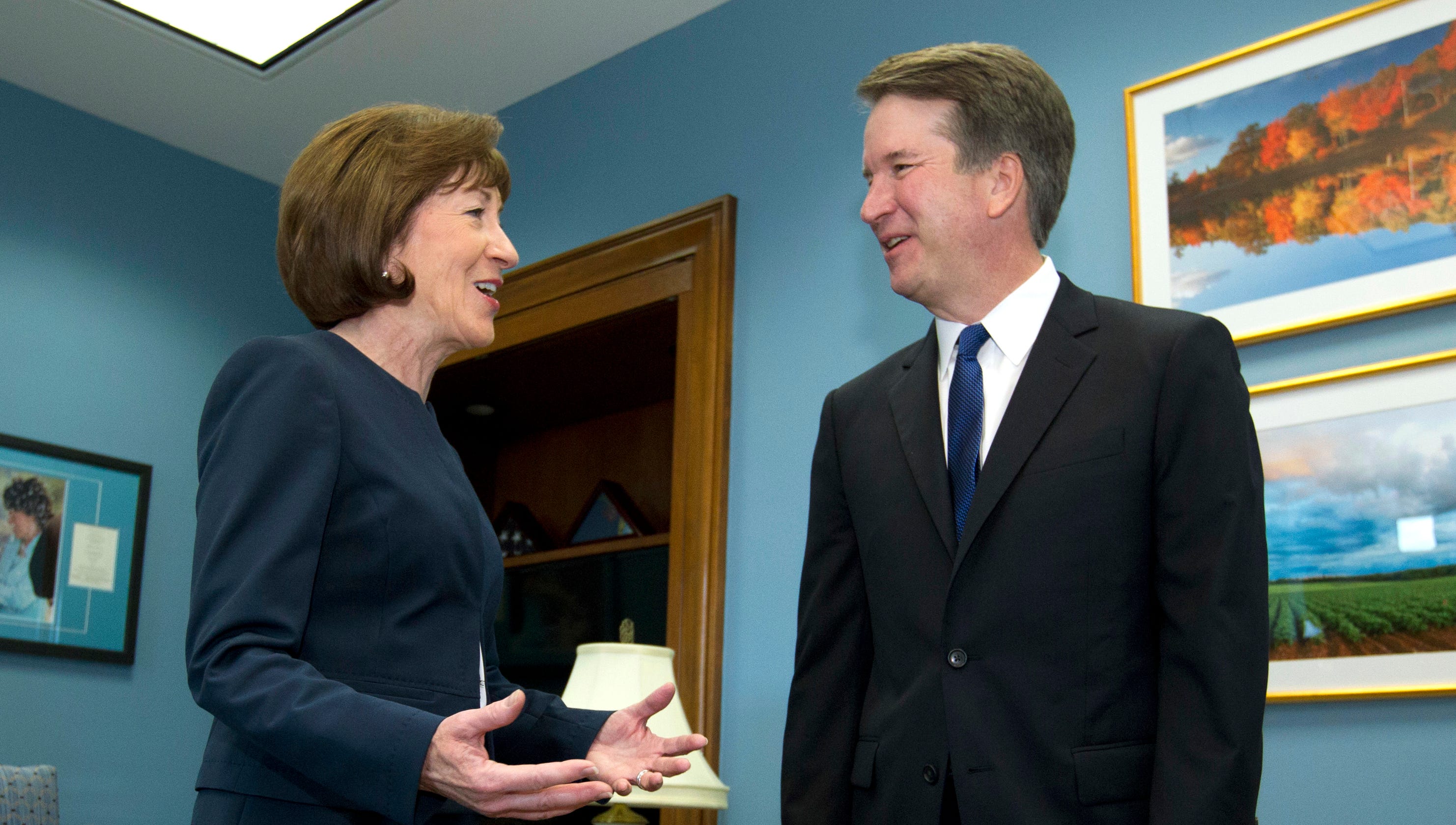
Republican Sen. Susan Collins of Maine indicated on Friday that she planned to vote to confirm Brett Kavanaugh, the embattled Supreme Court nominee, during a final floor vote on Saturday. She voted earlier Friday to invoke cloture on his nomination.
Shortly after Collins’ announcement, Sen. Joe Manchin, a West Virginia Democrat, announced he would also vote to confirm Kavanaugh.
Collins said that the allegations of sexual misconduct against Kavanaugh failed to meet the “more likely than not” threshold and that they should not “fairly prevent Judge Kavanaugh from serving on the court.”
Collins spoke for more than 40 minutes on Friday afternoon, concluding by announcing how she intends to vote.
“Mr. President, I will vote to confirm Judge Kavanaugh,” she said.
Manchin said in a statement after Collins’ speech that while he had reservations about voting to confirm Kavanaugh given the allegations against him, the FBI report about its investigation into the accusations led him to conclude that Kavanaugh is qualified to serve on the Supreme Court.
“With respect to any cases that may come before him impacting the 800,000 West Virginians with pre-existing conditions, Judge Kavanaugh assured me personally that he would consider the human impacts and approach any decision with surgical precision to avoid unintended consequences,” Manchin said in the statement. “That is why I voted to confirm Judge Kavanaugh’s nomination to serve on the Supreme Court because I believe he will rule in a manner that is consistent with our Constitution.”
With the votes from Collins and Manchin, Kavanaugh’s confirmation is all but certain.
A moderate Republican who supports abortion rights, Collins had for months been scrutinized over her vote on Kavanaugh’s nomination. She is also the subject of an unprecedented fundraising campaign by Maine activists that they say will automatically trigger over $1.9 million in donor pledges to fund her future opponent when she goes up for reelection in 2020 if she votes to confirm Kavanaugh.
While Collins and Senate Majority Leader Mitch McConnell have decried the campaign as a form of bribery, two law professors, Deborah Hellman and Stuart Green, wrote in The Atlantic last month that it did not fit within the legal parameters of a bribe because it was threatening to give the funds to her eventual, unnamed opponent instead of offering her money to vote a certain way.
Kavanaugh, a federal judge on the Court of Appeals for the District of Columbia Circuit, has been accused of sexual misconduct by three women. He has vehemently denied the allegations, which date back to the 1980s.
His nomination proceedings were delayed so he and Christine Blasey Ford, who has accused him of sexually assaulting her in high school, could testify before the Senate Judiciary Committee and the FBI could conduct a supplemental background investigation, which it completed on Wednesday.
Ariana Grande released one of the best albums of the year, Sweetener, just 49 days ago, but that hasn’t stopped her from working on new material. The 25-year-old returned to the recording studio recently (she even teased a tracklist on her Instagram Story), and now, she’s giving fans a taste of what she’s cooked up.
Late Thursday night (October 4), Ari tweeted a video from the studio with an unreleased song playing in the background. “Passionate but I don’t give no fucks / I admit that I’m a little messed up,” she sings over minimalist production (this definitely isn’t a Pharrell joint). “I can be needy / Way too damn needy / I can be needy / Tell me how good it feels to be needed.”
No word yet on if and when we’ll get to hear the final versions of the music Grande’s working on. Fans are speculating that she’s already at work on her fifth album and, if so, that she’ll tour in support of both #AG5 and Sweetener. Grande didn’t outright confirm that rumor, but she slyly alluded to the possibility in an Instagram comment this week. She also wrote in a since-deleted tweet, “can’t wait for you guys to start being weird little ag5 detectives,” which sounds like a promising sign.
All in all, fans definitely weren’t expecting a Sweetener followup this quick, but it’s a welcome surprise from Grande, who’s, by her own admission, had a tough year. Her team recently shared a statement about her taking time off after her ex Mac Miller passed away, but as Ari herself explained on Twitter this week, “music is the best medicine.”
Fans of The Boys got their wish on Friday during New York Comic Con. Simon Pegg, who served as a physical model for a lead character in the comics, surprised those gathered at the Hammerstein Ballroom in Manhattan to confirm he does have a part to play in the R-rated Amazon series adaptation.
As Pegg stormed the stage, the actor — who now joins a cast that includes his Star Trek costar Karl Urban — revealed he’ll portray the father of Hughie (played by Jack Quaid), one of the members of the titular Boys.
Darick Robertson, who drew the original comics with writer Garth Ennis, famously modeled the character of “Wee” Hughie in the comics off of Pegg. “I heard from Darick and I found out that my face is being used in this comic book,” the Star Trek actor recalled, and DC Comics, who released the title at the time, “wrote me a frightened letter just saying, ‘Please don’t sue us.’”
Instead, he was “flattered beyond belief.”
As showrunner Eric Kripke, the creator of Supernatural and Timeless, developed the comic as a series with Preacher‘s Seth Rogen and Evan Goldberg, conversations with Pegg were inevitable. Pegg recalled having discussions with the production about “maybe being in the show and we discussed how, and it just seemed so perfect to be Jack’s father.”
The hardest part of the part, according to Pegg, was “eating pizza rolls. I’d never had one before and this scene required me to ingest upwards of about three and I felt very unwell by the end of the day.”
The Boys — also starring Laz Alonso, Karen Fukuhara, Antony Starr, Erin Moriarty, Chace Crawford, Elisabeth Shue, and Tomer Capone — embraces the graphic nature of the comics. It’s a world where superheroes exist, but instead of accepting that with great power comes great responsibility, they are completely corrupted by power. The Boys, a blue-collar team of ruffians, are the ones who keep them in check — even if that means disemboweling.
“We have a competition between us about who can be in the most franchises,” Urban joked.
“We’re a couple of franchise whores and we’re really proud of it,” Pegg quipped.
The prospect of Judge Brett Kavanaugh being elevated to Supreme Court justice – without a thorough investigation of the multiple allegations of sexual assault against him and after a confirmation hearing in which his rage and sense of entitlement were on full display – has triggered an outpouring of shock, pain, and righteous anger.
However, for one prominent “advocate for women’s rights”, Harvard and Stanford fellow Ayaan Hirsi Ali, the real victim of the whole process has been Kavanaugh himself.
She has tweeted that the Senate should “confirm Brett Kavanaugh”, and shared articles insisting that he is the target of a “set-up” comparable to the Salem witch trials: an analogy that astonishingly manages to twist one of the most infamous exhibitions of institutionalised patriarchy into a shield for patriarchal violence.
Beyond her Twitter crusade for Judge Kavanaugh’s “rights”, Hirsi Ali has also been fully supportive of the Trump administration and its onslaught against women’s rights.
This same woman has been lauded in the West as a courageous feminist standing up to Islam in defence of women. A closer look at her work shows that her advocacy for women’s safety and equality is hardly principled or consistent, while her “critique” of Islam built on a foundation of distortions and fabrications.
Imperial feminism
Hirsi Ali’s enthusiastic complicity with non-Muslim sources of violence against women indicates that her politics are not anti-oppression, but anti-Islam. Over the years, she has also never spoken out against crimes committed by Western countries against Muslim women (or men) and she has demonstrated a remarkable lack of concern for the plight of non-Muslim women.
Unsurprisingly, since Donald Trump won the presidential elections in 2016, she has been an avid supporter of his. She has never criticised him for boasting about violating women or separating thousands of migrant children from their parents, but she has pointed out that he has “lost his focus” on “radical Islam.”
She has exhorted Trump to expand his Muslim ban and intensify “extreme vetting” of Muslim migrants: Measures that impose collective punishment on Muslim women while simultaneously relying on stereotypes of them as helpless victims who need to be saved from Muslim men.
Apart from failing to defend Muslim women refugees (despite herself pursuing refugee status in the West), Hirsi Ali has also failed to show any sympathy for American women or fellow feminists.
She has dismissed the Women’s March as an “anti-Trump crusade,” and demeaned feminists in North America, calling them “idiotic women” consumed with “trivial” matters like ” who does the dishes at home“.
The one-sided reasoning and double standards that pervade Hirsi Ali’s output are all too common in the annals of imperial feminism. From British colonial officials such as Lords Cromer and Curzon, who paraded as saviours of women in the colonies while heading the League for Opposing Women’s Suffrage at home, to US President George W Bush, who launched a global “war on terror” in the name of rescuing Muslim women while assaulting women’s reproductive rights in the US, self-serving and cynical appeals to women’s liberation have long been a speciality of imperial crusaders.
But individuals like Hirsi Ali provide something that the Cromers, Curzons, and Bushes cannot: a stamp of ostensibly authentic insider approval to their supremacist discourses.
And so, despite the alternative-facts quality of her assertions and Trumper-than-Trump nature of her politics, Hirsi Ali continues to be given prestigious posts at Ivy League universities, and prominent platforms in newspapers including the Wall Street Journal, New York Times, and Washington Post.
In an interview last year denigrating organisers of the Women’s March, Hirsi Ali told “the serious and sincere feminists who really care about the equality between men and women” that they “should not be seen with these fake feminists.” But her advocacy track record shows that her own feminist credentials are largely a sham.
Getting Islam wrong
Hirsi Ali is also no mere “critic of Islam”, but a cheerleader for Muslim annihilation. In interviews, she has labelled Islam a “destructive, nihilistic cult of death” that must be “crushed” – an operation that, ironically, would itself require mass infliction of destruction and death, including upon the very same Muslim women whose rights she claims to be championing.
Hirsi Ali’s depictions of Islam and Muslims bear the same tenuous relationship to reality as her own biography, which she substantially fabricated to bolster her claim for asylum in the Netherlands. In her 2007 autobiography, Infidel, she urges readers to “judge [her] on the validity of [her] arguments, not as a victim” – but judgment on either basis reveals an impressive talent for blatant misrepresentation.
For instance, in her latest book, Heretic: Why Islam Needs a Reformation Now and various derivative op-eds, Hirsi Ali identifies “five precepts central to the faith” that she diagnoses as requiring urgent reformation: Prophet “Muhammad’s semi-divine status”, “the supremacy of life after death”, “shariah, the vast body of religious legislation”, “the right of individual Muslims to enforce Islamic law” and “the imperative to wage jihad, or holy war”.
However, none of the five is actually an accurately-stated “precept” of Islam, rendering their description as “central” spurious and the call to reform them (now!) nonsensical.
Some of Hirsi Ali’s formulations are the exact opposite of mainstream interpretations. Prophet Muhammad is not considered semi-divine but repeatedly described in the Quran as “only human” and ascribing partners in divinity to God is a fundamental transgression. Enforcement of Islamic law by private individuals is not only not a right, but explicitly prohibited by Muslim jurists.
The rest of her “precepts” are simply incorrect. Far from discounting the importance of earthly life, the Quran represents actions in this life as the basis for reward or punishment in the afterlife. Shariah is not a book of codified legislation, but rather “a body of Quran-based guidance that points Muslims toward living an Islamic life”, in the words of University of Wisconsin law professor Asifa Quraishi-Landes. And jihad is not holy war – the concept of holy war being, as UCLA law professor Khaled Abou El Fadl notes, “the unique product of European Christian culture … Islamic theology does not recognize the idea of a sacred or consecrated war.”
Hirsi Ali’s grasp of basic facts about Islam is disturbingly shaky, particularly for someone listed as an “expert” on the Harvard and Stanford websites and entrusted with teaching seminars on Islamic political theory.
While highly-qualified women of colour continue to struggle against their exclusion from American academia, Hirsi Ali has been welcomed with open arms to its most elite echelons.
Clearly, the utility of her interventions lies not in their scholarly rigour or factual accuracy – both remarkably lacking – but in their confirmation of Orientalist caricatures of exceptional Muslim backwardness, under the cover of standing up for Muslim women.
Repudiating her imperial faux-feminism is the least we can do to support the Muslim activists and organisations struggling against patriarchal systems around the world – whose brave and essential work is only made more difficult by the intensifying Islamophobia and securitisation fuelled by ideologues like Ayaan Hirsi Ali.
The views expressed in this article are the author’s own and do not necessarily reflect Al Jazeera’s editorial stance.
There’s a consensus in Hollywood: Change is slow and it’s coming, but the industry can’t afford to let the gas run out. And it might.
A year ago, the #MeToo movement took flight as The New York Times and The New Yorker published stories cracking open the decades-long predation of movie mogul Harvey Weinstein. Since then, the producer has been banished from the glitterati’s ranks, and more victims began speaking up about the horrors behind Hollywood’s doors. (A New York judge will decide if a case against Weinstein involving assault and rape will move forward on Nov. 8; aside from civil suits he is also facing a civil discrimination case brought by the New York attorney general ).
With their stories, so too went the standing (and careers) of top executives and formerly revered figures like Charlie Rose, Louis C.K. and Kevin Spacey. Some cases have proved too old or flimsy to hold up in court; prosecutors rejected filing charges against stars including actors Ed Westwick and Anthony Anderson, while director Brett Ratner settled with one of his accusers, whom he sued for defamation, just this week.
CLOSE
“He was very clear. He had helped other actresses get major roles, and he would like to help me. Then he put his hand up my skirt and pulled my panties over.” USA TODAY
But jobs were lost by the likes of “Transparent” star Jeffrey Tambor, who was fired by Amazon following sexual harassment claims (he has denied the allegations), and “Today” show’s Matt Lauer, who was dismissed after allegations rose against him. And just last week, Bill Cosby, whose accusations from more than 60 women mushroomed before #MeToo, went to state prison for drugging and molesting a woman.
But as the one-year anniversary approaches – and the country focuses on whether Christine Blasey Ford’s emotional testimony will deter Judge Brett Kavanaugh’s ascent to the Supreme Court – it begs the question: Is Hollywood’s #MeToo movement in full flux or in danger of losing traction?
Much of that answer so far comes from the actual changes women are seeing off the red carpet. On the ground. In meetings. In auditions. On sets.
It is, of course, futile to expect a dramatic change in the pervasive extent of workplace sexual abuse in a mere 365 days, in Hollywood or anywhere else in American life. The entertainment industry is 100 years old and functions the way it does – the “casting couch,” for instance – for reasons that go beyond just the selfish or criminal behavior of some of the powerful men who have run it over the decades.
Moreover, quantifying change in a reliable and understandable way is tricky when dealing with a complicated multi-billion–dollar international industry that operates at the intersection between economic and artistic priorities.
Having said that, how has the industry fared, one year after #MeToo exploded, in its effort to put new protocols in place to prevent history from repeating itself?
Analyzing new pathways to reporting sexual harassment in Hollywood
First, in the past year more tools and pathways have become available to victims. Time’s Up launched and raised $22 million for its Legal Defense Fund, administered by the National Women’s Law Center.
Women in Film’s Los Angeles chapter launched a new helpline in December, and has since received hundreds of calls from women who have experienced sexual abuse and harassment, according to executive director Kirsten Schaffer. They have referred roughly 100 women to pro-bono attorneys.
CLOSE
Actors, writers and producers sound off on the Emmys red carpet about the last year of the #MeToo movement. USA TODAY
And just this week Gov. Jerry Brown signed a bill into law in California that prohibits secret settlements and non-disclosure agreements in sexual harassment cases. Beginning in 2019, a victim can choose to keep his or her name private, but the perpetrator’s identity cannot be confidential.
But the law can only go so far. Los Angeles County District Attorney Jackie Lacey established a task force of specially trained prosecutors after the Weinstein news broke to investigate allegations of sex crimes in the entertainment industry. To date, law enforcement agencies have referred 36 cases to the sex crimes unit but there has yet to be a criminal filing.
Lacey’s spokesman Greg Risling says 10 cases were declined because they were outside the statute of limitations; open cases involve Weinstein, Sylvester Stallone, Steven Seagal, Kevin Spacey, adult film star Ron Jeremy and producer David Guillod.
On the ground, most Hollywood studios and companies say they have retrained their staffs on harassment (with many including unconscious bias training). But what follows the (frequently pedantic) sessions is often laughter.
“The way people react when they walk out of those meetings, it’s almost, like, funny,” says Brittany Rostron, the founder of FACES, a nonprofit organization aimed at helping women develop their careers in the entertainment industry.
“It’s not taken that seriously for the most part,” says Rostron, who has worked on several studio-backed productions in the past year. “It seems more like a ‘this is what we have to do now’ and less ‘we’re trying to change the culture of the industry.’ ”
Some studios don’t want to talk about how they address sexual harassment within their studio systems. Warner Bros. and Sony each issued statements to USA TODAY affirming their commitment to workplaces free of unlawful discrimination, harassment and retaliation. Disney, 21st Century Fox, Paramount Pictures and Universal Studios declined to comment or respond.
But unions have beefed up their support systems. A sampling:
The International Alliance of Theatrical Stage Employees says they’ve redoubled outreach efforts to inform members about available resources, and have seen an increase in reports of inappropriate workplace conduct to its hotline and representatives.
As of July 2017, prior to Weinstein hitting the news, the Directors Guild of America began including a provision for employers to provide sexual harassment training for all members.
The Producer’s Guild of America now urges the practice of naming multiple, gender-diverse crew members on sets as points of contact for reporting harassment.
And the Screen Actors Guild‐American Federation of Television and Radio Artists called for a ban on auditions and interviews in hotel rooms or residences unless a support peer is present. SAG-AFTRA is expected to work the proviso into their 2020 contracts.
More recently, SAG-AFTRA began to offer counseling services and scenario-specific guidance for members on how to avoid and/or address sexual harassment in the workplace.
The audition guideline “has had a powerful impact,” says Gabrielle Carteris, SAG-AFTRA president. “I’ve heard directly from members that they are seeing a shift in industry norms. Our members are feeling more empowered to decline these types of meetings and value the ability to request a support peer.”
But is it enough?
“It’s awesome that unions are putting things in place, now it’s just a matter of time of waiting to see them take effect,” says Morgana McKenzie, a freelance camera operator who previously shared her story with USA TODAY of the daily harassment endured on set. “People are this way because of habitual behavior. So we can post as many posters and PSAs as we want, (but) the ultimate problem is getting fully formed and grown adults to break habits, and that’s hard.”
‘There’s still a real big price to pay for coming forward’
What Hollywood continues to lack, say experts, is a centralized system for identifying repeat offenders. Non-union employees and employees who work for smaller companies, some of which lack dedicated HR teams, remain vulnerable. And still, many people fear retaliation for speaking out. Being blackballed. The loss of the ability to pay their bills.
Terry Lawler, executive director of New York Women in Film & Television, says they’ve seen “an uptick in calls but not necessarily an uptick in legal action” on their partner hotline, managed by the Human Rights Commission. “There’s still a real big price to pay for coming forward.”
L.A.-based labor lawyer Genie Harrison, who represents a former Weinstein assistant and recently filed a John Doe case against Kevin Spacey, stresses that “every single” hotline caller with a harassment complaint should be referred to a lawyer, so as to understand “what the consequences are going to be if they choose not to take action within the statute of limitations.”
The odds remain stacked against the women who come forward unless investigations are handled appropriately – which, in many cases, comes down to whether an organization brings in a third-party to investigate, says Angela Reddock-Wright, managing attorney of Reddock Law Group.
Reddock-Wright, who has seen a 25 percent increase in calls for investigations by Hollywood-related corporations and guilds, stresses that impartiality remains a major factor in investigations. That’s especially the case when it comes to high-profile figures like Ryan Seacrest, who was cleared by an internal probe, or former CBS chief Les Moonves, pushed out after he was accused of sexual misconduct and retaliatory practices.
“The biggest lesson for companies in entertainment is to act quickly when they get the complaints,” says Reddock-Wright. “Even with Les Moonves, they sat on it. You’re supposed to bring in someone independent and you’re not supposed to put any inhibitions on the investigation.That’s going to be the next stage of the #MeToo movement –companies understanding they need to get on top of these complaints right away.”
A new temperature on film and TV sets
Has behavior on the ground changed? That depends on who you ask.
Last month Julia Roberts acknowledged she was the wrong sort of starto speak out , given how seldom she dips back into the throes of the industry. “I can’t say that I’m a credible witness because I don’t really participate in the world enough,” the Oscar winner told USA TODAY. “But I would say energetically I feel that people that felt they had to be silent don’t feel that way anymore.”
Talk to those in the trenches and it’s clear there has been a shift, at least as far as representation goes.
Actress Megan Densmore, who came forward with her story of sexual assault in USA TODAY’s investigation, says agents used to tell her: ” ‘Well, you’re not blond enough and your boobs aren’t big enough so you can dye your hair red and get a boob job,’ ” recalls the actress, who is also a professional body builder with short blond hair. “Now I look even more specific and unique look and I’m getting auditions.”
CLOSE
Megan Densmore said she faced an impossible choice. Risk her career or give in to her agent’s sexual advances. USA TODAY
Densmore says that since the past spring she’s auditioned for roles that weren’t necessarily written for women. “I get a lot of auditions that were clearly written male that even sometimes have the pronouns adjusted,” she says, noting “a slight open-mindedness,” by those casting traditionally male parts, such as doctors or military personnel. They’re “trying to find room (for more women), is what it feels like,” she says.
And more women are being hired below the line.
“People are specifically reaching out and saying, ‘I would really love to have more women on my team or in my department,’ ” as location scouts, production assistants and directors of photography, says Rostron, who shared her story of harassment by a college professor with USA TODAY earlier this year. “That is the real benefit of the MeToo movement.”
A changed mood is affecting big projects, too. Keira Knightley will soon begin work on “Misbehavior,” an intersectional feminist story she doesn’t think would have been greenlit a year ago.
On the surface, everyone is noticing the optics, Knightley says. “We did a crew photo and somebody made a comment like, ‘Oh, where are the 10 women we’ve got?’ ” recalls the two-time Oscar nominee. “People are actually looking around and going, ‘This is really white and male.’ And that’s a change. Because I’ve never heard that, even though it was obvious before.”
The spotlight has grown in the past year to push equality across the board, in pay and opportunity. Companies like NBC instituted Female Forward, which gives women a pipeline to directing its TV shows and HBO retroactively fixed gender-based pay disparities within their shows.
“I’ve definitely seen a commitment to hiring more women as directors and in other positions,” says Lawler. But when it comes to #MeToo, “I think men are just being much more cautious, but I don’t think there’s an actual understanding of what needs to change culturally. Considering women to be lesser, not equal, is still there.”
When women are the boss
But many could do without the snark.
“My experience of it so far has been a lot of lip service,” says Tatiana Maslany, the Emmy-winning star of “Orphan Black.” “I’m on set or I’m in a situation and somebody will be like, ‘Oh, you can’t do that anymore.’ They’ll say that in general and it seems like it’s an affront as opposed to an actual internalized change.”
When women are the boss, it still often only takes one misogynistic voice to poison the well, says Emmy-nominated director Kari Skogland of “The Handmaid’s Tale.”
A year into #MeToo, Skogland says she’s less afraid of speaking up and being labeled hard to work with. Still, disrespect “can come from anywhere. I’ve found crews to be very respectful. I think it often comes from only one bad egg who has enough of a voice that it polarizes a situation. I’m very good now at identifying that voice and making sure that they understand we’re equals and that I won’t tolerate it.”
Director/producer Ryan Murphy’s sets now require 50 percent of women behind the camera in accordance with his Half Initiative. But the Emmy-nominated “American Horror Story” actress Adina Porter says when it comes to reception of male and female directors, “there’s totally a difference.”
“Sometimes I have seen women having to prove themselves to the crew,” Porter says. “I love the crew and everything, but I have witnessed it. And I see her having to kind of take a breath and decide when she’s going to speak up. … I’ve seen women directors, their minds kind of going ‘OK,’ a little bit, like when I’m dealing with my kids. Like, ‘OK, I’m going to choose to pick this fight but not that one.’ ”
It’s why bystander engagement is so important, say experts.
“Even one person making an effort to contribute as best as they can to promoting a safe and respectful work environment has a positive impact,” says Laura Palumbo, communication director at the National Sexual Violence Resource Center. “We need for changes to be happening at all levels, at the policy level, but also with individuals that are seeing this as an opportunity to be a part of changing the workplace culture.
The numbers reported are still harrowing
The biggest imperative? Many say it’s keeping a stadium-sized spotlight on #MeToo, because the numbers – about workplace sexual harassment and about the lack of women in power roles in Hollywood – are still sobering:
Nearly all of the women who responded to USA TODAY’s survey said they have experienced some form of harassment or assault, often by an older individual in a position of power over the accuser. Worse, more than one-fifth of respondents (21%) say they have been forced to do something sexual at least once and 69% of women said they had been touched in a sexual way at work.
Recent studies mirror these results. A survey conducted by the Writers Guild of America West found 64 percent of women say they’ve faced sexual harassment at some point in their careers in film and TV. A 2018 study from Hiscox found 41 percent of female workers country-wide say that they’ve experienced harassment in the workplace.
“There have been times throughout the year where people have been over it, or tired of it or the (accused) men were going back to work,” says Schaffer. “We can’t get tired of it – the media, the culture. It’s still happening. It’s not over.”
A deeply divided Senate pushed Brett Kavanaugh’s Supreme Court nomination past a key procedural hurdle Friday, setting up a likely final showdown this weekend. (Oct. 5) AP
WASHINGTON – Republicans look to have enough votes to confirm Supreme Court nominee Brett Kavanaugh after Sen. Susan Collins said she would back him in a speech on the Senate floor Friday.
Collins had earlier in the day voted to end debate on Kavanaugh’s nomination, but had not said whether she would back Kavanaugh on the final vote expected Saturday.
Speaking on the Senate floor, Collins went over all the arguments against Kavanaugh, including his judicial record and the allegations of sexual assault. She explained her thought process and why these arguments did not hold merit in her eyes.
She said while she believed Christine Blasey Ford, who alleged Kavanaugh sexually assaulted her when she was a teenager, the allegations “fail to meet the ‘more likely than not’” standard. She said she believes voting against Kavanaugh without witnesses or proof could start a “dangerous” precedent.
“The Senate confirmation process is not a trial. But certain fundamental legal principles about due process, the presumption of innocence, and fairness do bear on my thinking, and I cannot abandon them,” she said on the Senate floor.
“I will vote to confirm Judge Kavanaugh,” Collins said, ending her speech.
Arizona Republican Jeff Flake, the other senator who had been wavering this week, said Friday he will vote to confirm Kavanaugh unless something significant changes.
West Virginia Sen. Joe Manchin, the only Democrat to vote with Republicans to end debate, announced minutes after Collins’ speech ended that he would also vote to confirm Kavanaugh.
This would bring Republicans to a 51-49 victory, assuming no lawmaker takes the unlikely step of switching positions after Friday’s vote.
The Senate voted 51-49 Friday to advance the nomination
Collins, of Maine, had faced fierce pressure from both sides of the aisle over the last several weeks as Kavanaugh’s nomination moved through the Senate Judiciary Committee. Before her comments on the Senate floor, Collins had lunch with Majority Leader Mitch McConnell.
She weighed the decision amid large protests in her home state, knowing her vote could have a deep impact on her political career and a reelection bid in 2020.
Her comments on the Senate floor Friday started with interruptions with protesters yelling, “Vote no!”
The moderate Republican has attracted votes from registered Democrats and she has vowed in the past not to support a Supreme Court nominee opposed to abortion rights and Roe v Wade.
Collins has differed from her Republican peers in the past, too. She voted against Education Secretary Betsy DeVos and Environmental Protection Agency head Scott Pruitt.
Boeing, a 102-year-old titan of the aerospace industry, is in a heated competition with SpaceX, Elon Musk’s rocket company, for billions of dollars in NASA contracts.
At a time when Boeing is seeking to secure that taxpayer funding — and the prestige of launching astronauts into space — the company might be secretly placing an op-ed that criticizes SpaceX in newspapers around the US.
Both companies are currently trying to show NASA they can safely launch the agency’s astronauts to and from the International Space Station (ISS) as part of NASA’s Commercial Crew Program, a roughly $8-billion competition the agency launched to spur private companies to build safe, cost-effective, American-made spaceships.
Through that program, SpaceX won a $2.6 billion contract to develop its Crew Dragon space capsule, and Boeing got $4.8 billion for its CST-100 Starliner space capsule. SpaceX hopes to launch its first Crew Dragon capsule with astronauts in early 2019, and Boeing expects to test-launch its first astronauts after mid-2019.
If these initial missions are successful, NASA is prepared to award potentially billions of dollars more in space-taxi contracts through the mid-2020s (each crewed flight is likely worth several hundred million dollars).
To that end, as Ars Technica’s Eric Berger reported on Thursday, some evidence suggests a Washington PR firm that counts Boeing as a client may be attempting to negatively sway public opinion about SpaceX via a critical op-ed that began to appear in newspapers around the country in July.
Business Insider has found a link between Boeing and the article’s author.
The negative SpaceX op-ed
The reason that so much NASA funding is at stake for Boeing and SpaceX is that the space agency hasn’t been able to transport its own astronauts to the ISS since July 2011, when its space shuttle fleet retired. According to some estimates, each shuttle launch cost the space agency roughly $1.5 billion, accounting for development costs.
For now, increasingly expensive Russian rocket ships are the only way to get astronauts into space. That’s why the Commercial Crew program was created: to spur the creation of American-made spaceships, create competition in the industry, and ideally drive down launch costs.
Nine astronauts will fly the first four crewed missions inside SpaceX and Boeing’s new spaceships for NASA, called Crew Dragon and CST-100 Starliner, respectively.NASA via AP
But just before the announcement, on July 22, an opinion article by an aerospace-industry veteran named Richard Hagar ran in The Washington Times, a right-leaning publisher. The op-ed paints Musk as inexperienced and castigates “special interests in Washington” for eschewing the development of commercial safety standards. It also argues that SpaceX’s plans to fuel its Falcon 9 rockets while astronauts are already loaded into the ship on top — a practice called “load-and-go” — is unsafe.
A short bio of Hagar that accompanies the op-ed describes him as someone who “worked on every Apollo mission for NASA at the Kennedy Space Center as a spacecraft operator on the launch team.”
That much is true. But an important aspect of Hagar’s professional identity is also this: He formerly worked for an aerospace company called North American Aviation. That company later became Rockwell International, which was bought by Boeing in the 1990s. So Hagar said Boeing now pays his pension.
“I’m a Boeing retiree, technically,” Hagar told Business Insider, though we were unable to independently verify that his pension checks come from Boeing. “I worked at the Cape [Canaveral], and I keep in contact with Boeing people down there.”
In fact, Hagar said he never submitted the article to The Washington Times. He only shared his written opinion with one person: a Boeing employee, whom he repeatedly declined to identify.
“I don’t want to start anything,” Hagar said. “I’m not interested in that.”
Shortly after Hagar gave his op-ed to Boeing, he said, it appeared in The Washington Times.
“I gave [Boeing] permission to publish it wherever,” Hagar said. “I knew it would be in different publications, but not how many.”
“It’s surprising, it’s been going around the country,” Hagar said. “I’m not out to try to get published everywhere. I have an opinion on it, and I was asked about it.”
Business Insider asked Boeing about Hagar’s op-ed, but the company did not provide a comment in time for publication. (We’ll update this story if we receive a statement.)
NASA also did not respond to queries in time for publication.
What is the deal with ‘load-and-go’?
SpaceX fuels its Falcon 9 rockets with cryogenic or super-cold propellants just before launch. That approach comes with a number of cost-saving, mission-enabling advantages.
Waiting to fuel up keeps the rockets’ high-grade kerosene fuel, called RP-1 very cold and very dense, allowing SpaceX to put more of it into a rocket, achieve greater performance, and launch bigger payloads deeper into space. The technique also helps SpaceX reserve fuel to reignite the rocket’s boosters, land them back on Earth, and make them available to be reused.
In his opinion article, Hagar argues that the “load-and-go” approach can’t be trusted. The longer astronauts are waiting with fuel around, the thinking goes, the greater the likelihood of a deadly accident. As evidence, he fingers SpaceX’s Sept. 2016 launch pad explosion of a Falcon 9 rocket.
An explosion at the launch site of a SpaceX Falcon 9 rocket in Cape Canaveral, Florida, in September 2016. Launch Report/Handout via REUTERS
“Congress and the administration should overturn these shortsighted restrictions on commercial spaceflight safety standards,” Hagar’s op-ed says, later adding: “NASA must ensure that before they put an astronaut on a commercial spacecraft that it lives up to the strict standards we have learned over the last 60 years of spaceflight.”
However, after nearly two years of work by SpaceX and an exhaustive review by NASA, the space agency announced on August 17 that SpaceX’s load-and-go fueling method “presents the least risk” to astronauts. NASA approved the practice, pending some final tests.
Yet even after that approval came through, Hagar’s op-ed kept appearing in newspapers.
He never personally pitched the piece to any outlet, according to his account. Several outlets that ran the op-ed did not respond to our questions about who pitched the pieces, but The Washington Times told Business Insider that the piece “was pitched by Kelly Ramesar […] on behalf of Richard Hagar.”
Kelly Ramesar is the name of a communications associate at a DC-based public relations firm called Law Media Group, or LMG, according to the firm’s website. LMG names Boeing as a client on its site. Ars Technica reported that two other people whose names are listed as communications associates at LMG — Casey Murray and Joshua Bak-Brevik — also successfully pitched Hagar’s piece to at least four news outlets.
Given Hagar’s insistence that he only gave his writing to a single Boeing employee, it seems someone from that company may have passed it to LMG, though this remains unknown.
Julian Epstein, the CEO of LMG, did not immediately return Business Insider’s calls or email.
Why Hagar says he wrote the piece
Neither Boeing nor any other entity paid Hagar for his writing, he said, though he’s fine with that.
“I’m 82 years old. Why would I do anything different than that?” he said. “I have no money in this. It’s an opinion I have on that process.”
Hagar said he had been thinking about the risks of load-and-go for years, and had discussed his concerns with a small group of retirees who used to work on the space program.
“I’m a Boeing supporter. But that doesn’t have any effect on my opinion of the load-and-go process,” he said.
But changing the perception of SpaceX could influence NASA and lawmakers who control the agency’s purse strings. And Hagar did acknowledge that he wrote his article after a conversation with a current Boeing employee (not a retiree in his group).
“I was talking to one of the Boeing people one time, and he asked me what I thought of the load-and-go process,” Hagar said. “I said, ‘Let me sit down and look at it in more detail.’ And that’s how [the op-ed] came about.”
SpaceX, for its part, has designed safety mechanisms to protect astronauts if something were to go wrong with the load-and-go procedure. An automated escape system in its Crew Dragon capsule would, in theory, blast astronauts away from an exploding rocket if there was a fueling mishap.
“I think that issue has been somewhat overblown,” Musk said during a call with reporters on May 11, prior to NASA’s approval.
He added: “We certainly could load the propellants and then have the astronauts board Dragon … But I don’t think it’s going to be necessary, any more than passengers on an aircraft need to wait until the aircraft is full of fuel before boarding.”
Despite Hagar’s criticism of load-and-go fueling, he said the strategy is not a deal-breaker — just not the approach he believes SpaceX should begin with to launch its first astronauts. He said load-and-go can create pressure to avoid calling off a launch, since doing so may incur extra expenses.
“If that process evolves to load-and-go, that’s great. But to start out with that? It’s a process that can be awful critical. It has to go perfectly,” Hagar said. “We lost Apollo 1, and we lost Challenger, and we lost Columbia, and a lot of that’s all based on cost. With commercial companies, I hope they have deep pockets.”
Are you a current or former aerospace industry employee with a story to share? Send Dave Mosher an email or get in touch via one of the secure options listed here.
The gods, both new and old, converged at New York Comic Con Friday afternoon. The big panel with executive producer Neil Gaiman and his cast from American Gods was the moment Starz had been asking fans to wait for, in light of reports suggesting the two showrunner changes were just the tip of a crumbling iceberg.
This wasn’t the subject of the panel, however. Gaiman, Ricky Whittle, Pablo Schreiber, Emily Browning, Orlando Jones, Yetedi Badaki, Bruce Langley, Crispin Glover, Omid Abtahi, Mousa Kraish, and Demore Barnes cracked jokes about season 1 and emphasized that season 2 is going to be harder for everyone involved.
Ian McShane didn’t make it. As Gaiman divulged, “He will be zapping kidney stones, which he will then be pissing out.” An appropriately NSFW tidbit to kickoff a jaw-droppingly provocative show.
“Shadow has discovered exactly who he is working for and now season 2 is gonna begin just a few short hours later and everything is going to get both better and worse,” Gaiman prefaced. “The first place we are all headed is The House On the Rock, and they closed down the real House On the Rock for us for several days and let us film there.”
As an added tease for book fans, Gaiman said “the most useful piece of advice” he could give was this: “We do not get to Lakeside in this season. However, we do get to Cairo [Illinois], we do get to a funeral home, Laura and Mad Sweeney get to go on their own journey, which takes them to some hot and exotic places, and other than that I think it’s fair to say things get worse for everybody in dramatically interesting ways.”
Bryan Fuller and Michael Green, who were at the showrunning helm of American Gods season 1, parted ways with the production, prompting delays. Then Jesse Alexander, who came on to keep the show going, was reportedly asked to leave the production earlier this year, according to The Hollywood Reporter.
Gaiman, who also acts as showrunner on Amazon’s Good Omens, said he wasn’t on set for season 2 day-to-day. “One of the things that really was inspiring from where I was on this, which was mostly across an ocean in a categorically different series, was how much all of the cast were invested in their characters, understood their characters this season. The writers were a whole new set of writers and the cast made sure that the integrity of their characters was never compromised and that, I think, says a lot for both the series itself and also for the fact that we have world-class actors who love and understand what they’re playing and are not prepared to compromise.”
Other new additions to season 2 include Kahyun Kim as New Media. Gillian Anderson won’t return as Media, the new god of entertainment and Hollywood, but New Media was glimpsed in the trailer as a New God of social media. Gaiman further teased “different incarnations of the Technical Boy,” played by Langley.
“In episode 6, which is mostly set in the 1930s, we get to meet the Telephone Boy, who had recently taken over from the Telegraph Boy, and Bruce gets to be all of these things,” the producer and author said. “With any luck, we may even find out where he’s going next.”
Jones’ Mr. Nancy will have more to do, as well. After his show-stealing monologue aboard a slave ship, this time he’s honing his attention to modern slavery, which he says is “mass incarceration and human trafficking. So it’s really focused on women.” There will be more backstory for Schreiber’s Mad Sweeney — Gaiman mentioned laying out “6,000 years of Mad Sweeney’s story” for the writers in episodes six and seven for potential use — and Barnes (returning as Thoth) teased an exploration of “adaptability and evolving” when it comes to the Old Gods. “There’s a reason why they were not only established but why they continue to endure.”
American Gods season 2 will premiere in 2019.
Stay tuned for more details on the new episodes from EW’s interviews with Gaiman and the cast.
A Chicago jury convicted a white police officer of second-degree murder in the 2014 shooting of Laquan McDonald, a 17-year-old African American.
Jason Van Dyke shot McDonald 16 times on the night of October 20, 2014, as the teen, who was carrying a knife, appeared to be walking away from him.
The shooting was captured on police video, sparking outrage throughout the city.
The 12-person jury reached a verdict on Friday, just a day after beginning deliberations. He was also convicted of 16 counts of aggravated battery, and acquitted of one count of official misconduct.
Protesters gathered outside the court as the verdict was read. Video posted on social media, showed activists and others cheering and chanting: “We finally got justice!”
Van Dyke was originally charged with first degree murder, a charge that requires a finding that the shooting was necessary and unreasonable. The judge told jurors the second-degree charge was also available, requiring them to find Van Dyke believed his life was in danger, but that the belief was unreasonable.Second-degree murder usually carries a sentence of less than 20 years.
Van Dyke is the first Chicago police officer to be charged with murder for an on-duty shooting in more than 50 years. The case has put the city at the centre of the national conversation about police misconduct and excessive force.
A jury on Friday convicted white Chicago police Officer Jason Van Dyke of second-degree murder in the 2014 shooting of black teenager Laquan McDonald. (Oct. 5) AP
CHICAGO – A jury on Friday found Chicago Police Officer Jason Van Dyke Guilty of second-degree murder in the 2014 shooting death of 17-year-old Laquan McDonald.
The October 2014 shooting was one in a series of deadly confrontations between law enforcement and black men and women that spurred a national conversation on policing, and an incident that fractured the already tattered trust of police in the African-American community of the nation’s third-largest city.
Van Dyke stared ahead with a forlorn expression on his face as the verdict was read.
Hewas found guilty of 16 counts of aggravated battery – one for each shot he fired at McDonald. He was found not guilty of official misconduct. His bond was revoked and he was taken into custody.
A sentencing date was not set. Second-degree murder carries a sentence of from four to 20 years. Aggravated battery carries a sentence of from six to 30 years.
Van Dyke had been charged with first-degree murder. Cook Count Circuit Judge Vincent Gaughan told jurors this week they could consider a second-degree murder charge.
The shooting on the southwest side of Chicago was captured on police dashcam video – graphic footage that appeared to show McDonald turning away from police when Van Dyke opened fire.
Police were called to the scene on reports of a person breaking into vehicles on a truck lot. They found McDonald wielding a knife with a three-inch blade.
The troubled teen ignored repeated calls from police to drop the knife. He popped the tire of a police vehicle and scratched a windshield.
Van Dyke arrived on the scene, got out of his vehicle and fired 16 shots at McDonald. He continued to shoot at McDonald for 12.5 seconds after he was already on the ground.
Van Dyke told investigators that McDonald raised the knife in a menacing manner before he fired, and that he backpedaled as the teen approached. The police video did not support the officer’s account.
“None of that happened!” prosecutor Jody Gleason told jurors. “You’ve seen the videos. He made it up to justify his use of force.”
Van Dyke’s lawyers stressed that McDonald had a long history of violent behavior and drug use and was behaving erratically in the moments and hours before the shooting. The teen suffered from mental illness.
A pharmacologist who testified on behalf of the defense said the PCP in McDonald’s system and the absence of psychotropic drugs the teen was prescribed were a volatile combination. Juvenile detention center officers recalled violent and profane outbursts from the teen while he was in custody. Officer Leticia Velez, who was present at the scene, testified that McDonald looked “deranged.”
Daniel Herbert, Van Dyke’s lead defense attorney, told the jury the shooting was a “tragedy but not a murder.”
“Laquan McDonald was the author, choreographer of this story,” Herbert said.
Police encountered McDonald after receiving calls that a young man fitting the teen’s description had been breaking into vehicles and stealing radios from a truck lot on the city’s southwest side.
The trucker who initially confronted McDonald, Rudy Barillas, testified that McDonald attacked him. But Barillas also said that he was able to fend off the teen by throwing his mobile phone and pebbles at the teen.
Prosecutors noted that there were at least 10 other officers at the scene, but Van Dyke was the only one to shoot. They used testimony from Laurence Miller, a forensic psychologist who evaluated Van Dyke in 2016 at the behest of the defense team, to bolster their case that the officer acted with malice.
Van Dyke and his partner had just stopped for coffee at a nearby 7-Eleven when they heard radio calls and sped toward the scene.
As Van Dyke and partner Joe Walsh drove toward McDonald, Miller said, Van Dyke asked Walsh why the officers on the scene hadn’t shot McDonald since he attacked.
During the psychological evaluation, Miller said, Van Dyke recalled remarking to Walsh: “Oh my God, we’re going to have to shoot the guy.”
The initial resistance of local leaders to release the video fueled allegations by activists that Mayor Rahm Emanuel and the police department were trying to cover up wrongdoing.
A court eventually ordered the city to release the footage, 400 days after the shooting. On the day of its release, Van Dyke was charged with first-degree murder.
The county prosecutor, Anita Alvarez, accused by activists of taking too long to charge the officer, was voted out of office. And local and federal authorities launched investigations of the police department.
Emanuel saw his standing in the city’s sizable African-American community plummet. He fired his police superintendent, and announced last month that he wouldn’t seek a third term in office.
He insists the Van Dyke trial did not impact his decision.
The police department’s relationship in the African-American community had been strained by a long history of police brutality and allegations of heavy-handed tactics in the city’s low-income and minority communities.
The city borrowed some $709 million to pay settlements in police misconduct cases from 2010 to 2017, according to the Action Center on Race & the Economy.
A U.S. Department of Justice review last year found Chicago officers used force nearly 10 times more often in incidents involving black suspects than against white suspects.
Antonio Romanucci, a Chicago attorney who has alleged misconduct by the Chicago Police Department in several civil lawsuits, said the prosecution’s case centered on making clear to the jury that Van Dyke intended to draw his gun and shoot McDonald as he pulled up to the scene in his squad car.
“That was an essential element the prosecution needed to prove, and was able to do so,” Romanucci said.
Some critics and activists say the justice system is too lenient with police.
An officer in suburban St. Paul, Minnesota, was acquitted of manslaughter and dangerous discharge of a firearm last year in the 2016 shooting death of Philando Castille.
Castille was gunned down during a traffic stop as his girlfriend and her 4-year-old-daughter sat in the car.
Violent protests erupted in St. Louis last year after a former police officer was acquitted in the 2011 shooting of black motorist Anthony Lamar Smith.
Former Officer Jason Stockley said he believed Smith was reaching for a gun in his car. Prosecutors accused the officer of planting a silver revolver to justify the shooting.
Three Baltimore police officers were acquitted in the 2015 death of Freddie Gray in police custody, and Baltimore State’s Attorney Marilyn Mosby dropped charges against three other officers involved in the incident.
Ahead of the verdict, Mayor Rahm Emanuel called on residents to respond peacefully. The police department canceled officers’ days off and stretched workdays to 12 hours to ensure they would have enough manpower in case things went south.
“I have absolute confidence in the residents of the City of Chicago,” Emanuel said. “This is our city, and this our home. And I hope everyone heeds the advice of Laquan McDonald’s family, the pastors, the community leaders to make their message heard in what they have to say and do it in a way that’s respectful to the city that we all call home.”
Some activists expressed concern that an acquittal or hung would demoralize the black community.
“If this case can’t lead to a conviction, I just don’t know how you can encourage people to have trust in the criminal justice system,” said the Rev. Marshall Hatch, a pastor on the city West Side and a critic of the police department.
Frank Chapman, an activist with the Chicago Alliance Against Racist and Political Repression, cautioned an acquittal of Van Dyke might spur unrest. His group was part of a coalition that planned demonstration in the aftermath of the verdict.
“If you don’t want things to burn, if you don’t want people to be raising hell, then do the right thing,” he said. “Don’t ask us to police for you. Do the right thing. Quit killing people. Quit mistreating people and then these things will not happen.”
Two other officers and a detective involved in the McDonald shooting face state charges of conspiracy, obstruction of justice and misconduct.
Officers Joseph Walsh and Thomas Gaffney are accused of lying to investigators and mischaracterizing the video recordings in hopes that independent investigators wouldn’t learn what happened and the public would not see the footage, according to an indictment.
Detective David March signed off on statements that several officers at the scene gave following the shooting and indicated in his report there were no discrepancies between what the officers said happened and what could be seen in the police dashcam video.
The three are scheduled to go to trial in November.




 Viral Eyes