Ohio State is very good but not yet good enough to win national championship

news image

CLOSE

Week 5 in college football brought us an instant classic between Big Ten rivals Ohio State and Penn State, incredible quarterback performances and much more
USA TODAY

STATE COLLEGE, Pa. — College football as a sport begins with a coin toss and somehow gets even more random from there, a lovable quirk illustrated in color as Ohio State broke Penn State’s heart, 27-26, in a game it shouldn’t have won but did anyway.

The Buckeyes trailed 13-0 in the second quarter before a touchdown just before halftime cut the Nittany Lions’ lead to 13-7 and briefly shifted momentum into the Buckeyes’ corner. Ohio State faced fourth-quarter deficits of 20-14 and then 26-14, with the Buckeyes silenced into a two-possession deficit by Penn State quarterback Trace McSorley’s brilliance, which should vault the senior deep into the Heisman Trophy conversation.

McSorley set a Penn State single-game record for total offense at 461 yards, with 286 coming through the air and another 175 on the ground. Penn State as a whole outgained the Buckeyes by 103 yards. The Nittany Lions averaged two additional yards per pass attempt than the Buckeyes, along with an added yard and a half per carry.

Ohio State committed 10 penalties for 105 penalty yards. The offense converted just four of its 17 third-down attempts. The same offense that steamrolled over hapless Oregon State and woebegone Rutgers learned not long into the first half that Penn State was many things but not Oregon State or Rutgers.

“The first half was awful in a lot of ways,” said Ohio State coach Urban Meyer. “The penalties, that’s awful. We’ve got to get that fixed, because usually you don’t win a game like that.”

More: 10 observations from Week 5 in college football

More: Winners and losers from Week 5 headlined by Clemson’s close shave

This was a game Penn State had almost no business losing. The Nittany Lions had the home environment in their favor. They had the best player on the field, McSorley, who willed the offense into some semblance of cohesion in the second half. They had a 12-point lead with eight minutes left and all of the momentum, only they coughed it up by allowing Ohio State to wrestle away the established pace of play. This was a game Penn State lost just as much as it was a game that Ohio State won, it not more so.

“It wasn’t pretty,” said Ohio State quarterback Dwayne Haskins, “pretty much the whole game.”

All the peripherals — the box score, the flow of the game, the two-possession edge in the fourth quarter — called Penn State a better team than Ohio State, if only on this one night. The scoreboard said otherwise, which is why Ohio State now finds itself in the driver’s seat in the Big Ten Conference. But the scoreboard can’t cover up the fact that Ohio State isn’t ready for a stiffer test than the one the Nittany Lions presented on Saturday.

Penn State is a very good team. Postgame, an impassioned James Franklin put it perfectly: Penn State is a great program and Ohio State an elite one. As a team, however, the Buckeyes are one point better than the Nittany Lions. Being one point better than Penn State doesn’t inspire tremendous confidence in the Buckeyes’ end goal when you consider the eventual competition.

Ohio State wants to win a national championship, as this program always does, and in certain ways is perfectly equipped to do so. Even without a healthy Nick Bosa, the All-America end out indefinitely with an injury, the defensive line ranks among the best in college football. A maligned receiver corps has turned into an asset. There is speed and athleticism to burn at the offensive skill positions and in the defensive backfield. In Haskins, the Buckeyes have chanced upon another game-changing talent at the position.

That this program has such grand goals means that it doesn’t compare itself to Penn State — as Franklin said, the Nittany Lions aren’t yet in that class. Ohio State compares itself to Alabama. At present, the comparison doesn’t reflect well on the Buckeyes. That nearly every team pales in comparison to the Crimson Tide isn’t an excuse.

Asked in what areas he feels his team has yet to tap into its full potential, Meyer said “to put a big circle around the first half.”

“Everything,” he said. “We gave up a big hit, a 95-yard touchdown or something. The biggest thing is just offensively, ineptitude. Not blocking guys. Not executing.”

More: With Ian Book, Notre Dame has the look of a legitimate Playoff contender

In meetings with the two Power Five opponents on their schedule with a pulse, Penn State and TCU, the Buckeyes are allowing a whisper over 500 yards per game and 6.6 yards per play. Each of those games has seen the Buckeyes’ defense allow at least one play from scrimmage of 90 or more yards. For all of Saturday’s first half and much of the second, Penn State’s attacking defense made Haskins look less like one of college football’s rising stars and more like what he is — a redshirt sophomore just now putting the finishing touches on his first month as the starting quarterback.

“It was tough sledding there for a little while,” said Ohio State offensive coordinator Ryan Day. “It was a learning game for the whole offense and for (Haskins).”

There are mitigating factors at play. For one, Ohio State’s occasional sluggishness might be a byproduct of the chaos surrounding this program, which sent Meyer into a three-game coaching hiatus and altered the fragile makeup of a team reloading behind a new cast of contributors on both sides of the ball.

That the offense didn’t click for a good portion of Saturday’s win might be due to a handful of factors: Penn State’s hostile crowd, the Nittany Lions’ defensive scheme and Haskins’ inexperience. That the defense continued to juggle stinginess with porousness might be a result of one factor in particular — that would be McSorley, who put on a show that even in defeat should linger in Penn State’s history.

There are two takeaways from Saturday night, and while they may seem contradictory they’re not mutually exclusive. The first is that Ohio State is an extremely good team and one that may get even better as October turns to November, after a four-game stretch against Big Ten also-rans that’ll almost certainly leave the Buckeyes unbeaten midway into November.

“We’re really not even at our full potential yet,” said junior defensive tackle Davon Hamilton. “That’s how I feel. We let some plays go that shouldn’t’ve been let go. Just pure, small mistakes, really. We just have so much more potential to show. People don’t even know the real Ohio State Buckeyes, even after this game.”

The second is this: Ohio State needs to get better, needs to meet its full potential, if not against Penn State then before the last week of December. As the heart of conference play begins, this look like a team good enough to win the Big Ten and reach a College Football Playoff national semifinal. That’s pretty good. But barring improvement, that’s where the Buckeyes’ season will end.

Autoplay

Show Thumbnails

Show Captions


Read More

from Viral Eyes https://ift.tt/2xMkUua
via IFTTT

Tiffany Haddish is glad she didn’t have to kiss Kevin Hart in Night School: ‘Ew, gross’

news image

For most of Night School,  Kevin Hart and Tiffany Haddish’s characters seem destined to end up together. It’s a Hollywood tale as old as time: The main male character has a fiancée who doesn’t truly love him for him, but then he meets a woman who makes him a better man, and after some spirited back-and-forth, they realize they are the ones for each other. Well, that is what Teddy (Hart) thought, going in for a kiss on Carrie (Haddish) during a slow dance at prom, only for her night school teacher to reveal that she’s gay. And it turns out, Haddish is very thankful for the twist.

“I love that we switched it up,” she tells EW. “Me, being in love with Kevin? Ew, gross. [Laughs.] He’s like my brother. If they would have gone, ‘Okay, now you guys have to kiss,’ I would have been like, ‘Ughhhh.’ That would have been really hard for me to do. Kevin’s not gross, I’m just saying that’s like my big brother. Literally, I’ve known him for so long and he’s mentored me and checked me on so much stuff just like a big brother would, even though he’s only like four or five months older than me.”

Haddish further added that her excitement over the reveal was more than just her sibling-like relationship with Hart. “I was really happy with that scene and I thought it would be great for the people and the LGBT crew,” she continues. “It’s not about sex or anything and really about caring and nurturing this person to be their best self.”

Meanwhile, Hart, who co-wrote the script, was just glad to throw a curveball at the audience. “We wanted to go the opposite way from what is typically the case when dealing with movies like this,” he says. “These movies always give you a familiar ending, one that people can hint at and get towards. We thought it was a fun way to throw the curveball and give the audience something else to laugh at and appreciate. In our screenings and testings, we got a great response.”

A lot of the great response is surely from the chemistry between Haddish and her “big brother,” so does that mean these two stars could be Hollywood’s next great comedic pairing?

“I would definitely work with Kevin again,” says Haddish, who started Night School right after her big breakout Girls Trip was released. “I would have to make more money, though. [Laughs.]”

Night School, which also stars Taran Killam and Rob Riggle, is now in theaters.

Read More

from Viral Eyes https://ift.tt/2OUHg33
via IFTTT

‘Armageddon’-style asteroid will now not destroy human race, sorry

news image

This post is part of Science of Sci-Fi, Mashable‘s ongoing series dissecting the science (or lack of science) in our favorite sci-fi movies, TV shows, and books.

Some days are so damaging to your faith in humanity, you may find yourself idly wishing for the cleansing global firestorm that would follow an impact from the kind of asteroid that killed off the dinosaurs 65 million years ago.

If that’s the case, then astrophysicist and planetary scientist Michael Busch has some bad news. Over the last couple of decades, telescope-watchers like him have done such a good job of detecting and tracking the orbits of all possible extinction-level rocks out there that we can now say with confidence that none will hit us, at least not in the next 860 years. 

“We think we’ve discovered everything out there that’s larger than 1 km across,” Busch, who has been tracking asteroids since 2005, told me from his office in Mountain View, California. “Anything smaller than a kilometer would only cause regional destruction.” 

For comparison, the dinosaur killer that landed in Mexico was a whopping 10 to 15 kilometers wide.

C’mon, really, everything has been logged? Well, Busch concedes, “it’s possible there may be one or two behind the sun” where we can’t see them with current telescope technology. But the rocks would have to have been hiding there for the past decade, which is highly unlikely.

And what do we get in 860 years’ time? A puny rock called 1950 DA, which is a mere 1.1 kilometers across, and according to NASA models has at best a 0.3 percent chance of hitting the Earth in 2880. We don’t know exactly where yet, because climate change is altering the Earth’s rotation by tiny amounts — and on a timescale of 9 centuries, that change matters.

The next frontier for scientists like Busch is finding all space rocks larger than 100 meters in diameter — the kind that “if it fell on a city, there’s no more city,” he says. 

But even if a potential city-buster lurks out there in the darkness, that still means we have to reset our cultural expectations of total planetary apocalypse — which have been stuck in the same place for the last 20 years, largely thanks to Hollywood.

In 'Deep Impact', astronauts attempt to plant nuclear bombs aboard a comet heading for Earth --  utterly unnecessary, according to experts.

In ‘Deep Impact’, astronauts attempt to plant nuclear bombs aboard a comet heading for Earth —  utterly unnecessary, according to experts.

Image: paramount pictures/Getty Images

Old-school end of the world

In 1998, two asteroid disaster movies collided on the screen at roughly the same time. First came Mimi Leder’s Deep Impact, which we might best describe as blue-state America’s vision of an impact event. It was the somber, serious version, starring an MSNBC reporter and lots of government officials, including President Morgan Freeman. 

And then there was Michael Bay’s Armageddon —  an asteroid movie for the red states. Ignoring science, Bay casually devastated New York and Paris with a meteor shower (take that, liberal elites!). The rest of the movie focused on Bruce Willis, Ben Affleck and a couple Space Shuttles’ full of roughnecks, who blast off to kick some asteroid ass with an all-American H-bomb. 

“Every time I give a public talk about asteroids, someone jokes about Bruce Willis.”

This was so unrealistic that Bay had to add a disclaimer in the credits that though he had consulted with NASA, the space agency did not endorse his story. Many years later, scientists calculated that for the movie’s plot to work — the H-bomb splitting the Earthbound asteroid in two with enough energy to completely change the course of the two chunks — it would have to be a billion times more powerful than the largest H-bomb ever built.  

Not surprisingly, it is the unserious Armageddon vision that persists in our cultural imagination. 

“Every time I give a public talk about asteroids, someone jokes about Bruce Willis,” Busch laments. 

When it comes to deflecting those smaller city-busting asteroids, it turns out, an H-bomb can be a useful tool. But “blowing an asteroid in half is not how it’s done,” Busch says. “It’s a poorly-controlled process” — you wouldn’t be able to designate where the chunks of rock went.

If you’re going to make a fusion bomb do the work of predictable asteroid deflection, what you want to do is detonate it near one. Because it isn’t about the explosion, it’s about the waves of radiation that come in its wake. “What matters for an asteroid is the X-rays,” Busch says. “They’d vaporize one whole side of the asteroid, just turn it into a cloud of gas” — and nudge the bulk of the rock off course. 

But nobody’s going to make a Hollywood thriller about the sensible method of bending asteroid orbits to our will

That’s kind of a last resort option. Busch’s preferred method for asteroid deflection is what he calls a “gravity tractor.” If you simply park a spacecraft near an object like 1950 DA, then over a number of years the weak gravitational pull of the spacecraft itself would change an asteroid’s course enough to save the Earth. 

But nobody’s going to make a Hollywood thriller about the sensible method of bending asteroid orbits to our will, Busch laments: “A gravity tractor wouldn’t look that exciting, because you’re basically sitting there with the motor running for 10 years.” 

Morgan Freeman as president announces an extinction level event, which now unfortunately will never happen. Also unfortunate: Morgan Freeman is not the president.

Morgan Freeman as president announces an extinction level event, which now unfortunately will never happen. Also unfortunate: Morgan Freeman is not the president.

Image: paramount pictures/Getty Images

Space rocks, the next generation

The fact that Busch is involved in the anti-asteroid effort at all says a lot about how we got to this terribly safe juncture. Technically he works for the SETI Institute, the goal of which is to use telescope time to look for alien signals from the stars. 

But at a certain point, everyone’s just looking for stuff from the sky. And there’s been so much cross-pollination of asteroid science and research around the world in the last couple of decades, so much telescope-sharing, that it’s hard to say exactly how many people are involved in the effort to log and track dangerous rocks. 

Back in the Armageddon years, there were “fewer people working on this full-time than work in the average McDonald’s,” Busch says. These days, “there’s a large international effort that happens to be below the radar of the daily news.” Some of it even recruited members of the public, as in the game-like project known as Asteroid Zoo

A big part of that effort, and a lot of the funding behind it, came in 2013. That was the year a meteorite hit Russia, landing near Chelyabinsk, 930 miles east of Moscow, and injuring 1,000 people. You probably remember the viral dash cam videos of the meteorite’s path across the sky. 

Most of the injuries were caused by a shockwave of shattered glass after impact — which is why the smartest thing you can do if you happen to see a rock streaking through the sky is to get away from the windows. 

The Chelyabinsk rock was a mere 20 meters wide. Which helps to make Busch’s point that the rocks that remain still pose a threat, even if they aren’t going to be ending human civilization any time soon.

In fact, he thinks it’s high time Hollywood made a more realistic film — perhaps one about a 100-meter-wide city-killer landing on a major metropolis. “If we can get someone interested in that, I’m happy to advise,” Busch says. 

Your move, Michael Bay.  

Https%3a%2f%2fblueprint api production.s3.amazonaws.com%2fuploads%2fvideo uploaders%2fdistribution thumb%2fimage%2f9442%2fd92d948e 0360 459d 8f6f 5c455c31ce3c

Read More

from Viral Eyes https://ift.tt/2OpjzmB
via IFTTT

Real Madrid football club honours Palestine activist Ahed Tamimi

news image

Palestinian activist Ahed Tamimi, whose arrest last year drew international condemnation, has been honoured by Spanish football club Real Madrid after she was released from Israeli prison.

The 17-year-old was arrested in December 2017 after a video of her slapping and hitting two Israeli soldiers outside of her house in the village of Nabi Saleh in the occupied West Bank went viral.

Tamimi and her father Basim Tamimi were hosted at the side’s Santiago Bernabeu stadium in the Spanish capital on Saturday, where she was greeted by former striker Emilio Butragueno and presented with a personalised football jersey.

The 17-year-old activist is currently in Europe for a series of political events.

She was released from prison in late July after being sentenced to eight months behind bars for an altercation with Israeli soldiers in front of her house.

She has emerged as a symbol of Palestinian resistance against Israeli occupation. Her case has brought global attention to the issue of detention of Palestinian children by Israeli forces.

Writing for Al Jazeera, Palestinian author Razy Baroud said Tamimi is “an icon of a rebellious young generation of Palestinians”.

“After spending eight months in jail for confronting Israeli occupation soldiers in her backyard, Ahed emerged even stronger and more determined to convey the pains and struggles of her people to the world,” he wrote last month.

Israel’s Foreign Ministry spokesman Emmanuel Nahson lashed out at Real Madrid’s decision to host the teenager on Twitter, calling it “an embarrassment”.

“Real Madrid hosts a terrorist who incites hate and violence. What does that have to do with football values!??! [Angry emoji],” he said.

Israel’s ambassador to Spain Daniel Kutner also blasted the football club, calling their reception of Tamimi an indirect encouragement of aggression.  

Ahed Tamimi does not fight for peace, she defends violence and terror, the institutions that have received and celebrated her indirectly encourage aggression and not the dialogue and understanding that we need. Today I won’t go to Bernabeu [stadium],” he said on Twitter.

Others celebrated Real Madrid’s decision to host the activist. 

Read More

from Viral Eyes https://ift.tt/2P0zxR4
via IFTTT

It’s time to speak about the economic cost of sexual assault

news image

I recently did a straw poll of the women in my life and realised that I know more survivors of sexual assault than I do mothers.

The national statistics are staggering – according to the National Sexual Violence Resource Center, “one in three women … in the US have experienced some form of contact sexual violence in their lifetime.” US Department of Justice data shows that only 310 out of every 1,000 sexual assaults are reported to the police. That means two out of every three incidents go unreported. Often times, even when these incidents are reported, they’re not taken seriously.

I still can’t believe that this is the reality of most of the women I know. The sun will rise in the east, the sun will set in the west, you’ll get your period, and you’ll probably be sexually assaulted at some point in your life. That’s a raw deal.

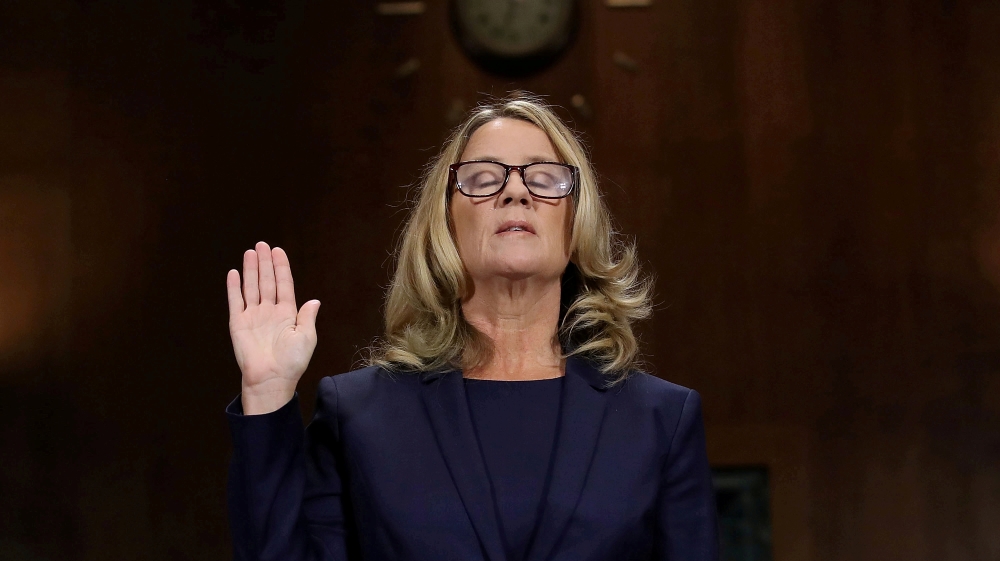
But as I watched Dr Christine Blasey Ford give testimony about how Supreme Court nominee Brett Kavanaugh sexually assaulted her – a moment of reluctant unity for at least one third of women in the US – my mind was focused on the economic cost of sexual assault on women.

I asked myself: Is there a causal relationship between experiencing the event and aftermath of assault, and the lack of economic parity that exists between genders in the US and abroad? In addition to everything else that holds women back financially and professionally, could the prevalence of assault also help explain why women make up an infinitesimal margin of the ruling class and power elite? How do the long-term effects of surviving assault continue to impact survivors in every way, including achievement?

Let us take the case of Dr Ford, who had to put her mental, emotional, and physical safety on the line to report the sexual assault she suffered. During her testimony she was asked to discuss the short and long-term impacts of being a survivor. Dr Ford mentioned her first two “disastrous” years as an undergrad at University of North Carolina. Although she went on to earn a PhD, those disastrous times could have cost her academic career.

Imagine all the women who experienced life-long economic disadvantage from the devastating trauma brought on by assault. Perhaps due to the resulting anxiety and post-traumatic stress disorder (PTSD), they are unable to go back to work or complete college, or even if they do, they subsequently struggle financially or are unable to advance in their careers.

In the simplest of terms, survivors and the subsequent decrease in accumulation of wealth they experience is lost human capital. As has been proven time and time again, the more capital that’s funneled into an economy, the more robust that economy. By allowing “boys to be boys” with impunity, we’re not only compromising on a social contract of civility, we’re actually preventing a third of the female population from fulfilling their economic potential, which is handicapping the American economy, plain and simple.

The research findings that are offered about the costs of sexual assault are in no way exhaustive, but they do offer a slice of the pie. For example, according to the Bureau of Justice Statistics, the total cost survivors incurred as a result of sexual assault was $18m in 2002. Adjusted to today, that number would probably be significantly higher.

The National Alliance to End Sexual Violence states “survivors who were sexually assaulted during adolescence have been found to have reduced income as adults, with an estimated lifetime income loss of $241,600.”

One study by the New York City Alliance Against Sexual Assault indicates that “one cause of reduced lifetime income is related to reduced education.” They contend that women who have survived sexual abuse are three times more likely not to complete high school, compared to women reporting no sexual abuse. But even if one graduates from high school and gets higher education, the financial burden of being a survivor remains significant.

Take me, for example. I – an upper middle-class coastal dweller and a woman of colour – am a two-time survivor. My first experience was when I was 9 or 10, I don’t recall. Yes, there is a journal with tearful scribblings, exact dates, and shameful admissions of something just not being right – I just can’t offer those details at present because I’m rage-writing this piece from an airplane on my way to a work trip. But it did happen. When I decided to confront this reality at 18, I was told I could either sweep it under the rug, I could come forth and shame my family and myself, or I could try therapy and hope for the best.

I paid a dear price for waiting so long to address my past – I paid in the form of PTSD, anxiety, and serious panic attacks. One statistic from the National Sexual Violence Resource Center reports that 81 percent of women are impacted by PTSD, post-incident. According to the same organisation, health care costs are 16 percent higher for women who were sexually abused as children. To sum it up, therapy costs money, and so does anxiety medication. It doesn’t end there.

I also pay a price for taking time off of work to attend these appointments, not to mention the time it takes to recover after a panic attack. That is time during which I’m not working and earning. For those of you who have experienced an authentic panic attack, you know what I’m talking about. For those of you who haven’t, it really does feel like you’re dying. And it’s hard to revive yourself afterwards – sometimes it takes days. And in this economy, time is money.

My second experience was later in life and did include an all-too-common mix of alcohol, drugs, and a romantic entanglement which make it harder for some to label the incident as rape. But when a woman says no (physically or verbally) and the incident happens anyway, the psychological toll is the same. Once again, I am paying a price – but there’s an economic angle to this too. Since the incident, I had upped my therapy to twice a week and was thinking of seeing someone for additional mental health assistance in the form of a psychiatrist. That all costs money.

After this incident occurred, I felt the same feelings I did as a child. I felt vulnerable, unsafe, confused, and a little less courageous. In turn, I felt slightly less emboldened to go after the things I want, the things I am interested in, the things I need to do to fulfill my life’s intention – and that includes my professional path.

I do think that as a result of what I went through, I was more compelled to go into non-profit work – to spend my days working towards a more equal world – as opposed to going into finance or consulting, paths that were also offered to me as a result of where I’m from and how much schooling I have been lucky enough to have.

I’ve learned through years of therapy that I have a deleterious tendency to help others before helping myself. And I am learning that the reason I’m like that is because this thing happened when I was younger; this thing that I couldn’t control, I’m now trying to “fix” it by working in non-profit and social justice.

Professional trajectories matter and going into social work or the non-profit sector oftentimes requires a secondary degree. Now on top of costs for therapy, costs for meds, you likely add on student debt. That’s a lot of money, that’s a lot of toll to pay forward for situations that you couldn’t control.

For the last ten plus years I’ve been threading the needle between advocacy and media, lending my voice to the voiceless, offering my time and intellect to somewhat intractable goals like achieving equality, liberty, and justice for all. I don’t do this because I’m a good person. I do it because it’s compulsive. I have to do it because of two reasons: If I don’t, then I am complicit in a system that is inherently and systematically unequal in relation to my gender and I do it because no one did this for me.

Which leads me to circle back to my thesis. Would it be better for me and maybe the economy if I worked in the for-profit sector? If I was in finance, consulting, or some other more lucrative field? If I made more money and didn’t have to account for the cost of being a survivor?

Why are women not running the world? Or at the very least occupying more positions of power and control? After witnessing this circus of a confirmation hearing, I am now convinced that the prevalence of assault could be a contributing factor.

Once again, not only is there a significant psychological and emotional toll to sexual assault, but there’s a literal economic toll. Being a survivor has hindered my economic growth, potential, and in turn, my economic health, and I’m pissed about it.

As I crest on my 34th turn around the sun, I’m reconsidering this path and I’m starting to adjust my professional trajectory for purely economic reasons. Only I have the agency to change my professional trajectory and become financially sound, but not everyone can do that. Plenty of more disadvantaged women struggle with the trauma, often cannot afford therapy or proper health care, and as a result are unable to emerge from the cycle of poverty they have been living in.

And in particular, women of colour survivors, living within a capitalist framework where most of us are statistically likely to make less than many of our white counterparts, suffer financially that much more.

If there’s something we should come away with from this hellish and insane news coverage of the Kavanaugh accusations, it is that sexual assault exacts a heavy toll not only on the women who have gone through it, but on our society as a whole. And it is time this becomes part of our national conversation. 

The views expressed in this article are the author’s own and do not necessarily reflect Al Jazeera’s editorial stance. 

Read More

from Viral Eyes https://ift.tt/2OmkbJD
via IFTTT

10 political podcasts to help you keep your sanity before the midterms

news image

In a time of volatile politics and chaotic news cycles, it can be hard to separate the signal from the noise, to stay informed without getting completely and totally overwhelmed. 

Which is why, despite recent talk of a “podcast bubble,” the medium is exactly what we need right now. Podcasts can slow down and really study a topic or event, bringing in the kind of nuance that’s too often lacking in our current discourse.

Sure, partisan political podcasts — from the Crooked Media/”Pod Save America” crew on the left to Ben Shapiro’s show on the right — are still incredibly popular, as are news podcasts that dip into politics, like the New York Times‘ “The Daily.” 

But if you’re looking to preserve your sanity while keeping up to date, try one of these 10 podcasts, which offer a more balanced analyses, and a respite from the multi-person shouting of television news. They’ll keep you informed … without subjecting you to the vicious cacophony of the burning tire fire that is the world around us. 

“Can He Do That?” The Washington Post

To say that Donald Trump’s presidency is unprecedented is an understatement, and we’re not even halfway through his first term. The constant churn can leave us feeling burned-out and confused. Enter Allison Michaels and “Can He Do That?” which views Trump’s actions through the lens of the actual limits on presidential power. Each episode features deeply researched analysis from journalists and experts, spelling out what Trump can and can’t do and the consequences therein. It’s a vital listen in an age of never-ending tumult. 


“Ground Game,” The Associated Press

Believe it or not, American politics extends beyond the White House, even though Trump dominates so many headlines. And there’s an extremely important midterm election coming up … you may have heard of it? Fortunately, the Associated Press’ “Ground Game” cuts through the noise to deliver reporting from its network of journalists on congressional races from around the country and beyond. A recent episode gave detailed insight into what goes into the AP’s decision to call a race. 

“Politics Podcast,” NPR

This podcast is exactly what you expect from an NPR production: the latest news, terrific analysis, and a wide range of topics. While you won’t find hot political takes here, it’s anything but dry. The discussion is engaging and informative without leaving you lost in the weeds. Being this thorough and covering such a breadth of topics — from the White House down to state races — makes it invaluable for those trying to keep up in a world in which news that’s more than a day old feels ancient. 

“Political Gabfest,” Slate

If you like your political roundtable talk a little spicy, Slate’s “Political Gabfest” offers astute and lively debate that’s well worth a listen. The three hosts — David Plotz, Emily Bazelon, and John Dickerson — have been doing the show together for nearly 13 years, and that’s to its advantage. Not only does the familiarity bring a richness to their rapport, but they aren’t afraid to disagree and occasionally tangle about their topics. You’ll find everything from nuanced discussions about criminal justice reform to tutting over the latest scandals and fallout. 


“Left, Right, & Center,” KCRW

Like Slate’s “Political Gabfest,” one of “Left, Right, & Center’s” strengths comes from its unique mix of voices — Josh Barro is in the middle, hosting a rotating door of guests — and the way these hosts play off each other. They’re purposefully from unique political viewpoints, enabling plenty of debate about the latest political news, issues, and controversies of the day, but always in a calm, respectful manner, never allowing the different perspectives to boil over the way we so often see online.

“Politics Podcast,” FiveThirtyEight

After Trump’s upset win in the 2016 presidential election, there was a lot of ire directed at Nate Silver’s site for projecting Hillary Clinton as the winner. But one of the great aspects of the site’s political podcast is how Silver and other staffers take these challenges head-on, explaining how the model works (including their current midterm models) and how readers should interpret them. The political discussions are also meticulous and often fun, as guests (usually FiveThirtyEight staffers like Clare Malone and Perry Bacon, Jr.) aren’t afraid to antagonize each other, keeping the podcast lively as they break down current events and try to interpret the larger impact on the chaotic political world. 

“More Perfect,” WNYC

The judicial branch gets its due thanks to WNYC’s “More Perfect” podcast, which explores the history, the figures, and the cases that have made the highest court in the land such an important and, at times, contentious bedrock of our country. With so much attention being given to the Supreme Court lately, especially in terms of its political lean and sway, this podcast is a valuable asset in filling the knowledge gaps.

“Slow Burn,” Slate

Understanding history is essential to understanding our political present, not just because, as the saying goes, history repeats itself. As talk around the potential impeachment of Donald Trump simmers, it’s important to look back at our embattled presidents, and “Slow Burn” does that exquisitely, digging deeper into the Watergate scandal under Richard Nixon (season 1) and the scandal surrounding Bill Clinton’s affair with Monica Lewinsky (season 2). 


“Whistlestop,” Slate

This is John Dickerson’s second appearance on this list, but for very good reason. His delightful “Whistlestop” podcast has been churning out episodes of presidential history for years. (I included his book, based on the podcast, in a presidential biographies project I did for this site a few years back.) The podcast is still going, dipping into the past to give us essential context for events of the present. Recent episodes focus on the failed nomination of Robert Bork to the Supreme Court by Ronald Reagan in 1987. 


“Presidential” and “Constitutional,” The Washington Post

Much like “Whistlestop,” this pair of podcasts from The Washington Post delves into our political past to give us context for current politics and actually teach us a few things. Both are fascinating, breaking the history, historical interpretations, and debates around our presidents and the country’s most important document into digestible bits without dumbing anything down. “Presidential” has one episode for each president, and “Constitutional” clocks in at a tidy eight episodes that look at the document’s impact on our country, plus a special reading of the preamble. 

With any luck, these podcasts won’t just keep you up to date on political happenings without immersing you in the digital echo chamber —  maybe you’ll keep your sanity and learn some U.S. history along the way.

Https%3a%2f%2fblueprint api production.s3.amazonaws.com%2fuploads%2fvideo uploaders%2fdistribution thumb%2fimage%2f86672%2fc585e369 c256 4967 b916 23f0d2174409

Read More

from Viral Eyes https://ift.tt/2R9V0bX
via IFTTT

How Afghanistan fell in love with cricket

news image

Afghanistan recently ended its 2018 Asia Cup journey in Dubai with a series of impressive performances, filling Afghans at home with joy.

With victories against Sri Lanka and Bangladesh, a tie against India and a competitive effort against Pakistan, the team returned home winners, despite not making it to the final.

Pakhtoon Sarfaraz, a 22-year-old student of agriculture at the Said Jamal Uddin-e-Afghani University in Asadabad, the provincial capital of the eastern Kunar province, is among those who have been left feeling inspired.

A local cricket player, he believes the national team has made significant progress over the past few years and has his sights set on one day representing Afghanistan internationally.

“In the years to come, we will bring the World Cup home, I truly believe that. And maybe, by then, I will also be a part of the team.”

In his childhood, Sarfaraz watched on as his brothers, Nooragha and Abdul Wahid, played cricket in the afternoon after school with a cracked bat and a tennis ball in Jalalabad city in Nangarhar. 

Sarfaraz has played in several local cricket tournaments [Courtesy: Pakhtoon Sarfaraz]

He used to field with them occasionally, but started competing more seriously when he was admitted to the Nangarhar Cricket Academy at the age of 11.

“I remember when I first started practising cricket, I felt like I was born to do this. I picked up everything so quickly,” he told Al Jazeera.

“My coach at the time was very happy with me,” he said, referring to Raees Ahmadzai, a well-known former Afghan cricketer who represented the national team until his retirement in 2010.

“Over the years, I just developed a lot of passion to represent my country on an international level in cricket.”

Sarfaraz has played in provincial cricket tournaments alongside national players including Usman Ghani, Farid Malak, Shabir Noori and Batin Shah.

He has also represented seven provincial cricket teams since 2008 and captained squads in district and inter-college contests.

He now plays for about four hours a day after university lectures at the Kunar Cricket Academy.

“By the end of the day, I am very tired. I barely socialise outside of university and academy. I have a goal in my mind and I want to achieve it,” he said. “It is an amazing feeling to play cricket. I can only express my love for cricket by practicing to be the best.” 

How cricket evolved in Afghanistan

Cricket is relatively new in Afghanistan and particularly popular in the east of the country, along the border with Pakistan, a country which enjoys the game with unparalleled passion.

The sport was imported by Afghan refugees who had lived in Pakistan in the 1990s, after they fled the Soviet invasion.

Upon returning, they brought cricket home with them.

But sports including cricket and football were banned and condemned by the Taliban during their rule, which began in 1996.

The Taliban lifted the cricket ban in 2000, making it the only sport approved by the group.

Sarfaraz, right, started playing cricket at the age of 11 [Courtesy: Pakhtoon Sarfaraz]

In 2001, when a US-led invasion toppled the Taliban, the national team was formed and in the same year, the International Cricket Council (ICC), which is the global governing body of cricket, granted “affiliate” status to the Afghanistan Cricket Board, formerly known as the Afghanistan Cricket Federation.

In 2017, the ICC awarded Afghanistan with a full “test” status.

“One of the main reasons that our national team started doing so well is because the Afghan government started investing in them and in the cricket academies across the country,” Adro Gul Stanikzai, a former cricket coach at the Nangarhar Cricket Academy and a sports commentator, told Al Jazeera. 

“The team was then encouraged by the love and support that they got from Afghans. Across the country, when Afghanistan is playing, everyone is praying for them to win.”

In October, Sharjah Cricket Stadium will host the Afghanistan Premier League T20.

The Emirati ground has been the home ground of the Afghanistan team for their international fixtures for over a decade, owing to security concerns.

Back in Kunar, Sarfaraz says he wants to finish his education before competing internationally.

“If we can’t speak English properly or have basic knowledge and etiquettes, we won’t be representing our country in the best way,” he said.

Sarfaraz’s father was injured in a Taliban attack and has lost the ability to walk. His two brothers are the main breadwinners for the family of eight.

“My brothers are the reason of where I am today. They support me through every possible hurdle,” he said.

Sarfaraz reflected back on the 17-year-old conflict in Afghanistan and said every individual is “fighting a battle to fulfill his or her dreams.

“We don’t have it easy, we have to fight through many challenges especially because of the ongoing war in our country.”

Sarfaraz has played with the members of the Afghan National Cricket team including Usman Ghani, Farid Malak, Shabir Noori and Batin Shah [Courtesy: Pakhtoon Sarfaraz]

In May, an attack during a match at Spinghar Cricket Ground in Jalalabad killed eight people and wounded dozens. The Taliban denied involvement.

Hundreds had gathered to watch the evening game in Sarfaraz’s hometown.

“We are completely in shock because I have played several cricket matches in that stadium,” he said. “I do worry for my life but my love for cricket just surpasses that fear.”

England and Wales will host the next world cup from May to July next year.

“We can hold our heads high, and this performance gives us pride,” said Asghar Afghan, the co-captain of the Afghan national team, speaking in Dubai after tying with India. “Remember, this is a warning for the World Cup teams.”

Read More

from Viral Eyes https://ift.tt/2Qegeny
via IFTTT

In Jharkhand, a tribal assertion met with fierce police crackdown

news image

Jharkhand, India: It was dusk in Uduburu, the time that farmers usually return home after working in the paddy fields, but the hamlet in the eastern Indian state of Jharkhand was deserted. 

The village square was empty and the mud huts were locked.

After darkness fell, a few women cautiously approached a hand pump at the entrance to the village to draw water.

Lucia Soy, a tall, gaunt, middle-aged woman, explained that the villagers had gone into hiding, fearing police action.

Thousands of people from across several villages in the area have been accused in criminal cases by the police of agitating against what they say is the forceful acquisition of their farms and pasturelands.

They [police] didn’t even spare domestic animals. They thrashed our pigs in anger when they did not find the men

Lucia Soy, villager

“On several successive nights last month, the police came to the village and started beating anyone they could find,” said Soy, speaking in Mundari, the language of the local Munda tribe.

“They didn’t even spare domestic animals. They thrashed our pigs in anger when they did not find the men.”

Maga Purty* (not her real name), an elderly woman, said security forces had thrown her cooked rice to the ground and took away her blankets and farm tools.

“They locked me inside my hut while they beat my son outside,” said Purty, who requested anonymity.

After the allegedly violent police raids on their hamlet and villages in the surrounding area, the farmers fled to the forest and hid for nearly a month, the women said, missing the window of sowing paddy in their fields. They are now struggling to resume work.

Several women and men slowly gathered around the water pump. In faint torchlight, they showed their injuries. Some still had swollen feet, weeks after the alleged police beatings.

Uduburu in Khunti district is near the birthplace of Birsa Munda, an Adivasi indigenous community leader who had led guerrilla resistance against British colonial rulers in the 19th century. 

A nationalist icon, many state institutions are named after Birsa Munda, including Jharkhand’s main airport in the capital, Ranchi.

Uduburu is also home to Joseph Purty, a government college teacher who over the past year led a movement for a boycott of all government institutions against the allegedly forceful acquisition of tribal land for “development work” – a euphemism for industrial or mining projects.

Hundreds of farmers joined in the demand.

Their protested centred on a centuries-old Munda tradition in which the community engraves stone monoliths to mark significant milestones in the village.

Large stone edicts freshly painted green and white can be seen in many of Khunti’s hamelts [Anumeha Yadav/ Al Jazeera]

The “pathalgadi” rebellion saw farmers organise ceremonies in which they carved the constitutional provisions of tribal autonomy on large rocks, and erected these at the hamlets’ entrances.

But the assertion by the Munda farmers that the government follow the laws and the constitution’s special provisions granting self governance in predominantly tribal areas such as Khunti has drawn the ire of the state.

Jharkhand Chief Minister Raghubar Das promised to crush the movement, as the police launched crackdown on defiant farmers.

Between February and July, more than 3,300 farmers, including the heads of village assemblies, have been charged under the law of sedition.

Those found guilty under the colonial era law may face up to three years in prison.

Formal police complaints were filed in March, invoking charges of sedition and rioting for “wrongly interpreting the constitution”, and for demanding the administration remove police and paramilitary camps from Kevada and other villages.

More than 2,000 paramilitary forces were deployed in the area, stated the district police superintendent. Now, over 300 security personnel are camping in schools in Khunti’s interior villages, forcing students to drop out.

Between February and July, more than 3,300 farmers, including the heads of village assemblies, have been charged under the law of sedition [File: Khunti police station/EPA]

The police have registered several criminal complaints against Joseph Purty, the college teacher in Uduburu. He was also named, along with other youth from the pathalgadi movement, in a gang-rape complaint filed by five women on June 21.

However, questions over the investigation were raised when one of the rape survivors later stated in a news interview that she did not name Purty or any other pathalgadi movement leaders in her complaint, claiming that police added their names.

Purty, who is in his late forties, and his wife, a teacher, are currently on the run.

Khunti Superintendent of Police AK Sinha declined to comment on the rape investigation, but backed the sedition cases against the tribal farmers. 

“These tribals were not merely installing stone edicts,” he said. “They were inciting people [and] insulting officials who visited the villages.”

He added: “The farmers were demanding that tribal farmers arrested [between February and August this year] be released from prison, merely on orders of their village assemblies.”

The farmers also threatened to ban outsiders from entering their villages and warned of using force if needed, claiming they will raise their own armies,” said Sinha.

On several of the megaliths, the farmers engraved messages saying outsiders were not permitted to reside in protected tribal areas or enter the village boundaries without seeking permission of village assemblies.

The farmers denied police allegations that they were raising an army, explaining that following pathalgadi ceremonies, there were large public rallies with protesters carrying traditional weapons including sticks, axes, bow and arrows.

However, they said no one was assaulted.

Inspector P Prasad, the investigating officer in the rape complaint, also declined to speak on the sexual assault case.

But he said police had filed several criminal cases against the farmers because they were “not allowing the administration’s movement in the area”.

He added: “We wanted to acquire land to expand police camps in Khunti’s Saiko and Marangahada villages, but the farmers refused to give land for this. They regularly obstruct developmental work,” he said.

Police officials accused the residents of illegally growing opium and siding with groups belonging to the banned Communist Party of India (Maoist).

The impoverished forested “tribal belt” in central and eastern India, where Jharkhand lies, is conflated with the area of a decades-old Maoist rebellion. 

Of 30 districts most affected by the violent conflict between the Maoists and Indian security forces, 13 are in Jharkhand, and include Khunti. 

The Maoists have played no visible role in the pathalgadi movement.

The farmers have long-standing grievances, fear being displaced from their farmland, and oppose the steady militarisation in Khunti and adjoining districts in the name of pushing out the Maoist uprising.

They accused the administration of being corrupt, domineering and exploitative, and diluting the land tenancy laws meant to protect indigenous communities’ land rights. 

“We want to ask the police administration, why are they raiding and beating us?” said a Munda youth in a village in Murhu block, who did not wish to be identified in the report.

“They beat me and my wife from head to toe with [a long, heavy iron-bound bamboo stick] when we had not even touched any policemen,” he said. “We organised pathalgadi ceremonies following our tradition. We were simply stating that all Adivasis in Jharkhand must unite.”

Netram Munda, an elderly man in Murhu, told Al Jazeera that the villagers had organised stone carving ceremonies in an attempt to save their ancestral farmland.

“In Khutkatti (forest patches first cleared by the Munda indigenous communities), no one outside the community has the rights to buy land, but Chief Minister Raghubar Das is framing new laws allowing the district commissioner to sell our farmland to anyone.”

After India’s independence from Britain in 1947, the government accorded special protections to the tribal areas under the Fifth and Sixth Schedules of the Constitution.

The government in free India recognised the historic wrongs the tribal communities had faced from the British colonial rulers, as well as people from the mainland. 

There are restrictions on sale and transfer of tribal land and property to non-tribals in the Fifth Schedule areas, such as Jharkhand.

About nine percent of India’s population are from tribal communities, or Scheduled Tribes as they are categorised in the constitution.

In Jharkhand, tribal communities, or Adivasis, form 28 percent of the population, and 54 percent of them live below the poverty line.

Villagers say the government school in Kochang has now been occupied by paramilitary forces [Anumeha Yadav/ Al Jazeera]

In 1996, parliament enacted the Panchayats Extension to Scheduled Areas Act (PESA), acknowledging the continued threat to indigenous communities rights and resources, and upholding their rights to self-governance in tribal areas.

PESA acknowledges that all adult members of a habitation constitute a village assembly, which can act to prevent land loss, should be consulted on land acquisition, and can grant of certain mineral leases.

In addition to national law, land cultivated by indigenous communities in Jharkhand are protected under colonial-era tenancy laws.

Though Birsa Munda had died in prison at the age of 25, the British in a concession to the Munda rebellion had enacted the Chotanagpur Tenancy Act of 1908, which confers protection to the land of small cultivators.

In the state capital Ranchi, Ratan Tirkey, a member of the state Tribes Advisory Council, a government body appointed in all Fifth Schedule, or protected areas, said: “Khunti is on the boil because the government is ignoring Fifth Schedule provisions, and bypassing consulting the [village assembly] on acquisition of farmland and pastures.”

Dayamani Barla, a Munda land rights activist in Ranchi, explained that one of the first steps the right-wing Bharatiya Janata Party (BJP) government had undertaken after coming to power was to propose changes to dilute the Chotanagpur Tenancy Act, the region’s unique land tenure system. 

But the proposed changes could not be passed following deadly agitation launched by the tribals.  

The government, however, found ways around the tenancy laws, reducing the scope of progressive provisions in land acquisition laws despite questions raised by the Tribes Advisory Council, Tirkey said.

“If after all this, people analyse the constitution’s Fifth Schedule provisions themselves and inscribe it on rocks or megaliths, or anywhere in their homes, how is that unconstitutional?” he asked.

Ironically, Tirkey pointed out, the first pathalgadi ceremonies inscribing the Constitution’s tribal area provisions had been organised by government officials in 1996 after the PESA law was passed. 

Several of these megaliths are still standing in Khunti. 

“The only difference now is the language has turned more assertive, reflecting people’s bitter experiences with the administration,” he added.

Neelkanth Munda, member of the state legislative assembly from Khunti, and the state’s minister for rural development, declined to comment on the changes made to land acquisition laws by the government. 

He told Al Jazeera by phone that “normalcy has returned” in Khunti after dampening pathalgadi movement.

In Khunti, the Adivasi inhabitants expressed growing distrust of the government’s ongoing land acquisition projects.

Durgavati Odiya, an activist with the Central Sarna Committee, a Munda religious organisation, who has also been named in several criminal complaints, claimed the police were threatening the village assemblies to “vacate land for projects, or face repercussions”.

She said the administration continued to disregard norms for consent, and were not transparent over why they needed the land.

“The officials told us they were acquiring land for a ‘Knowledge City’, and people thought it was to build a university, but now they have stated that they will be building a military training school and an airstrip on the land,” said Odiya.

“In Japud village, 84 of 130 households in the [village assembly] opposed diverting 14 acres of pastureland for an electric sub-station, but the administration still went ahead with the construction,” she said.

Khunti Deputy Commissioner Suraj Kumar, the head of the civil administration, confirmed that a training centre for security personnel was going to be built on the land acquired for the “Knowledge City”. 

He said that officials had documents to prove that consent of the village assembly had been obtained for a power sub-station in Japud. 

Kumar accused the village functionaries of working under the influence of the banned Maoist rebels. 

“We also support traditions such as pathalgadi, but under the Maoists’ influence, the tribal communities are inscribing inflammatory statements and this can turn into a violent movement, which it is our responsibility to prevent.”

After intensifying raids, the Jharkhand Armed Police and paramilitary now occupy school buildings in remote villages of Kochang, Kurunga, Sinko and Sarda, leading to more resentment.

In Kurunga and Kochang forest villages, Veronica Soy, an elderly farmer, said the paramilitary Central Reserve Police Force had occupied the only government primary school building, with no prior information to the community. Soy questioned how this could be termed as being tribal communities’ “development”.

“The paramilitary met our village head only after occupying the school and said they will remain here until “peace” is established,” Soy recounted. “But even the school principal was not informed.”

She said security forces had told residents that their local school had been “merged” with another school in Ruggudi, four kilometres away.

“The younger children cannot walk so far to classes through the forest, they will be forced to drop out of school,” Soy said.

Concertina wire around a school occupied by paramilitary in Kochang village in Khunti, Jharkhand [Anumeha Yadav/ Al Jazeera]

Read More

from Viral Eyes https://ift.tt/2IpRPJa
via IFTTT

Iraq’s Kurds vote in parliamentary election

news image

Kurds have started voting in Kurdish parliamentary elections a year after the semi-autonomous region’s failed bid for independence from Iraq.

Sunday’s election will see hundreds of candidates vying for 111 seats in the regional parliament, including five seats allocated for Turkmen, five seats for Christians and one seat for Armenians.

More than 3.1 million people are eligible to vote in the semi-autonomous region.

With opposition parties weak, the Kurdistan Democratic Party (KDP) and Patriotic Union of Kurdistan (PUK) are likely to extend their almost three decades of sharing power.

But splits within the PUK present the possibility that KDP will take a dominant position in Kurdish politics, both in the regional capital Erbil and in the difficult formation of a federal government in Baghdad.

Prime Minister Nechirvan Barzani of the KDP cast his vote shortly after polls opened on Sunday morning. 

“I hope the results of the vote are respected because it’s about the people’s choice for a new parliament and government,” local media quoted him as saying. 

Elections had been scheduled for late 2017, but were deferred in the aftermath of a referendum for independence which was met by a swift backlash from Baghdad.

With 92 percent of Iraqi Kurds voting in favour of independence, Iraq issued a strong response imposing economic penalties and taking over the oil-producing city of Kirkuk. 

Even though relations with Baghdad have improved, the Kurdish region has lost territory and economic autonomy, and voter frustration is rising.

Years of stagnant politics, unpaid salaries and corruption have undermined faith in politics and shrunk the turnout in recent elections.

Most major parties say they do not expect more than about 40 percent of the 3.85 million registered voters to go to the polls – below even the record low of 44.5 percent who voted in the federal election.

SOURCE: Al Jazeera and news agencies

Read More

from Viral Eyes https://ift.tt/2N5D66Z
via IFTTT

Saturday Night Live recap: Adam Driver leads lackluster season premiere

news image

Since the news has been happening at such a lightning-fast clip, Saturday Night Live was presented with the daunting task of playing summer catch-up. Host Adam Driver gamely committed to the sketches, but more focus was drawn by Pete Davidson’s tabloid romance with Ariana Grande and Kanye West, well, being Kanye West.

Cold open

In what was the highlight of the evening, Matt Damon made a special appearance as Brett Kavanaugh, “the proudest, drunkest virgin you’ve ever seen!” Damon perfectly mastered Kavanaugh’s blustery shouting, which included the poorly thought-out declaration: “I don’t know the meaning of the word stop.” 

The show failed to maintain the energy of that cold open, which also included a surprise cameo by SNL alum Rachel Dratch (and a cardboard cutout of Alyssa Milano).

Monologue

“Adam designated Driver,” star of Girls and the Star Wars films, was hosting SNL for the second time. Without a project to promote, the opening monologue was a little unfocused — Driver pretended to tease new Star Wars spoilers before he was interrupted by SNL cast members talking about how they spent their summers. Spoiler alert: they all involved work and travel. That is, of course, with the exception of Pete Davidson.

“Actually, you’re the only one whose summer I want to hear about!” Driver said to Davidson, who simply winked at the camera. 

Worst sketch:

Driver played a divorced dad trying to get into popular online game Fortnite in order to relate to his son more. Although seeing his incompetence play out with live actors was amusing, the joke (“adults are bad at technology!”) was more than a little one-note. 

Weekend Update:

Though there was plenty to talk about, hosts Michael Che and Colin Jost focused the majority of their Weekend Update jokes on Thursday’s Brett Kavanaugh Senate hearing.

“You’re not really helping yourself in a drunken assault case when you yell about how much you love drinking and how strong you were at the time,” Jost cracked in reference to how Kavanaugh kept repeating how much he liked beer, and how his calendar detailed how often he worked out. Jost had a follow-up joke about how weird it was that the judge still had his high school calendar: “You know when most people throw out their calendar from 1982? 1983.”

Meanwhile, Che reminded viewers that the hearing was essentially a job interview for Kavanaugh. “Typically, when you’re asked about your sexual assault and your drinking at a job interview, you don’t get the damn job. You can’t just pick another dude from your Illuminati lizard meetings,” he said. “Are Republicans so pro-life that you don’t even have a Plan B for this?”

The segment was rounded out with an always welcome appearance from Kate McKinnon’s Ruth Bader Ginsberg, with her signature Gins-burns and dance moves. RBG couldn’t resist pulling out her own 1982 calendar, which had entries like “turn 100,” break glass ceiling,” and “do laps in a bird bath.” Her current calendar features one simple daily reminder: “Don’t die.”

Pete Davidson also dropped by the Update desk to offer an update on his whirlwind romance with singer Ariana Grande, revealing no one can believe the two are an item.

“Remember when that whole city pretended this kid was Batman because he was sick? That’s what this feels like,” he laughed.

When Jost asked what their prenup situation was, Davison replied, “Obviously, I wanted one. God forbid we split up and she takes half my sneakers. Look, I’m totally comfortable being with a successful woman. I think it’s dope. I live at her place. She pays like 60 grand for rent and all I have to do is like stock the fridge… yeah.”

A joke about switching Grande’s birth control with Tic Tacs to make sure she’d stick around fell flat, but Davidson pulled the crowd back in with a bit on how he doesn’t make royalties on her music, including the song named after him.

“If we break up — we won’t, we will — but in like 10 years, if god forbid that ever happens, there will be a song called ‘Pete Davidson’ playing in speakers at K-Mart, and I’ll be working there.”

Best short

Jealous of the attention Pete has been getting over his pop-star paramour, Kyle Mooney decides to steal Pete’s look — from his bleach blond hair to his colorful wardrobe. Kyle also enlists talk show host Wendy Williams as his own hot celebrity girlfriend. Eventually, Pete engages Kyle in a fight “SNL-style,” which turns out to be a renaissance/gladiator battle on stage. While it felt worthwhile to acknowledge Pete’s omnipresent fame that emerged during the SNL hiatus, a winking reference in the monologue, a Weekend Update appearance, and a short felt like overkill.

Most committed host moment

Props to Adam Driver for donning old-age makeup in a “Career Day” sketch to become Abraham A. Parnassus, the elderly parent of one of the students and attempts to bestow his wisdom of being a ruthless oil baron upon the class: “Crush your enemies! Grind their bones into dirt!”

Weirdest moment

Kanye West dressed as a bottle of Perrier to perform “I Love It” with Lil Pump, who was dressed as a bottle of Fiji water. I don’t even know what to say about that.


The original late-night comedy sketch show from the one and only Lorne Micheals.

Read More

from Viral Eyes https://ift.tt/2DIA8G2
via IFTTT

Design a site like this with WordPress.com
Get started