The Zaghari-Ratcliffe case and Theresa May’s outrageous hypocrisy

news image

On September 26, British Prime Minister Theresa May told the Iranian president Hassan Rouhani that she has “serious concerns” about the imprisonment of British-Iranian dual citizen Nazanin Zaghari-Ratcliffe. In April 2016, Zaghari-Ratcliffe was arrested and later sentenced to five years in prison in Iran for spying – an accusation she has vehemently denied throughout her ordeal.

Soon after taking up his post, British Foreign Minister Jeremy Hunt met with Zaghari-Ratcliffe’s husband, Richard Ratcliffe and tweeted about the “shocking and desperate” situation the family find themselves in. He also demanded Zaghari-Ratcliffe’s release during his first face-to-face meeting with his Iranian counterpart earlier this month. 

Of course, May and Hunt are right to be concerned about Zaghari-Ratcliffe’s incarceration, and to advocate for her release. But where is their concern for the hundreds of women, often the victims of sexual and gender-based violence, currently held in the UK’s many “immigration removal” centres?

The conditions of these detention centres are notoriously poor – in February of this year, over 100 women in Yarl’s Wood (an immigration removal centre primarily housing female detainees) went on hunger strike to protest what they referred to as “inhumane conditions”.

As the former home secretary and current prime minister, May has been a key architect and proponent of the hostile environment policy which has led to the detention of hundreds of women from across the globe. As a result of these policies, the UK immigration detention estate is one of the largest in Europe; from 2009 until the end of 2017, between 2,500 and 3,500 migrants have been in detention at any given time.

May’s selective concern for the unjust imprisonment of Zaghari-Ratcliffe stands in stark contrast to this, particularly as immigration detainees in the UK are sent to immigration removal centres as an administrative process rather than a criminal procedure. Detainees are not accused of a crime, but are victims of state bureaucracy, something which is weaponised to make the immigration process as difficult as possible.

When you consider that the single most common category of immigration detainees is people who have sought asylum in the UK at some point, this system appears to be all the crueler.

The Conservative government goes to great lengths to keep UK immigration detention unseen and unheard. Shadow Home Secretary Diane Abbott tried to gain access for over a year before she was finally allowed to visit Yarl’s Wood.

However, this double standard is not limited to May or even the Conservative government. The media coverage, and wider discourse, of Zaghari-Ratcliffe’s case, has laid bare the contrasting principles of British society.

We see Zaghari-Ratcliffe’s imprisonment as political and unjust (which it is), but simultaneously construct the women languishing in Yarl’s Wood as an unfortunate necessity – just part of the ugliness of things that “have to be this way”. In doing so, we depoliticise the UK’s regime of border control, which subjects immigration detainees to periods of indefinite detention.

But the way we enforce border regimes is inherently political, and fundamentally unjust. The UK is a rich country, having accumulated wealth and power through colonial exploits, at the expense of the global South. Now, we clutch greedily at our stolen resources, and we punish the people we stole from. We base our logic for this on the notion that there is a birth lottery and damned are those unlucky enough not to be born entitled to a British passport.

This way of thinking has become increasingly entrenched in UK society, and it is incredibly mean-spirited. It allows us to formulate immigration policing as apolitical. We deliberately ignore that the legacy of Britain’s colonialism continues to shape the world as it is; it’s not a coincidence that people from former colonies continue to migrate to the UK.

Immigration detention centres are not natural occurring phenomena but the result of these deliberately crafted systems, designed to keep wealth in and people out.

In a statement after his meeting with Iranian Foreign Minister Mohammad Javad Zarif, Hunt stated that “[Nazanin Zaghari-Ratcliffe] deserves to be at home with her family”. This is equally true for female immigration detainees in the UK.

The women confined in Yarl’s Wood are, like Zaghari-Ratcliffe, three-dimensional people, with lives outside of the walls of their confinement. Like Zaghari-Ratcliffe, they have friends and families waiting for them on the outside.

And, like Zaghari-Ratcliffe, they have a right to access justice, equality and freedom.

The views expressed in this article are the author’s own and do not necessarily reflect Al Jazeera’s editorial stance. 

Read More

from Viral Eyes https://ift.tt/2zFcuGm
via IFTTT

Life without Elon Musk could lead to big changes for Tesla

news image

CLOSE

SpaceX just announced it has signed up the first private passenger to fly around the moon. Elizabeth Keatinge has more.
Buzz60

For Tesla, life without Elon Musk once seemed like a long way off.

Now it could be imminent.

The Securities and Exchange Commission sued Musk on Thursday, accusing him of fraud and asking a judge to remove him as CEO and chairman of Tesla

That move raises the serious possibility that Tesla could be forced to find a new leader at a crucial time for the company, which is fervently trying to end its money-losing ways and improve its fledgling production of the vital Model 3 electric car.

“Tesla and Musk are inextricably connected,” Autotrader analyst Michelle Krebs said. “Without Musk, if that should happen … can it maintain that strength of brand and almost cult-like following?

The thought of Tesla without Musk is like Ford Motor Co. without Henry Ford. It’s unthinkable until, one day, it happens.

The difference is that Ford was already one of the world’s largest, most diversified automakers when Henry Ford exited. Tesla remains a niche electric-vehicle company aspiring to be much more.

Talking Tech: Can Tesla CEO Elon Musk survive SEC charges? 5 key factors to watch

Talking Tech: Here are Amazon’s 5 best deals right now

Talking Tech: Gig economy: Here’s how much you can make delivering for Grubhub, Uber Eats and DoorDash

Autoplay

Show Thumbnails

Show Captions

Musk is a “charismatic character who had a vision which is somewhat contagious,” said Ian Beavis, chief strategy officer for automotive consultants AMCI Global. “He is like what Steve Jobs created for Apple.”

But unlike Jobs, who nurtured Tim Cook to succeed him as CEO, Musk has no one on the bench ready to take over as manager of this team.

In fact, he has declined to hire a clear No. 2 executive despite calls for him to install a chief operating officer with financial and manufacturing expertise to speed up production of the Model 3 electric sedan. He has also churned through dozens of other executives, making leadership instability one of the only constants at the company.

“He hasn’t cultivated a next generation of managers and operators to make the company move forward,” Beavis said. “It’s all about him.”

Autoplay

Show Thumbnails

Show Captions

By contrast, his other major company, rocket-ship maker SpaceX, has a clear team of well-qualified executives in the background executing his vision.

Musk is more than just the public leader of the company –  to many investors he is the company, corporate branding expert Rob Frankel said.

“He’s 100 percent the face of all of his interests, everything from flamethrowers to rocket ships,” Frankel said. “I would say he’s probably got higher public awareness than some of his own brands. That’s by design. That’s a big issue.”

Without Musk at the helm, Tesla could face radical changes. Key possibilities:

1. A successor from the outside is appointed.

Musk’s successor almost certainly would come from outside the company. The candidate could also be found outside the auto industry, much like Ford hired CEO Alan Mulally in the 2000s to execute a turnaround, Krebs suggested.

But possible contenders for the job are extremely difficult to identify.

“Given the financial condition of the company, production problems and logistics/
delivery problems, it is unclear how quickly the Board could bring in a seasoned automotive executive even if they wanted to,” Cowen analyst Jeffrey Osborne wrote.

CLOSE

The Tesla CEO has tweeted a few questionable items, and one is bringing about a lawsuit from the Securities and Exchange Commission.
USA TODAY

2. Musk retains a visionary role.

Musk could negotiate a diminished role at Tesla as part of a settlement with the SEC, likely serving in a visionary or engineering role capacity.

It wouldn’t be unprecedented. In 2003, the SEC sought to bar lifestyle guru Martha Stewart from serving as a director and restrict her activities as an officer of any publicly traded company when the regulator accused her of insider trading in shares of biopharmaceutical company ImClone Systems.

However, a 2006 settlement imposed a lesser penalty: a five-year bar on Stewart serving as a director of a public company and a five-year restriction on the scope of her service as an officer or employee of such a firm.

She had already resigned as CEO and chair of Martha Stewart Omnimedia in 2004 after being found guilty on criminal charges of obstruction of justice and other allegations. She took on the role of the company’s founding editorial director.

In 2011, Stewart rejoined the company’s board of directors.

Musk has previously contemplated the possibility of one day relinquishing his post as CEO and focusing on product development.

This outcome would allow Tesla to maintain Musk’s appeal while fixing its operations under new executive leadership.

But it’s unclear whether strong-willed Musk could defer to a newcomer.

“Musk is very dynamic and very strong, and I think his visions are pretty much encoded in the DNA of all of his companies,” Frankel said. “Even if the SEC says, ‘you can’t own it, you can’t touch it, you can’t do anything,’ there’s nothing to say that he can’t counsel them, he can’t advise them.”

3. Tesla pares down its ambition.

Under Musk, Tesla has pursued a wide range of world-changing products, including electric cars, an electric semi-truck, solar roof tiles, batteries for the home, batteries for utilities and solar panel installation.

Some critics say the company is unfocused and needs to devote its efforts to its core business: electric-vehicle production and sales.

“They’re in a precarious financial situation, and this is make-or-break time on the financial front,” adding to the company’s need to get the Model 3 electric car into customers’ hands, Krebs said.

A more focused Tesla could be a more viable Tesla, perhaps even with sustainable profits to show for it.

4. The board gets new members.

Tesla’s board backed Musk’s leadership and integrity after the SEC lawsuit was filed. But the board members have come under fire for not providing sufficient oversight of Musk.

The board may yet feel pressure to nudge Musk to settle the case before the ship sinks.

“The problem is the board has done nothing to date, period,” said John Coffee, a securities law expert and professor at the Columbia University Law School. “They’ve got to do the impossible, and that is, ask him to be mature.”

Until further notice, though, “the board just lets him do whatever he wants,” Beavis said. 

Follow USA TODAY reporter Nathan Bomey on Twitter @NathanBomey.

Follow USA TODAY reporter Kevin McCoy on Twitter @kmccoynyc.

Follow USA TODAY reporter Chris Woodyard on Twitters @ChrisWoodyard.


Read or Share this story: https://usat.ly/2NNW4Ed

Read More

from Viral Eyes https://ift.tt/2DH0iJo
via IFTTT

I confronted Jeff Flake over Brett Kavanaugh. Survivors like me won’t stand for injustice.

news image

Ana María Archila, Opinion contributor
Published 4:00 a.m. ET Sept. 29, 2018 | Updated 8:24 a.m. ET Sept. 29, 2018

Jeff Flake finally called for an FBI investigation, showing the power survivors of sexual assault have when we stand together in the fight for change.

I began my week in tears, as I stood in front of Sen. Jeff Flake’s office to tell my story of sexual assault for the first time. I ended my week in rage after learning that Flake, R-Ariz., would vote to confirm Brett Kavanaugh to the Supreme Court of the United States.

I never thought that I would share my story of assault. It happened when I was five years old, before I had the consciousness to know exactly what was taking place. Even still, I knew that it was wrong.

I told two adults at the time and they didn’t believe me. So I kept this as a secret, too afraid and ashamed to tell my parents. It has been a burden that has weighed on me greatly ever since.

On Monday, I was with the organization that I co-lead, the Center for Popular Democracy Action, and hundreds of people from across the country who came to D.C. to urge their senators to vote no on the Kavanaugh nomination.

Brett Kavanaugh is not fit to serve

Much of his record on civil rights, worker protections, health care and reproductive justice is an abomination. So, too, is his personal history of treating women as less deserving of respect and control over our lives, as these accusations against him have shown.

For weeks people have traveled to D.C. to tell their stories trying to secure and save their health care, exercise their right to vote and, more recently, survive. People came to tell their survivor stories, discuss how Kavanaugh’s judicial record would harm working people and to urge their senators to vote against the nomination.

More: I was falsely accused and my reputation was disparaged. I don’t regret fighting back.

Christine Blasey Ford testimony was bloodbath for Brett Kavanaugh, Trump and Republicans

What messages young men hear amid sexual abuse allegations against Brett Kavanaugh

I had not planned to share my story that day. I hadn’t shared it for three decades because I wanted to protect my parents from my pain. But Christine Blasey Ford told her story to protect our country and, in solidarity with her and as a way to thank her, I decided to tell mine too.

I, like thousands of women who have chosen to do the same, are doing this in the hopes that when the senators hear our stories, they will not only believe us, but most importantly, they will use their power to help heal our country, and not further reinforce the culture that condones sexual violence by ignoring survivors.

I was counting on Flake to act with a sense of responsibility for his country and for the children who are watching this debate right now. And I was enraged and deeply saddened when I read his statement Friday morning announcing his support for Kavanaugh’s nomination to the Supreme Court.

I know that I am not alone. There are people across Arizona and across the country that have stories just like mine. Many have also shared them for the first time.

Supreme Court delay shows power of survivors

I had the opportunity to confront Flake on Friday. I reminded him that I had told my story in front of his office earlier in the week. I asked him how he could live with himself, as a father of a daughter, knowing that Kavanaugh allegedly violated a young girl.

In this time, we need a Supreme Court justice who is truly committed to justice. To the hard work of recognizing, understanding, and then repairing hurt. Someone who is willing to take responsibility for their past actions and do better in the future. That someone is not Brett Kavanaugh.

Through all of our interaction, Jeff Flake was silent. Then, he went missing from the meeting. He came back later and said that he could not vote for Kavanaugh on the Senate floor until after an FBI investigation.

His reaction shows the power that we have, together, when we chose to tell our stories and stand up for our vision of an inclusive society. When we take action, we breathe new life and possibility into our democracy.

I believe that the history of our country is one of constant struggle for more of us to be included in the promise of freedom and democracy. From the struggle to end slavery, to the fight to secure health care for all, people fighting for their lives and their dignity, together, gets us closer to bringing into existence the country where we can all be free. Let’s continue this struggle.

Ana María Archila is the co-executive director of the Center for Popular Democracy Action. Follow her on Twitter @AnaMariaArchil2.


Read or Share this story: https://usat.ly/2NOxD9Z

Read More

from Viral Eyes https://ift.tt/2zDDHsV
via IFTTT

A 29-year-old cancer patient accidentally labelled herself as a terrorist right before a bucket list trip to New York City

news image

A 29-year-old cancer patient was forced to postpone her bucket list trip to New York city after accidentally labelling herself as a terrorist.

The BBC reported that Mandie Stevenson accidentally answered “yes” when an online Esta (Electronic System for Travel Authorization) form asked if she was seeking to, or had ever, engaged in terrorist activities or genocide.

Stevenson said she only realised her mistake when the application was rejected — and it meant postponing a trip to New York City that had been on her bucket list since being diagnosed with terminal breast cancer in 2015.

Speaking on the BBC’s Mornings with Stephen Jardine, Stevenson said: “At first I thought it was a bad dream and then I realised what I had done.”

From Falkirik in Scotland, she went straight to the US embassy in London to try and persuade US officials she was not a security threat, and eventually had a full visa granted — though the appointment cost her £320 ($417) compared to the much cheaper Esta, which allows UK citizens to waive their need for a full US visa.

She was also advised to rebook her trip, which she had planned to take with her boyfriend, as there was no guarantee the visa would arrive on time for her flight.

Stevenson said she first tried to fill out the form using her tablet, but the form crashed, so she tried again at work the follwing day.

To the question that reads “Do you seek to engage in or have you ever engaged in terrorist activities, espionage, sabotage, or genocide?” she told the BBC she “believed she ticked ‘no’ then when scrolling it ‘nudged and moved.’”

She was told by the embassy that it was “the worst box you could have ticked,” and was told it could take three to five days to be granted the full visa.

She said: “I pleaded but they just said ‘change your holiday.’”

She added that they did not seem sympathetic to the fact she has terminal cancer.

“I live in 12-weekly cycles because I get scanned every 12 weeks. I book my holidays in very specific times and this New York trip was going to be before I get another set of scan results, so I was really looking forward to it.

“It was stress I didn’t need.”

According to Simon Calder, travel editor of The Independent, the question on the form is “completely pointless” in the first place as “nobody who was engaged in terrorism, espionage, or genocide would ever tick ‘yes.’”

However, he said: “Once you are on that list you are never going to get off it. America is completely unforgiving. If that box gets ticked for whatever reason, immediately it’s as though the alarms go off, the shutters go down and you are into a spiral of despair.”

Stevenson rearranged her trip for the next month, costing her more than £800 ($1,042).

“A lot of people have said ‘how on earth could you do that?’ but to me I’ve done it really easily,” she said. “I thought because it was a genuine error it would be quite easy to fix but I was quite wrong.”

Still, she said she’s now “happy again and keen to get going” — and plans to make it through the other items on her bucket list, which include a trip to Canada, visiting Thailand, and meeting football star Steven Gerrard.

Read More

from Viral Eyes https://ift.tt/2DNChjA
via IFTTT

US shuts down consulate in Iraq’s Basra citing Iranian ‘threats’

news image

The United States has announced it is closing its consulate in the Iraqi city of Basra and evacuating its diplomats from there after increasing threats and rocket fire from Iran and Iran-backed fighters.

The decision adds to mounting tension between the US and Iran, which is the target of increasing economic sanctions imposed by Washington.

US Secretary of State Mike Pompeo, explaining the move, renewed a warning that his country would hold Iran responsible for any attacks on US diplomatic facilities and citizens.

The move follows recent rocket attacks that Pompeo said were directed at the consulate in Basra.

US officials said the rockets, however, had not impacted the consulate, which is located in the Basra airport compound.

“I have made clear that Iran should understand that the United States will respond promptly and appropriately to any such attacks,” Pompeo said in a statement.

He did not explicitly say whether a US response was imminent, however, and other US officials did not disclose potential response options.

The US State Department said the consulate was placed on “ordered departure,” which technically involves a drawdown in staff. Although some personnel could remain on the diplomatic compound, the move is believed to effectively close the consulate, at least temporarily.

In a statement, Iraq’s foreign ministry said it “regrets the American decision to pull its staff out of Basra”.

Rouhani, Trump trade barbs

The decision came days after US President Donald Trump and Iranian President Hassan Rouhani exchanged taunts at the United Nations General Assembly, with Trump vowing more sanctions and accusing Iran’s leaders of sowing “chaos, death and destruction”.

The rial has lost 40 percent of its value against the US dollar since April.

Iran has blamed US sanctions for the currency’s fall, saying the measures amount to a “political, psychological and economic” war on Tehran. It also accused the US and Israel of involvement in a deadly attack at a military parade in southwestern Iran this month.

Basra has already been rocked by violent protests seen by experts as a rejection of the Iraqi political establishment that has held on to power – with the support of the Washington and Tehran – despite failing to improve people’s lives there.

Protesters in Basra ransacked and torched Iraqi government buildings this month and the Iranian consulate was set alight by demonstrators shouting condemnation of what many see as Iran’s sway over Iraq’s affairs.

Read More

from Viral Eyes https://ift.tt/2zEkuas
via IFTTT

Ryder Cup tracker: Americans are in big trouble early in fourballs

news image

USA TODAY Sports
Published 3:11 a.m. ET Sept. 29, 2018 | Updated 7:44 a.m. ET Sept. 29, 2018

CLOSE

SportsPulse: USA TODAY Sports’ Steve DiMeglio is on site at the Ryder Cup and describes a dreadful afternoon for the United States.
USA TODAY

Starting the second day of Ryder Cup matches with a 3-5 deficit, the United States has some work to do with eight points up for grabs Saturday at Le Golf National. 

Europe needs 14 1/2 points total to win back the Ryder Cup after sweeping Friday’s foursomes.

Follow the big moments of Saturday’s fourball and foursome matches here as the Americans look to make up some ground.

While you were sleeping

Rory McIlroy/Sergio Garcia vs Brooks Koepka/TonyFinau

After not making a birdie in Friday’s foursome matches, McIlroy made four on the front-nine and helped guide teammate Garcia to a 4-up lead thru 13 holes. Then the Americans climbed back to within one after yet another great bounce on No. 16 set Finau up for a birdie. Team USA came up short as Europe wins, 2 and 1.

Paul Casey/Tyrrell Hatton vs. Dustin Johnson/Rickie Fowler

Casey birdies five of the first six holes, while Fowler claimed three to keep the European lead to just two. It fluctuated between 2- and 3-up from there through No. 15. Johnson didn’t win a hole until his second birdie of the day on No. 11. Europe wins, 3 and 2.

Francesco Molinari/Tommy Fleetwood vs Tiger Woods/Patrick Reed

Team Moliwood took a 1-up lead to the back-nine, but a Woods birdie on No. 10 squared the match. Molinari responded, as he’s done time and time again versus Woods, with three consecutive birdies to take a 3-up lead through 13. Reed’s struggles continued to Saturday morning. His score has been used on just four holes: One birdie, two pars and a bogey. He hasn’t won a hole today for the Americans. Europe wins, 4 and 3.

Ian Poulter/Jon Rahm vs Justin Thomas/Jordan Spieth

What a match this has been. Poulter, a fan favorite here at Le Golf National, took it upon himself to keep the Americans at all-square for seven of the first 10 holes. Birdies from Spieth, Thomas and then Rahm gave the Americans a 1-up lead through 13.

Foursomes pairings

Here’s the lineup for afternoon matches:

Dustin Johnson and Brooks Koepka vs. Justin Rose and Henrik Stenson

Bubba Watson and Webb Simpson vs. Sergio Garcia and Alex Noren

Tiger Woods and Bryson DeChambeau vs. Francesco Molinari and Tommy Fleetwood

Jordan Spieth and Justin Thomas vs. Ian Poulter and Rory McIlroy

USA under pressure

All eyes are on Tiger Woods and Patrick Reed and Justin Thomas and Jordan Speith as the Americans need points from them to stay in the game. 

Reed does his first “shush” of the crowd after his birdie on the ninth to halve the hole. Reed and Woods are one shot behind Tommy Fleetwood and Francesco Molinari.

Thomas and Spieth are all square against Ian Poulter and Jon Rahm through eight.

The other two matches (Finau-Koepka and Johnson-Fowler) seem too far out of reach for Team USA.

Tiger’s first birdie putt

Woods finally cards his first birdie of the day, a long putt on the par-4 seventh, and tries to get his partner Patrick Reed going. They’re now down by one to Fleetwood and  Molinari. Reed can’t hit a fairway to save his life.

No stopping Rory

The Europeans have all the momentum and Rory McIlroy has taken control of the first match. He’s won three holes, and along with Sergio Garcia, has taken a commanding 4-shot lead against Tony Finau and Brooks Koepka through nine. 

After not making a birdie in fourballs Friday, Rory is in the zone. This Ryder Cup is falling apart for Team USA. 

Casey on fire

Paul Casey has four birdies in his first five holes as he returns to the Ryder Cup for the first time since 2008. The Englishman was one of Thomas Bjorn’s captain’s picks and is coming off T-11 at the Tour Championship. Casey and Tyrrell Hatton are 1 up against Dustin Johnson and Rickie Fowler as the Euros have dominated fourballs so far. 

Make that five birdies in six holes for Casey and now 2 up.

Finau holes out from bunker

Tony Finau, playing in his first Ryder Cup, holes out from a bunker on the fifth and celebrates with a big fist pump. But then Rory McIlroy matches him with a long birdie putt. The Euros remain 2 up in Match 1 and lead three of the four matches. 

DJ’s horrific start

Things are not going well for Dustin Johnson, who has found water on the first two holes. On the opening hole, his tee shot went to the edge of the water and he chipped out before his third spun into the water. The Americans were already in trouble as Rickie Fowler’s tee shot also landed in the drink. They conceded the hole to Paul Casey and Tyrrell Hatton without a putt.

On the second hole, DJ finds water again, but Fowler birdies the par 3 to get the match back to even. Goes to show that not even the world’s No. 1-ranked player is immune to the pressure of the Ryder Cup.

Autoplay

Show Thumbnails

Show Captions


Read More

from Viral Eyes https://ift.tt/2DNCcMO
via IFTTT

USA TODAY Sports college football staff picks for Week 5

news image

Share This Story!

Let friends in your social network know what you are reading about

USA TODAY Sports college football staff picks for Week 5

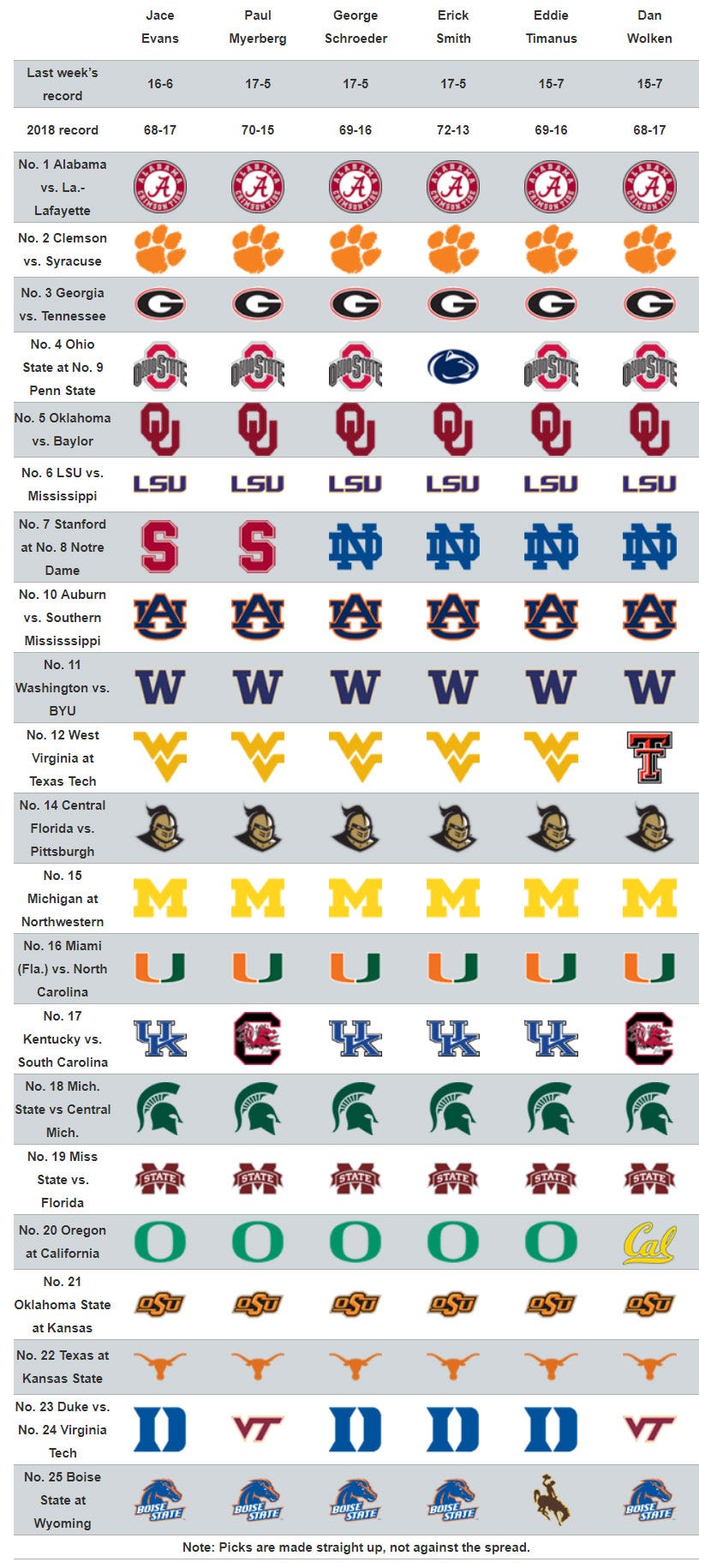
College football staff picks focus on a Big Ten showdown between Penn State and Ohio State and a meeting of Notre Dame and Stanford.

Loading…Post to Facebook

Posted!

A link has been posted to your Facebook feed.

CLOSE

SportsPulse: USA Today Sports’ Paul Myerberg and George Schroeder tell us how each team can pull off the victory in the Ohio State-Penn State matchup.
USA TODAY

The last weekend of September puts a fitting end on the first month of college football. There’s two huge top 10 showdowns that are certain have an impact on the playoff chase.

Perhaps the biggest game of the Big Ten regular season will take place in State College when No. 9 Penn State hosts No. 4 Ohio State. The past two winners of the conference have staged memorable showdowns in the last two meetings. The winner gets a huge lift in the East Division. The loser will need some help if it wants to keep its title hopes alive.

The other matchup sees No. 7 Stanford visit No. 8 Notre Dame. The Cardinal are fresh off their stirring comeback against Oregon. A win would add a significant non-conference victory to their resume. For the Irish, this shapes up to be the biggest hurdle on their path toward the playoff. 

BOWL PROJECTIONS: Penn State keeps hold of College Football Playoff spot

RE-RANK: Texas makes giant leap into top 25 after second consecutive big win

POWER SHIFT: Transfer by Clemson’s Bryant illustrates change in college football

The other game between ranked opponents sees No. 23 Duke host No. 24 Virginia Tech. This looked to be a meeting of two unbeatens before last week’s shocking loss by the Hokies at Old Dominion.

Elsewhere, No. 12 West Virginia get its first Big 12 test on the road at Texas Tech. The Red Raiders will look to continue their momentum after beating Oklahoma State last week.


Read More

from Viral Eyes https://ift.tt/2zEkrLO
via IFTTT

A tribute to the persistently grim tweets from the Norway Ice Service

news image

Monday through Friday of each week, the Norwegian Ice Service, a government agency within the Norwegian Meteorological Institute, tweets out rather dismal news about the state of the thawing Arctic.

But these tweets aren’t intended to be grim. They’re simply an objective account of the modern Arctic reality. Each morning, the agency puts the current sea ice cover over a large swath of ocean between Norway and the North Pole into an emotionless, historical perspective. 

Take, for instance, a post from August 22, 2018:

The happenings in this 600,000 square-kilometer area monitored by the Ice Service are consistent with what’s occurring in the greater Arctic: Of the nearly 40 years of satellite records observed by the National Snow and Ice Data Center, each of the last 12 years have been the 12 lowest ice extents on record.

“It’s certainly really enforcing that we are on a declining trend — and we can expect it to go lower,” Nick Hughes, head of the Norwegian Ice Service, said in an interview. 

Arctic sea ice is now vanishingly at an accelerating rate. As more ice melts, there are significantly fewer bright, white surfaces to reflect the sun’s energy back into space. Instead, the ocean absorbs the heat, further boosting the warming over the expansive Arctic.  

“Sea ice cover at the end of Arctic summers has dropped precipitously since the 1980s,” Yarrow Axford, a climate and Arctic scientist at Northwestern University, said over email. “It’s one of the most profound changes we’ve witnessed in terms of climate change so far.”

In the Norwegian corner of the Arctic, the Ice Service is in a particularly good position to put the present ice cover into a greater historical perspective.

“We have about 50 years of records,” said Hughes.  “We’re one of the first users of satellite imaging technology.”  

But the Ice Service doesn’t just exist to send daily Twitter updates. 

The agency came into being half a century ago to provide navigation support for Norwegian mariners on the high seas. Today, with less ice cover, more vessels are able to use the waters, which makes the Ice Service increasingly relevant.

“There’s more hazards to be aware of,” said Hughes. “Even though there’s this decline in cover, there’s a need to stay vigilant for changing ice conditions.”

Hughes and his team, then, keep quite busy as all types of fishing, transportation, and natural gas vessels navigate through the precarious, frigid waters. 

And this a primary reason why the daily tweets are so stark, emotionless, and similar. Lacking time to always type and send out the tweets, a bot — not a human — gathers the day’s ice updates, uses the prewritten text, and then sends it out to the account’s waiting followers.

The tweets actually arrive each morning in pairs: One with a stark statement, and the other with raw numbers illustrating just how many square kilometers below the historical average the ice presently sits.

For perspective, 1 square kilometer is about the same total area as 187 football fields. So the ice cover on August 23, 2018 was 19.6 million football fields below the historical average. 

That sounds like a lot. And it sounds grim. But it’s reality.

“Unfortunately, grim is the state of change in the Arctic, and really globally at this point,” Twila Moon, a scientist at the National Snow and Ice Data Center, said in an interview. “We’ve fundamentally changed some of the dominant features of the surface of the Arctic.” 

Naysayers might say that the Earth is billions of years old, and the Arctic has melted before. That’s true, said Moon, who researches long-term environmental changes. But the Arctic — like the world — is warming at an unprecedented rate.

“The Earth has seen much higher and lower temperatures, but they happened through very slowly moving processes,” said Moon. “We’ve created a system in which we’re really quickly creating carbon.”

The year's sea ice is well below the historical average.

The year’s sea ice is well below the historical average.

Image: national snow and ice data center

The levels of carbon dioxide in Earth’s atmosphere are now the highest they’ve been in at least 800,000 years.

In last 100 years, these carbon dioxide numbers, following in tandem with the burning of ancient fuels, have skyrocketed.

Both the Norwegian seas and the greater Arctic may seem far-off. And for many of us, it’s thousands of miles away. But there’s a reason why scientists are watching it so intently.

“The Arctic is like a canary in a coal mine, and it’s warning us that our planet’s climate is undergoing a really profound change,” said Axford.

It’s a reality that’s difficult to ignore, as NASA and European Space Agency satellites now track the dwindling ice each day. 

Accordingly, tweets from the Norway Ice Service will continue to arrive each morning, a bearer of straight, unfettered reality.

“It’s only once a day, so hopefully that’s not too much of a nuisance,” said Hughes.

Https%3a%2f%2fblueprint api production.s3.amazonaws.com%2fuploads%2fvideo uploaders%2fdistribution thumb%2fimage%2f85981%2f120f5e1f 7646 4214 ac05 8e5ec6b6f03d

Read More

from Viral Eyes https://ift.tt/2DHzN6r
via IFTTT

The toll of burying Grenfell’s dead

news image

“I’d never heard of Grenfell before. I didn’t think there were that many Muslims in Chelsea,” exclaims Abu Mumin, 48, of Eden Care, a Muslim end-of-life support charity run from a compact, green and white-walled Whitechapel office.

It’s a frantic Monday and the hallway outside clacks with rapid footsteps as doors open and close in quick succession. Mumin is bright, bubbly and dressed in a black suit. As he recounts the London Muslim community’s mobilisation during the Grenfell Tower fire on June 14, 2017, he’s joined by two female colleagues, Jusna Begum, 43, and Tahera Ayazi, 42.

When the blaze began at around 1am local time during the month of Ramadan, it was nearby Muslims, awake after tarawih night prayers, who were among the first to raise the alarm.

At around 10am the following morning, five seven-seater vans packed with food, water and blankets collected by East London Muslims eager to help arrived on the scene.

It was chaos; there was smoke and fire pluming from the burned-out tower and people everywhere. 

“At first, we didn’t know who were the victims and who were the supporters,” says Mumin.

Jusna Begum, left, 43 and Tahera Ayazi, 42. Two of Eden Care’s staff who performed Ghusl body-washing on the Grenfell fire victims [James Rippingale/Al Jazeera]

‘I will never forget the first burial’

In the weeks and months that followed, Eden Care and the nearby Haji Taslim funeral directors played a crucial role, performing the Islamic funeral rites and burials for the 42 Muslims counted among the fire’s 72 confirmed dead.

“I will never forget the first burial I did,” says Tahera, recalling a young man whose father had died in the blaze.

“They were on the 17th or 15th floor and because his father’s got dementia he couldn’t get [him] out of the flat. He had to leave his father … When we spoke to him, you could just see a shell there. He was like somebody without a soul.”

“I’d never done children before that,” adds Jusna, a former office recruitment consultant who turned to Muslim burials after her sister’s long-fought battle with cancer.

“I didn’t see [the child] as a body, I saw her as my own.”

“I was saying, ‘She’s gone to paradise, she’s gone to Jannah.’ That’s what we believe. She was from one of the families where she’d lost her mum, dad and her baby brother. But when we [buried] her mum, she’d hugged her son and the body was melted, stuck to her.”

London’s oldest Muslim funeral service

Muslim burials require strict protocols. A body must be committed to the ground as soon as possible – typically within 24 hours of death. It must be purified in a ritual body-washing known as ghusl and wrapped in a white shroud before funeral prayers – janazah – can be conducted, and then buried without a coffin. 

Haji Taslim, London’s oldest established Muslim funeral service, coordinated the burial process after Westminster Public Coroners began to slowly release the Grenfell bodies. 

Within strolling distance of Eden Care, Haji Taslim’s office sits sandwiched between an Islamic bookshop and the west edge of the East London Mosque. Its purpose-built rooms for washing the dead run deep under Whitechapel High Street. 

He was crying as they were bringing the five coffins out. I wasn’t looking at the coffins; I was just looking at him. I didn’t know how to speak to him. What do you say to that person?

Abu Khalid, Haji Taslim’s nephew, citing a young man who lost five family members in the Grenfell tower fires

It’s late afternoon and 40-year-old Abu Khalid, the nephew of the company’s founder, after whom it is named, has already conducted two funerals. Amid constant phone calls, he explains the spiritual significance of ghusl. 

“We’re being presented back to Allah. Before we prayer our five daily prayers we wash and prepare ourselves: Wudhu. So, this is our final bath.” 

Downstairs, two imams are performing ghusl on a recently deceased man. A plastic sheet covers his torso, lit by the bluish glow of an overhead strip light. They wash gently and attentively at high speed: neck, ears, sweeping motions across the back, stomach, legs and feet before shrouding the body. 

Haji Taslim are no strangers to tending to the dead following tragic events, having dealt with the aftermath of the 7/7 London bombings and the Ladbroke Grove rail crash in 1999.

The logistics of both remained manageable for a company employing six full-time staff, with three fatalities referred to them after the crash, and five after the bombings on July 7, 2005. However, the scale of Grenfell presented major complications.

“If somebody just passed away from an incident or died at home and was at Westminster Coroners, yes, once the coroners have issued papers we could go and get a body out of the mortuary within 15 or 20 minutes,” explains Khalid. 

But with victim identification via DNA and dental records pending a full investigation, death certificates, mortuary release forms and cemetery burial orders suffered extensive delays, contradicting Islamic conventions of rapid burial and angering families. 

There were also complications with washing and shrouding bodies – many of which were merely collections of charred remains pulled from the ashes. But it was the funerals themselves which left an indelible imprint on all who helped coordinate them. 

“The funerals that really stuck out for me were the younger people in the fire,” says Khalid, citing a young man who’d lost five family members whose bodies were so badly burned they required coffin burials.

“I just sat there and I looked at him. He was crying as they were bringing the five coffins out. I wasn’t looking at the coffins; I was just looking at him… I didn’t know how to speak to him.”

“What do you say to that person?” 

Dealing with death on a mass scale

Each Islamic organisation involved in Grenfell offered their services for free, with Eternal Gardens cemetery, located in the southeast London borough of Bexley, conducting Muslim and non-Muslim burials side by side.

The etiquette of Islamic burials states that emotion should be restrained. But this became problematic with so many burials of people from different cultures and religions taking place in close proximity. 

“We had an incident where first aid had to be given because a woman fainted. She actually stopped breathing. They had to resuscitate her. Twice,” says Jusna. 

On this occasion, volunteers from the East London Mosque formed a human barrier, linking arms to screen and separate each burial.

“When you’re dealing with death on a mass scale like this, it’s a question of how you deal with it. There’s no time to educate people. There’s no time for anything,” says Tahera. “You have to be thinking on the spot.”

‘What do you tell someone whose entire world has collapsed?’

Nineteen kilometres away from Whitechapel High Street: from the fast food outlets and the crowded market stalls selling dried fish and colourful saris sits Gardens of Peace Muslim Cemetery. It’s here, on a turn-in from a sparse, windblown suburb, that 34 of Grenfell’s Muslim dead are buried. 

Gardens of Peace Muslim Cemetery: Hainault, where 34 of the 42 Muslim victims of the Grenfell Tower blaze are buried [James Rippingale/Al Jazeera]

Fig and pomegranate trees line its paths and wild geese dot the banks of a small, bubbling stream. Mohamed Omer, 61, an eloquent, unassuming man with a warm demeanour and the cemetery’s head trustee, conducted 32 of the burials personally. 

“Were there challenges? Yes. Lots of challenges. The first was trying to keep the press and media out,” he says turning his palms upwards. 

When burying multiple family members, there were also major concerns that graves dug next to each other would collapse. 

“The biggest challenge was that we had already buried a few of the families from Grenfell when we were struck with another tragedy: The Finsbury Park murder,” he says, referring to a van attack outside a north London mosque on June 19, 2017, that left one man dead.

“So, we had to handle two different scenarios, but at the same level of media interest. This was something which was very difficult for us. In addition, we had normal burials which were taking place and each of them, for a family, is a tragedy. So, we had to handle all that at the same time.”

Mohammed Omer, head trustee of Gardens of Peace Muslim Cemetery [James Rippingale/Al Jazeera]

The sky clouds over as Omer walks towards the gravesites, a brisk wind bending the poplars that line the outer edges of the cemetery. 

“Was it difficult for me to handle it?” Yes, it was,” he says solemnly.

“What do you tell an individual whose entire world has collapsed? He’s lost his wife, he’s lost his two children, he’s a broken man. How do you tell that person everything will be okay? It’s not possible.”

“How do you tell a son who has just buried his parents and his brother and his sister, ‘Please have strength and patience,’ when that same individual is at the gravesite muttering, ‘Please forgive me, please forgive me.’”

“How do you come to terms with lowering a mother and placing a stillborn child who died in the fire next to her?”

Waiting for justice

He stops, pointing towards an earthen mound and small granite marker: Mohammed Alhajali, the first Grenfell victim to be buried and one of two Syrian brothers.

The grave is identical to the thousands of others stretching from the middle distance out into tiny silver specks. Behind him, the London skyline is the size of a child’s thumbnail.

Although more than a year has passed since the fire, for many the pain remains fresh. 

“One of the aunts whose niece has been buried here still has nightmares. There was one time, in the winter months, when we close as it gets dark early,” he says staring into the distance and recalling her frantic need to visit. 

“She said, ‘Uncle, I need to see the grave today. If I cannot see the grave today, I will not be able to sleep’… This is what the public does not understand: this is the real trauma that these families are going through.” 

“And the only thing they want is justice.” 

Across Europe, the far right is on the rise and it has some of the continent’s most diverse communities in its cross hairs.

To the far right, these neighbourhoods are “no-go zones” that challenge their notion of what it means to be European.

To those who live in them, they are Europe. Watch This is Europe

Read More

from Viral Eyes https://ift.tt/2OniprU
via IFTTT

The Latest: Reed getting fired up at Ryder Cup

news image

AP
Published 3:21 a.m. ET Sept. 29, 2018 | Updated 5:39 a.m. ET Sept. 29, 2018

SAINT-QUENTIN-EN-YVELINES, France (AP) — The Latest on the Ryder Cup at Le Golf National (all times local):

11:35 a.m.

Patrick Reed is getting fired up after a quiet start to the Ryder Cup.

After holing a 5-foot birdie putt to halve a hole at No. 9, the man nicknamed “Captain America” made a shush gesture to the crowd, cupped his ear, then wafted his hand in the direction of spectators as he walked off the green with playing partner Tiger Woods.

It was only his first birdie of the day, though, and Reed and Woods were still 1-down to Francesco Molinari and Tommy Fleetwood heading to the back nine.

Reed arrived in France with six wins and just one loss in nine matches at the Ryder Cup. Reed and Woods lost 3 and 1 to Molinari and Fleetwood in the fourballs on Friday, and sat out the foursomes.

___

10:30 a.m.

Coming off a first sweep of a Ryder Cup session since 1989, Europe is dominating the early stages of the morning fourballs on Day 2.

Rory McIlroy rolled in a 40-foot birdie putt on the eighth hole as Sergio Garcia and McIlroy went 4-up on Brooks Koepka and Tony Finau in the opening match.

Paul Casey and Tyrrell Hatton are 2-up against Dustin Johnson and Rickie Fowler after six holes, and Francesco Molinari and Tommy Fleetwood are 2-up against Tiger Woods and Patrick Reed after five.

Casey is the hottest player on the course, making birdie on five of his first six holes.

The other match is all square.

___

9:15 a.m.

All four matches are underway in the fourballs on a chilly morning at Le Golf National, and Europe’s star pairing of Tommy Fleetwood and Francesco Molinari have made another strong start.

Fleetwood holed a 20-foot birdie putt at No. 2 to put the Europeans 1-up against Patrick Reed and Tiger Woods, who is wearing a woolly hat over a cap.

Molinari and Fleetwood won matches in the fourballs and foursomes on Saturday.

There have been plenty of wet balls already. Americans Rickie Fowler and Dustin Johnson, playing together in the second match, both went in the water on the first hole. Europeans Sergio Garcia and Paul Casey found the water to the left of the par-3 second hole.

___

7:30 a.m.

Europe has a 5-3 advantage going into the second day of the Ryder Cup, a lead that feels even bigger with the momentum from its first sweep of a session since 1989.

U.S. captain Jim Furyk is not ready to panic.

After the Europeans won all the foursomes matches to overcome a 3-1 deficit, Furyk was looking at the big picture. He points out there are 20 matches still to be played at Le Golf National.

Furyk is sending out the same fourballs pairings Saturday that he used in the opening session.

Tiger Woods and Patrick Reed get a rematch against Francesco Molinari and Tommy Fleetwood, the European duo who won both matches on Friday. Furyk is expected to shake up his foursomes pairings in the afternoon.

___

For more AP golf coverage: https://ift.tt/2rVF67x and https://twitter.com/AP_Sports

Copyright 2018 The Associated Press. All rights reserved. This material may not be published, broadcast, rewritten or redistributed.

Read More

from Viral Eyes https://ift.tt/2DGH0Uf
via IFTTT

Design a site like this with WordPress.com
Get started