Jennifer Garner is a ticking time bomb in HBO’s Camping: EW review

news image

Jennifer Garner is a woman in pain. As Camping’s Kathryn McSorley-Jodell — a high-strung wife, mother, and extremely minor Instagram celebrity — she suffers from a “dysfunctional pelvic floor,” inflamed “pipes,” regular bouts of candida, and “tissue issues.” Kathryn counters the chaos in her body by managing her family’s life with a rigid efficiency that would make the Navy jealous. The comedy (and pathos) of Camping, then, comes from the myriad ways life — and the hell known as other people — interferes with the meticulously engineered birthday trip Kathryn plans for her husband, Walt (David Tennant).

After securing the Groupon rate at the campground and mapping every minute of the excursion in her binder, Kathryn is poised to unleash four days of mandatory fun on Walt, son Orvis (Duncan Joiner), and the assembled couples — including her timid sister, Carlene (Ione Skye), and Joe (This is Us’ Chris Sullivan), Carlene’s recovering addict boyfriend, as well as Kathryn’s estranged friend Nina-Joy (Janicza Bravo) and her husband, George (Bravo’s real-life husband, Brett Gelman). Everyone is resigned to following their leader’s strict birthday-weekend itinerary — until Walt’s buddy Miguel (Arturo Del Puerto) shows up with his new girlfriend, Jandice (Juliette Lewis, bringing her usual dose of effortless lunacy), a free-spirited reiki healer/notary who instantly derails the micro-managed proceedings.

Just as Kathryn is such a tyrannically attentive hostess that no one wants to be around her, Camping — adapted from the British series by Girls duo Lena Dunham and Jenni Konner — is initially off-putting with its onslaught of broad humor. Kathryn’s obsessiveness, which seems to be fueled by a deep-seated misery, is played for maximum laughs early on, while Jandice and her manic-hippie-sex-goddess antics — jelly donut shots for everyone! — is just this side of exhausting. But when Camping allows itself to dial back the quirk, it delivers some laugh-out-loud moments and emotional observations about marriage and femininity. Sullivan is clearly having a ball playing the foul-mouthed, ill-tempered Joe, while Tennant is adorable and poignant as Walt, a man as determinedly easygoing as his wife is anxious.

Even when Kathryn is at her most extreme, Garner’s innate humanity helps infuse her character with a woeful relatability. Kathryn is so at war with the pressures of being a modern woman — a hyper-organized, successful, people-pleasing caretaker of everyone but herself — that she literally had her entire female reproductive system removed in a hysterectomy five years ago. But still, the pain lingers. Four episodes in, Camping has yet to offer any hints as to the cause of Kathryn’s sadness, but we do know it will not be contained. “You can feel fine,” she tells Orvis, “but also know that you are a ticking time bomb.” Camping is not perfect, but if it allows Jennifer Garner to explode with the white-hot rage of aggrieved womanhood, it will all be worth it. B

Camping premieres Sunday, Oct. 14, at 10 p.m. on HBO.

Related content:

Read More

from Viral Eyes https://ift.tt/2IFfXrv
via IFTTT

The Reformist project in Iran is dead

news image

Iran is facing growing domestic and international pressure as US sanctions on oil exports are about to take effect amid increasingly visible public discontent with the ruling elite.

Since last December, waves of strikes and protests have hit the country, while the Iranian government has struggled to contain the economic and political fallout of the Trump administration’s withdrawal from the Joint Comprehensive Plan of Action (JCPOA).

The Iran has launched a massive diplomatic campaign to gain the support of the European Union, China and Russia in dealing with the crisis and even in pressuring the US to go back to the deal. This effort, however, has not managed to rein in the sharp devaluation of the Iranian currency and the skyrocketing inflation that have left basic commodities out of reach for ordinary Iranians.

Pundits in the West have often argued that in the face of US hostility, Iranians would rally around the Islamic Republic and empower the hardliners. However, as the US withdrawal from the JCPOA is taking its toll on the economy, Iranians are blaming their leaders rather than rallying around them.

The reality on the ground in Iran once more reveals the error in evaluating the complexity of what is unfolding through the prism of moderates vs hardliners. What is lost on many pundits and political forces is that, despite maintaining the appearance of a democratic alternative, Iranian Reformists have not been able to bring any tangible positive change for the past two decades.

Their mission, by definition, was to ensure the Islamic Republic endured through minor modifications, or “reforms” if you will, but the recent wave of protest indicates they have reached the end of their limited and fragile existence.

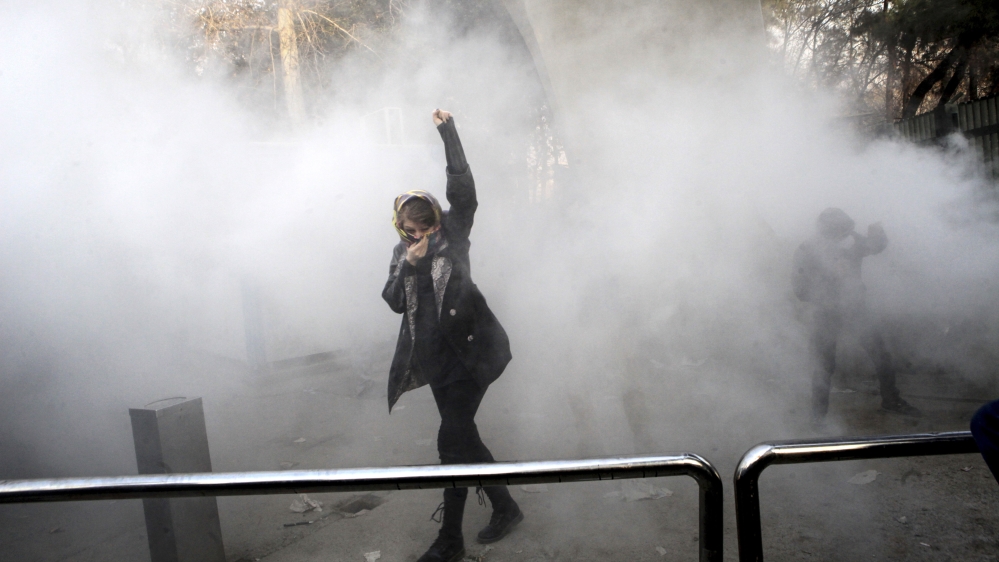
The Reformist movement is rapidly losing legitimacy and relevance, as the citizenry now view it as no different than the hardliner Iranian leadership. This evolution in the collective consciousness of the Iranian public is captured in the protest slogan chanted at this year’s demonstrations: “Hardliners! Reformists! The game is over!”

There is also no indication that the Reformists can rebuild public trust in the regime – because they have chosen not to take the side of the Iranian people. Various Reformist figures have made disparaging remarks about the demonstrations, including Massoumeh Ebtekar, Iran’s vice president for women’s affairs, who said protesters were being directed by outside forces; Reformist leader Abbas Abdi, who called protests “uncalculated and irrational”; and the Association of Combatant Clerics, a group led by former Reformist President Mohammad Khatami, who claimed “opportunists and troublemakers have exploited” them.

It is clear that the Reformists have failed to see the breadth and depth of public discontent.

Whereas the Green Movement of 2009, the last uprising of comparable scale, was largely an urban middle-class uprising, the current wave is more diverse and extends to both urban and rural areas. One of the major reasons for this diversity is that the economic crisis has affected all segments if Iranian society (except of course the ruling elite).

When, in 2015, the Obama administration lifted some sanctions as part of the JCPOA, Iranians had grand hopes for economic prosperity. After all, the majority of them had voted President Hassan Rouhani into power to help negotiate the deal.

Yet, the economic growth that lifting of the sanctions produced did not trickle down: The political and military elite remained the sole beneficiaries of it. As a result, public anger accumulated over time and eventually sparked a wave of protests in December 2017, which spread to some 100 cities across the country. Particularly scourging for Iran’s hardliner political elite was that the “Mostaz’afan” (the dispossessed class) who are the Islamic revolution’s claimed base, have been at the heart of these protests.

Simultaneously, however, the middle class, the Reformist political base, also has taken to the streets, deeply disappointed and angered by the government’s failure to deliver not only on the economic front but also on promises for more civil liberties.

The convergence between these two large socioeconomic segments is probably the most dangerous development for the Islamic Republic this year. It appears that it can no longer play the two groups against each other, nor is it capable of keeping them content through symbolic political divisions between hardliners and Reformists. The latter have clearly demonstrated that their political project no longer has any legitimacy as a viable pro-democratic alternative.

What effect this cross-sectional public anger will have on the Iranian regime remains to be seen. It is not the first time the Islamic Republic faces an existential crisis and in the past it has managed to emerge from it using a mix of coercion and increased social provision spending. Time will tell whether it will weather this crisis as well.

Until the outbreak of protests in December 2017, Iran portrayed an image of itself as one of the most stable countries of the Middle East. One can’t help but draw a comparison to January 1978, the year before the outbreak of the Islamic Revolution, when Jimmy Carter raised a glass to the Shah and called Iran “an island of stability”.

If history has taught us anything, it is the unpredictability of Iranian politics and the fact that the political reality of modern Iran is by no means fixed – rather it is fluid and capable of giving birth to realities unforeseen by stakeholders. Nevertheless, the fact remains that the Reformist movement no longer has legitimacy as a viable democratic alternative.

The views expressed in this article are the author’s own and do not necessarily reflect Al Jazeera’s editorial stance.  

Read More

from Viral Eyes https://ift.tt/2CrKd8N
via IFTTT

Live stream: Senate debates Brett Kavanaugh Supreme Court nomination

news image

Share This Story!

Let friends in your social network know what you are reading about

Live stream: Senate debates Brett Kavanaugh Supreme Court nomination

The U.S. Senate holds procedural votes and debates the nomination of Brett Kavanaugh to the Supreme Court

Loading…Post to Facebook

Posted!

A link has been posted to your Facebook feed.

The U.S. Senate will move forward with the nomination of Brett Kavanaugh to be elevated to the Supreme Court. A procedural vote, called a “cloture” vote, on the Kavanaugh nomination is scheduled for Friday at 10:30 a.m. EDT. If it passes, it could pave the way for a final vote as early as Saturday.

It’s an important vote because it effectively blocks any filibuster attempt by Democrats to delay a vote on Kavanaugh and officially gives the Senate 30 hours to debate the nomination. 

The 30 hours gets divided equally between Republicans and Democrats. The debate could take less than the 30-hour maximum if either party decides not to use all of its allotted time. Senators will take to the Senate floor to give speeches and make a last effort to sway votes. 

Sen. Steve Daines, R-Mont., who is a reliable vote for Kavanaugh, will be walking his daughter down the aisle at her wedding on Saturday and will not be available to vote. That could lead Republican leaders to delay the final vote on Kavanugh until Sunday or next week.

USA Today will be providing live coverage in the player above of the Senate floor for the votes and debate on the Kavanaugh nomination.


Read or Share this story: https://ift.tt/2PeNxHl

Read More

from Viral Eyes https://ift.tt/2IFfIg5
via IFTTT

Canada trade deal gives automakers breathing room but may boost car prices for US buyers

news image

CLOSE

Donald Trump called NAFTA the “worst trade deal maybe ever signed anywhere.’’ So he wants to renegotiate it — or kill it altogether. So just what is NAFTA? (May 18)
AP

As the Trump administration touts a last-minute deal with Canada to remake the North American Free Trade Agreement, the agreement’s importance may be more about simple certainty than wholesale change for the automotive industry and the jobs it produces.

Experts caution that it’s unclear whether the deal will lead to more jobs, and some warned that consumers could take a hit from higher vehicle prices. Ending the threat of more tariffs on key trading partners such as Canada and Mexico will allow the industry to breathe easier, but trade disputes with countries such as China mean uncertainty remains.

Requirements for more regional content produced by workers making higher wages should mean a boost for American workers, but other aspects of the deal between the United States, Canada and Mexico muddy the waters.

Under the deal, called the United States-Mexico-Canada Agreement (USMCA),  automakers can qualify for zero tariffs if 75 percent of their vehicles’ components are manufactured in the United States, Canada or Mexico, which is an increase from 62.5 percent under NAFTA.

It also calls for higher wages for autoworkers.

Starting in 2020, the agreement requires that 30 percent of vehicle production must be done by workers earning an average production wage of at least $16 per hour. That’s about three times the pay of the average Mexican autoworker, and in 2023, the production percentage rises to 40 percent.

Previously announced steel and aluminum tariffs remain in place for now, but the  agreement would stop the imposition of the 25-percent tariffs President Donald Trump had threatened on imported vehicles from Canada and Mexico.

Ivan Drury, senior manager of industry analysis for Edmunds, which does auto research and advises car buyers, said the deal appears to save the industry from major headaches, but that challenges remain. 

“The elimination of a 25-percent tariff on imported vehicles is a huge win, but the new regional value content requirements mean that automakers will not be able to source parts as freely, so there will be added costs associated with vehicle manufacturing,” he said.

“Depending on how high these become, there could be setbacks to standard vehicle content or more content could become optional with higher markups,” he continued.

“Given that new vehicle prices are already stretched to record highs, things could take an ugly turn for consumer wallets, especially considering the trend of continuously rising interest rates.”

John Bozzella, president and CEO of the industry group Global Automakers, warned of ongoing trade concerns despite the deal. Global Automakers represents numerous auto companies with U.S. operations but which are headquartered outside the United States, including Toyota, Nissan and Subaru as well as technology companies and suppliers such as Aptiv and Bosch.

Canada’s decision to join the agreement  “is an important step, but it does not alter the fact that the cost and complexity of complying with the new auto rules will pose serious challenges for U.S. automakers,” Bozzella said.

Others cautioned that the impact, despite the rhetoric, would be less than advertised.

The agreement reached late Sunday is a “slight reform rather than the historic agreement the Trump administration is claiming,” an expert on international trade based in Canada said Monday.
 
“The Trump administration created a crisis, and then agreed to resolve it,” said Krzysztof Pelc, who is a political science professor at McGill University in Montreal and a top global trade analyst. “It remains to be seen whether voters will come away remembering the crisis, or its resolution.”

Read more:

Trudeau calls meeting as Canada, US near free trade deal

A NAFTA without Canada? Unthinkable.

He continued, “An example of this is the threat of tariffs on the Canadian auto industry: These threats were never credible to begin with, given the level of integration of the auto industry across the three countries, but the new deal is now being hailed as resolving that issue.”
 
In the end, he said, the good news is that there’s an agreement at all, and that the auto industry can return to the business of business, without having to fear a major adjustment in its day-to-day operations. 
 

Maryann Keller, of the New York-area consulting firm Maryann Keller & Associates, echoed the sentiment that the deal’s impacts would be limited.

“My initial impression is relief that there is a deal because uncertainty makes decision making impossible and that the deal does not tear apart the essential framework of NAFTA, Keller said. “Second, the outcome is not going to move jobs north or cause automakers to radically change their current assembly or supply footprints in North America.”

Keller said the agreement would likely raise costs somewhat “but probably not to the extent of the aluminum and steel tariffs.”

Jon Gabrielsen, a market economist who advises automakers and auto suppliers, said that U.S. manufacturers “dodged a bullet” with the  agreement.

“Given the millions of interdependencies in their supply chains across the Mexican and Canadian borders, the alternative would have been devastating,” Gabrielsen said.

He emphasized, “However, it is very unlikely that the agreement will lead to much manufacturing returning to the U.S. as a result. It simply won’t get worse.”

Michelle Krebs, executive analyst for Autotrader, noted that unknowns remain.

“At more than 1,000 pages in length, we won’t fully understand the overall impact of the trade agreement negotiated over the weekend without further study and until it is officially approved later this year. However, the fact that there is a directional agreement at all, one that has a long-term horizon of 16 years and will allow automakers and their suppliers to do long-range planning, is a plus,” Krebs said.

Some automakers also weighed in with positive comments.

General Motors said in a statement that “agreement is vital to the success of the North American auto industry; we have long supported efforts to modernize it in a way that strengthens the industry and positions it for long-term success. We appreciate the negotiating parties for engaging the industry stakeholders and look forward to continued collaboration as the agreement is implemented.”

Joe Hinrichs, Ford’s executive vice president and president of global operations, said the company applauds all three governments for working together.

“We stand ready to be a collaborative partner to ensure this agreement is ratified in all three markets because it will support an integrated, globally competitive automotive business in North America. The benefits of scale and global reach will help to drive volume and support manufacturing jobs,” Hinrichs said in a statement.

While GM and Ford expressed optimism about the deal, UAW President Gary Jones indicated the union would withhold judgment, saying that NAFTA, in part because of loopholes, had been “disastrous” for workers.

“The true test of a new NAFTA agreement will be in whether it protects and enhances opportunities for the U.S. workforce and leads to higher wages and benefits for UAW members and manufacturing workers who have suffered for far too long. We think the idea and concept of the USMCA could have the potential to provide some needed relief for America’s working families,” according to a statement from Jones. “Given the history of loopholes in NAFTA, the UAW will withhold final judgment until all the pieces are put in place in order to determine whether this agreement will protect our UAW jobs and the living standards of all Americans.”

Contact Eric D. Lawrence: elawrence@freepress.com. Follow him on Twitter: @_ericdlawrence. USA TODAY contributed to this report.


Read or Share this story: https://ift.tt/2y5CjgT

Read More

from Viral Eyes https://ift.tt/2CrKeJT
via IFTTT

‘The weak are suddenly going to get weaker’: Why a $603 billion investor is bracing for a rocky end-of-year ride for markets

news image

For stock-market investors, the year 2018 could come full circle if it ends with another volatility shock.

They still have fresh memories of the early-February episode, when the Dow Jones industrial average logged its biggest single-day point drop ever. The year may not end with another record-breaking stat, but it could wind down with volatility just as it began, according to Neil Dwane, a portfolio manager and the global strategist at Allianz Global Investors.

Earlier this year, the stock-market sell-off was attributed to concerns about inflation and higher rates— a scene that played out Thursday as stocks fell when the 10-year yield touched a seven-year high.

According to Dwane, the nervous investor base hasn’t gone away even though it has clearly moved on from the February shock, given the market’s 8% year-to-date gain and the drop in volatility. At the heart of investors’ nervousness is the gradual tightening of financial conditions, particularly in the US as the Federal Reserve continues to raise interest rates.

“A stronger dollar, a higher oil price, and tightening US dollar liquidity means the weak are suddenly going to get weaker,” Dwane, who helps create the house view of the €524 billion ($603 billion) investor, told Business Insider.

“That could be corporate companies, it could be global economies — but at the margin, this is all creating more fragility in the system. We saw what it could do in February.”

Since February, we’ve also seen what these conditions have done to non-US markets, which are underperforming in a way that has not been witnessed since the Great Recession.

“That’s kind of like the unseen noose in the markets,” Dwane said of quantitative tightening.

Although emerging markets have borne the brunt of the tightening this year, US markets may not continue to be spared.

“I think Wall Street is not listening to the Fed saying rates are going up,” Dwane said. “It’s paid Wall Street to go ‘no they aren’t.’”

One of the reasons for the volatility shocks in February, he added, was the market’s realization that burgeoning inflation meant the Fed was less likely to alter its rate-hike plans. The central bank’s most recent projections show that it’s on track to raise rates again in December and three times in 2019.

But the forthcoming months are not just about the Fed. The US midterm elections on November 6, and the UK’s official exit from the European Union on March 29, are just a few of the political events that could also create volatility, Dwane said.

Read More

from Viral Eyes https://ift.tt/2QyhQch
via IFTTT

The politics of second-hand clothes: A debate over ‘dignity’

news image

Kigali, Rwanda – Bayingana Mark is trying on a crisp white shirt in Biryogo market in Kigali’s Nyariambo district, known for its small-scale traders selling second-hand clothes from all over the world. 

Even when worn over his polo, the button-up shirt is too big, but Mark seems certain about buying it. He takes its off and tucks it under his elbow. Around him the market is overflowing in clothes. 

Hundreds of shirts and dresses hang from rails, trousers are folded on wooden tables, while hundreds and thousands of other items of clothing are jumbled on cotton sheets on the floor. 

But there are few customers.

Mark, a trader and head of Biryogo market, tells Al Jazeera that the lull is down to a government-imposed tax on imported second-hand clothes last year.

“Since the second-hand clothes tax was implemented in Rwanda, business dried up and most people have lost their jobs here,” 39-year-old Mark says.

“Look at this shirt, yes, it’s second hand, but its quality,” he says, unfolding his purchase.

Bayingana Mark, a trader in Kigali, says that many have lost their livelihoods since the taxes on used clothes were implemented [Azad Essa/Al Jazeera]

Second-hand clothing is a multi-million dollar industry in East Africa. 

While used clothing comes from across the globe, including Europe and China, most originates from the US.

According to USAID, the industry employs more than 355,000 people in East Africa, supporting the livelihoods of 1.4 million people.

But it is also seen as one of the primary reasons local textile industries collapsed in the eighties and nineties.

In a bid to resuscitate local manufacturing, East African governments, including Kenya, Tanzania, Uganda and Rwanda, agreed in March 2016 to increase their tariffs on imported used clothes with the intention of phasing them out by 2019. 

In the 2016/7 financial year, Rwanda raised the tax on imported used clothes from $0.20 to $2.50 per kilo and to $4 in the next financial year.

This is a political choice which holds the citizen’s dignity at its centre. We ultimately make decisions for ourselves and the Rwandan people.

Ladislas Ngendahimana, political analyst in Kigal

Reaction has been mixed. 

Those supportive of the Rwanda’s government’s bullish ambition to develop local manufacturing see the decision as a boon to their trade.

Traders such as Mark and a seller in Murambi village in southern Rwanda, who didn’t want to be named, say the taxes have made used products unaffordable for most Rwandans.

Around the Biryogo market, an entire network of traders have been affected by the tax. 

Tailors who altered used clothes and wholesalers and distributors who transported goods to smaller towns and villages across the country are now without work. 

According to those who remain, many left to the DRC or Uganda to continue their businesses.

One female tailor who works outside the main Biryogo market, and who asked not to be named, said her clientele had fallen by 60 percent. “We are battling,” she told Al Jazeera.

A question of ‘dignity’

The Rwandan government says the decision to tax used clothes was not just about money. It was also about reclaiming dignity.  

“This is a political choice which holds the citizen’s dignity at its centre,” Ladislas Ngendahimana, a political analyst based in Kigali, says of a “Made in Rwanda” campaign.

“We ultimately make decisions for ourselves and the Rwandan people,” he added.

Clare Akamanzi, CEO of Rwanda Development Board (RDB), says that it is the government’s “belief that our citizens deserve better than becoming the recipients of discarded clothes from the western world. This is about the dignity of our people”. 

Rwanda is attempting to shed the “dependency” and “third world” labels and wants to become a middle-income country by 2020.

But 63 percent of the population still earnless than $1.25 a day.

Some people don’t have a choice between dignity and necessity. They are too poor to be able to care much about that.

Bayingana Mark, trader and second-hand clothes market manager 

Rwanda’s insistence on maintaining the import tax and banning used clothing by 2019 has also ruffled feathers outside the country. 

At least 20 percent of all used clothes in Rwanda are imported from the US.

The US has repeatedly warned that should the East African community go ahead with implementing import taxes and eventually banning used clothes, they would lose the benefits of the African Growth and Opportunity Act (AGOA), which allows African countries to export certain items to the US without paying duties.

Tanzania, Uganda and Kenya in 2017 separately retreated from the pact to increase import taxes and ban used clothing. But Rwanda refused to join them.

The Rwandan government has reduced tariffs on imported textiles but tailors say it will take some time before price of production is reduced [Azad Essa/Al Jazeera]

In July, the Trump administration partially suspended Rwanda from the (AGOA), effectively taking away the country’s right to export clothing tax-free to the United States. 

In so doing, Rwanda joined a legion others, including Canada, the European Union and China, in facing off with Trump’s increasingly belligerent trade policies. 

Ahead of the suspension, President Paul Kagame told local media: “Rwanda and other countries in the region that are part of AGOA, have to do other things, we have to grow and establish our industries.”

Opportunity for tailors

Mukanyarwi Serafina cuts through a section of Kitenge cloth in her small tailor shop in the town of Nyamagambe in southern Rwanda.

Serafina told Al Jazeera that she understood why traders selling second-hand clothes would be aggrieved by the taxes.

“But they will change what they do. I know some who are now collaborating with tailors to sell new clothes,” Serafina said. 

The 47-year-old tailor said that the move to emphasise new clothes has “opened our eyes and energised our creativity”.

Mukanyarwi Serafina, a tailor in southern Rwanda, says demand for clothing will increase and is looking forward to expanding her skills [Azad Essa/Al Jazeera]

According to the Akamanzi from RDB, the decision to tax used clothing has already helped develop the local textile and shoe industries. Production has increased from $59.5million in 2015 to $70.6 million in 2017.

“It had a policy objective which we see already producing positive results.”

Similarly, tailors around Kigali city are buoyed by the opportunity.

Ngoye Emmanuel, 50, sits in an upper-floor shop of the market. He says it was only a matter of time before everyone got used to the change.

“I am not saying it is not going to be difficult. But I am confident that is an exciting time,” Emmanuel, who tailors clothes for both men and women, tells Al Jazeera. 

Teddy Kaberuka, a political analyst in Kigali described the move as “a strategic decision” aiming at boosting and create sustainable economic development. 

“In order to break the chain of economic dependency, each country needs to have a long term policy which aim at creating wealth for the country,” Kaberuka told Al Jazeera.

Ngoye Emmanuel, a tailor in Kigali, is pleased the government is supporting local creatives [Azad Essa/Al Jazeera] [Al Jazeera]

Back in the Nyarugenge market, Sindambije Jacque perches on a stool surrounded by colourful dresses and fabric and fiddles with his old teal-coloured sewing machine.

“It is a big opportunity for tailors,” the 38-year-old says. “But no one seems to know how to tackle it.

“I think they should have prepared and nurtured tailors. I don’t think there is any benefit for Rwandans at all.”

While Jacque understands the demand for self-respect, he says the economy does not run on “dignity”. 

“My clientele is not going to change. The costs and the prices will remain the same. These are clothes for the elites. Go ask the villagers, what they going through.” 

Can production meet the needs of Rwandans?

The C&H factory in Kigali’s Special Economic Zone is bustling with activity. Hundreds of workers cut fabrics, check labels, operate sewing machines, and carefully monitor the “Made in Rwanda” products for their quality.

Originally starting out as an export-oriented manufacturing plant, with most clients from the US and Europe, this Chinese-owned factory has moved into producing garments for the local market. Since the import tax on used clothing was implemented, orders from the US have decreased.  

But custom inside Rwanda has increased. C&H has opened a second plant to deal with the rising demand. 

“At the moment, we export 80 percent (to the US and Europe) and 20 percent is for the local market. We hope to act like a catalyst for the local manufacturing sector,” Malou Jontilano, marketing director of C&H, tells Al Jazeera.

The Chinese-owned C&H factory has moved into producing garments for the local market [Azad Essa/Al Jazeera]

The questions surrounding Rwanda’s capacity to mass produce affordable clothing for its population is a legitimate one. 

Designers and tailors say that given that textiles are still imported from China, Turkey or elsewhere across the continent like Senegal, prices are likely remain high. 

Then is the no-small matter of a skilled labour force, capital investment, dependable electricity supply and technology. 

In countries like South Africa, bans on used clothing have not been able to save the textile and garment industry from being washed away by cheap Chinese imports. 

Uwamahoro Delphine, who launched her fashion label DelphineZ in 2016, says she welcomes the opportunity the tax afford to businesspeople like her, but recognised the difficulties traders would have to endure.

“I understand that they need to feed their families. It is expensive to create clothes … but when it comes to pride, wearing second-hand clothes is not something anyone wants to do,” she says.

C&H factory has been exporting ‘Made in Rwanda’ clothing and now hopes to produce more for the local market [Azad Essa/Al Jazeera] [Al Jazeera]

Delphine’s designs are a mix of traditional and modern clothing for men and women. Her boutique in Nyamirambo is a full of shirts, jumpsuits and dresses all stitched in Kitenge cloth. She knows that her clothing isn’t for working class Rwandans and says she can only reduce costs if she can access a larger market.

According to Akamanzi, from RDB, the government is not unaware of the challenges and is trying to bring down the cost of production. 

She says that government has removed import duties for fabric brought in by clothes manufacturers.

“Furthermore, the government has established funds to support both production and market access for example, the Export Growth Fund, the Industrial Adjustment Facility and the Business Development Fund,” Akamanzi said. 

Efforts were also being made to partner with local businesses to train workers.

Kaberuka, the political analyst, says that although Rwanda has created a conducive environment, it will take time to pay dividends. 

“For now, we are far from seeing mass production meeting the needs of the population, but since launching the Made in Rwanda campaign, there is a significant increase of local production year by year; more jobs are created for the citizen and the trend will continue,” Kaberuka says.

But it is going to be an uphill task.

Mark, the trader, is clear in that he is not against the “Made in Rwanda” campaign or the prioritisation of Rwandan goods over used clothes from abroad. For him, it is a matter of choice.

“I believe there should be proper competition between Made in Rwanda and second-hand clothes. Some clothing can be found for less than a dollar which you can’t find with locally made clothes.

“Some people don’t have a choice between dignity and necessity. They are too poor to be able to care much about that. “

Read More

from Viral Eyes https://ift.tt/2zTEHJv
via IFTTT

The battle over Kavanaugh’s confirmation is reaching its finale — here’s what stands between him and a lifetime on the Supreme Court

news image

The battle over Brett Kavanaugh’s Supreme Court confirmation is reaching its finale, with senators due to take a vote on Friday. It will indicate how senators, including key undecided figures, stand on the nominee after a series of sexual misconduct allegations were made against him.

Senators will vote on whether to create a time window to debate Kavanaugh’s nomination at 10:30 a.m. on Friday. Senators can only limit the debate for 30 hours, meaning that if Friday’s vote passes, a final confirmation vote on Kavanaugh’s place could take place at 5:30 p.m. on Saturday.

Both votes require just a simple majority, which is 51 votes. So the outcome of Friday’s vote could offer a strong indication of whether Kavanaugh will be successfully confirmed in Saturday’s vote.

It is possible that some senators will vote to move forward with the debate but ultimately vote against his nomination.

So, even after Friday’s vote, speculation as to Kavanaugh’s fate on the court could continue.

Republican senators listen to Kavanaugh testify in front of the Senate Judiciary Committee.
Tom Williams-Pool/Getty Images

Republicans currently make up the majority of the Senate, with 51 votes. But some Republican senators have not yet said how they will vote and have previously expressed doubt about Kavanaugh’s confirmation.

The outcome of Friday’s vote will force lawmakers to show their hand and, after weeks of debate, indicate where they stand on the confirmation.

How Republicans Jeff Flake, Lisa Murkowski, and Susan Collins vote on Friday could be key to Kavanaugh’s nomination. They may vote on the debate limit and ultimately reject Kavanaugh’s confirmation.

The findings of the FBI report into sexual assault allegations made against Kavanaugh by Christine Blasey Ford will be key to how many senators vote.

Democrats slammed the report as “incomplete” and accused the White House of limiting the investigation. Republicans have said that the report does not offer any corroboration for Ford’s claims.

At least one Republican senator, Steve Daines, said he will miss the confirmation vote.

All senators can vote. If there is a tie, Vice-President Mike Pence can step in and break it.

Read More

from Viral Eyes https://ift.tt/2E8oq82
via IFTTT

Denis Mukwege, Nadia Murad awarded 2018 Nobel Peace Prize

news image

Last 10 winners:

2018: Denis Mukwege, Nadia Murad

2017: International Campaign to Abolish Nuclear Weapons

2016: Juan Manuel Santos

2015: The National Dialogue Quartet

2014: Kailash Satyarthi, Malala Yousafzai

2013: The Organisation for the Prohibition of Chemical Weapons

2012: The European Union

2011: Ellen Johnson Sirleaf, Leymah Gbowee and Tawakkul Karman

2010: Liu Xiaobo

2009: Barack Obama

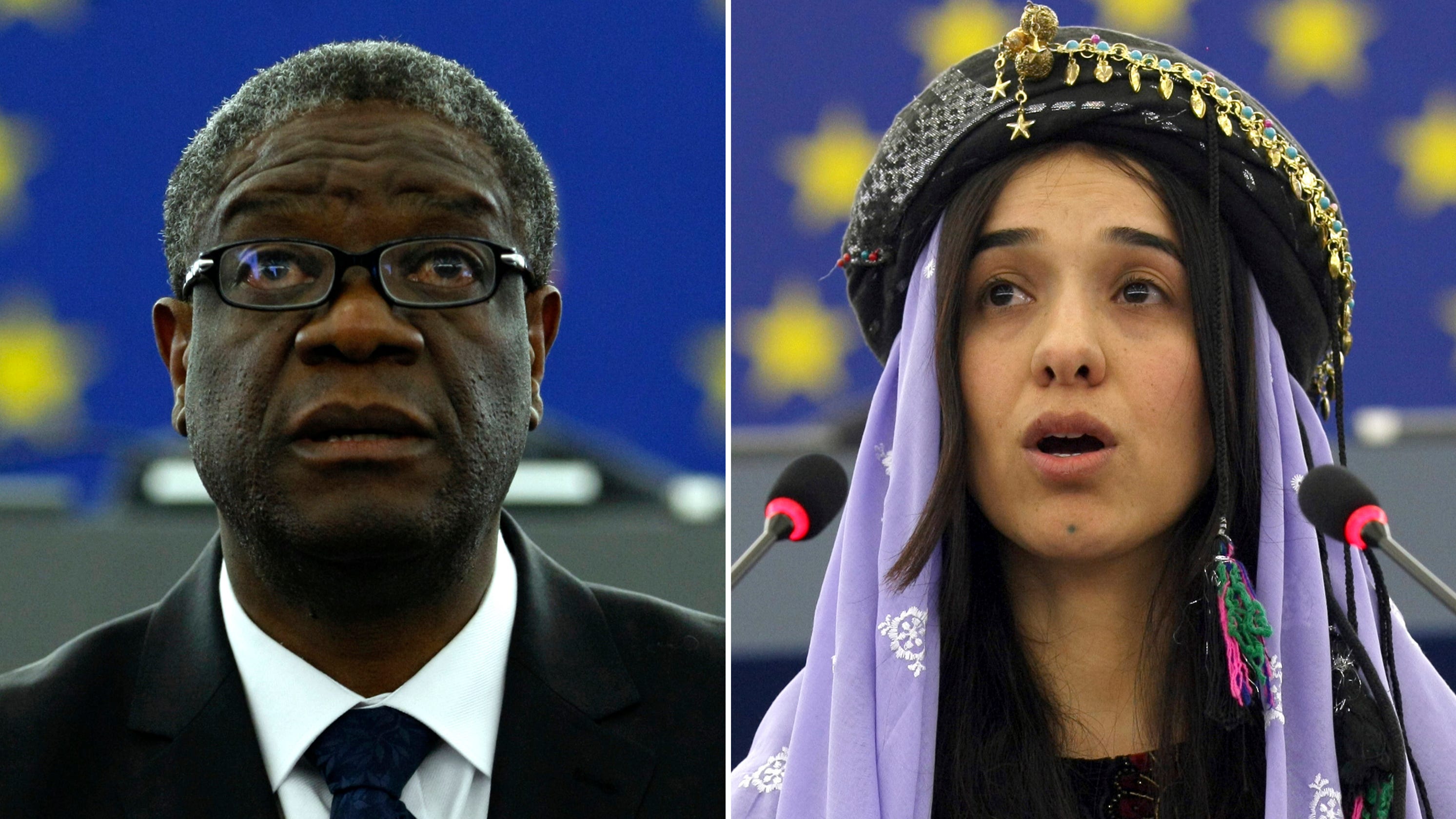
Denis Mukwege, a gynecologist treating victims of sexual violence in the Democratic Republic of Congo, and Yazidi human rights activist Nadia Murad have been awarded the 2018 Nobel Peace Prize.

The pair received the award for their “effort to end the use of sexual violence as a weapon of war and armed conflict”, Berit Reiss-Andersen, chair of the Nobel Committee, announced at a press conference in the Norwegian capital, Oslo, on Friday. 

“Both laureates have made a crucial contribution to focusing attention on and combatting such war crimes,” said Reiss-Andersen. 

“Denis Mukwege is the helper who has devoted his life to defending his victims. Nadia Murad is the witness who tells of the abuses perpetrated against herself and others.

“Each of them, in their own way, has helped to give greater visibility to wartime sexual violence so that the perpetrators can be held accountable for their actions,” she said.

Mukwege has spent decades helping victims of sexual violence in the DRC, where a long-running civil war has claimed around six million lives.

At the Panzi hospital, which he founded in the eastern city of Bukavu in 1999, Mukwege and his staff have treated thousands of women who have been the victims of sexual violence. 

Endemic in warzones, sexual violence is a commonplace in the DRC, which was once dubbed the “rape capital of the world”. A 2011 report from the American Journal of Public Health claimed that around 48 women were raped every hour in the country. 

In Friday’s announcement, Reiss-Andersen call Mukwege “the foremost, most unifying symbol both nationally and internationally of the struggle to end sexual violence in war and armed conflicts” and praised the surgeon’s principal of making justice “everyone’s business”.

“The importance of Denis Mukwege’s enduring dedicated and selfless efforts in this field cannot be overrated. He has repeatedly condemned impunity for mass rape and criticised the Congolese government and other countries for not doing enough to stop the use of sexual violence against women as a strategy and a weapon of war,” she said.

Murad has become a prominent activist for Yazidi women who were targeted by the Islamic State of Iraq and the Levant (ISIS, also known as ISIL) as the armed group established control of Iraqi territory.

In August 2014, she was captured by ISIS fighters and sold as a sex slave. During her three-month captivity, Murad was subjected to rape and got death threats if she did not convert to Islam.

The Yazidis are a minority religious community of about 400,000 people living in northern Iraq. Their beliefs combine elements of several ancient Middle Eastern religions.

ISIS does not consider the Yazidis’ faith legitimate and massacred hundreds and enslaved an estimated 3,000 girls and women.

During the announcement, Reiss-Andersen applauded Murad’s “uncommon courage” in speaking out about her experience, as well as on behalf of other victims.

“She refused to accept the social codes that required women to remain silent and ashamed about the abuses to which they had been subjected,” she said.

‘Stop all of this crime’: Nobel laureates visit Rohingya, call for Suu Kyi to resign

Although the Nobel committee does not release the names of those it considers for the prize, it revealed that it had sorted through more than 331 candidates for this year’s award, which recognises both accomplishments and intentions.

Recent laureates include The International Campaign to Abolish Nuclear Weapons for its work creating the Treaty on the Prohibition of Nuclear Weapons and former Colombian President Juan Manuel Santos, who worked to secure a peace deal with the FARC rebel group.

The prize announcement in the Norwegian capital was the culmination of a week in which Nobel laureates have been named in medicine, physics, chemistry. The literature prize will not be awarded this year due to a scandal involving the awarding Swedish academy.

SOURCE: Al Jazeera and news agencies

Read More

from Viral Eyes https://ift.tt/2O3yXpk
via IFTTT

Denis Mukwege, Nadia Murad win 2018 Nobel Peace Prize

news image

CLOSE

The Nobel Peace Prize has been awarded to Denis Mukwege and Nadia Murad “for their efforts to end the use of sexual violence as a weapon of war and armed conflict.” (Oct. 5)
AP

A Congolese doctor who has been a fierce critic of his government’s treatment of victims of sexual violence and a Yazidi, a Kurdish activist who was held captive and raped by members of the Islamic State group, are the winners of this year’s Nobel Peace Prize, the Norwegian Nobel Committee said Friday. 

Denis Mukwege, 63, and Nadia Murad, 25, were jointly awarded the accolade for “their efforts to end the use of sexual violence as a weapon of war and armed conflict.”

Mukwage is a gynaecologist who has treated thousands of women with extreme sexual injuries perpetrated by rebel groups in the Democratic Republic of Congo. Murad is a Kurdish human rights activist from Iraq. She is one of an estimated 3,000 Yazidi girls and women who were victims of gang rape and other abuses by the Islamic State group. Yazidis are a Kurdish religious minority group. 

The committee received nominations for 216 individuals and 115 organizations for the 9 million Swedish kronor ($1.01 million) award. 

The Nobel committee said that this year’s winners made a “crucial contribution to focussing attention on, and combatting, war such war crimes.” 

Last year’s winner was the International Campaign to Abolish Nuclear Weapons (ICAN). “The Nobel Committee has rightly chosen to highlight the role of women this year in giving the award to Nadia and Denis, and it is great to see women like Nadia leading on this issue just as they do in the disarmament movement,” the group said in a congratulatory statement.   

Past winners who came under criticism include former U.S. President Barack Obama, who won in 2009 after less than a year in office.

Among those put forward this year were the Syrian civilian aid group White Helmets, Russia’s Novaya Gazeta newspaper, Edward Snowden and the U.N. High Commissioner for Refugees.

While nominations for the prize are intended to be kept secret for 50 years, it was previously revealed that at least two 2018 nominations for President Donald Trump were forged. Trump has been nominated for the 2019 prize by U.S. Republican congressional members for his efforts at securing denuclearization on the Korean Peninsula. 

More: Does Donald Trump deserve to win a Nobel Peace Prize?

Autoplay

Show Thumbnails

Show Captions


Read or Share this story: https://ift.tt/2RtUd5V

Read More

from Viral Eyes https://ift.tt/2DYTkj5
via IFTTT

Lawmakers say that China’s reported use of a microchip to target tech giants like Amazon and Apple shows the ‘lengths that Beijing will go to in order to steal’ America’s secrets

news image

The Chinese government’s reported attempts to target major tech companies with malicious hardware drew a sharp rebuke from lawmakers in Washington who said it was the latest example of China’s aggression towards the US.

A Bloomberg Businessweek report Thursday alleged that Chinese government officials were able to slip tiny microchips into hardware from Supermicro, a major motherboard supplier, which could then swipe information from affected data centers. According to the report, the tainted Supermicro motherboards were used by the US government and tech giants like Amazon and Apple.

While the companies strongly denied the report, lawmakers said it was another example of China’s sustained efforts to gain access to the US’s security and technological secrets.

Rep. Adam Schiff, the highest-ranking Democrat on the House Intelligence Committee, told Business Insider that the report was “deeply disturbing.”

“The report that China sought to infiltrate the computer chip supply chain, if true, is deeply disturbing and the latest example of the lengths that Beijing will go to in order to steal America’s official and commercial secrets,” Schiff said in a statement. “For many years, the House Intelligence Committee has been deeply concerned about the potential for Chinese intrusion into our supply chain and has been looking at the problem as part of the Committee’s ongoing ‘deep dive’ into China.”

Sen. Mark Warner, the top Democrat on the Senate Intelligence Committee, echoed the sentiment in a statement to Business Insider.

“This report provides more evidence that China’s pattern of behavior is a serious threat to national security and supply chain risk management,” Warner said.

Lawmakers on Capitol Hill have been critical of Chinese technology. Earlier in the year, members criticized the Trump administration’s deal to ease sanctions imposed on Chinese phone maker ZTE. The company was hit with crippling sanctions after the US determined it did business in Iran and North Korea, a direct violation of US sanctions on those countries.

The Pentagon also banned the sale of ZTE and fellow Chinese phone maker Huawei’s devices on military bases, due to concerns that information on their devices could be accessed by Beijing. Likewise, the Democratic National Committee warned candidates running for office in November’s midterms not to use ZTE phones on the trail.

While attempts to strengthen sanctions on ZTE in Congress came up short, a handful of bipartisan senators introduced a bill to ensure the company will be whacked with harsh penalties if it violates the terms of the Trump administration’s probation.

Sen. Elizabeth Warren, one of the cosponsors of the new ZTE bill, said that the report showed that the US should focus on producing more high-tech products in the US rather than relying on Chinese manufacturers.

“China’s repeated attempts to compromise our national security and damage our economy by stealing intellectual property and corrupting the technology supply chain must stop,” Warren said. “We should be taking aggressive steps to make this kind of critical hardware here in the United States, rather than importing it from foreign competitors like China.”

A spokesperson for Sen. Marco Rubio, another cosponsor of the ZTE bill and a particularly vocal critic of China, told Business Insider that while the senator is still reviewing Bloomberg’s story, Rubio is very worried about the Chinese efforts to confront the US.

“Marco has long warned that China is manipulating its entire society, including the Chinese technology sector, in an aggressive and long-term effort to harm our national security and economy,” the spokesperson said.

Read More

from Viral Eyes https://ift.tt/2pBzFvj
via IFTTT

Design a site like this with WordPress.com
Get started